Removal of Wool Dyes from Industrial Wastewater by Reverse Osmosis Process
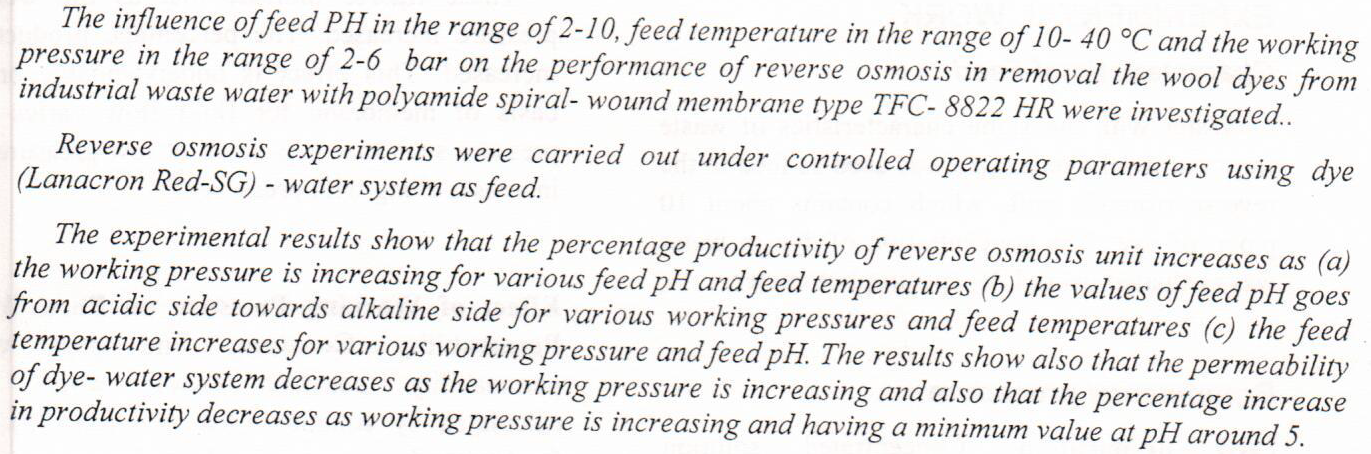

 (1)
(1)
 (1)
(1)


Reverse Osmosis (RO) has already proved its worth as an efficient treatment method in chemical and environmental engineering applications. Various successful RO attempts for the rejection of organic and highly toxic pollutants from wastewater can be found in the literature over the last decade. Dimethylphenol is classified as a high-toxic organic compound found ubiquitously in wastewater. It poses a real threat to humans and the environment even at low concentration. In this paper, a model based framework was developed for the simulation and optimisation of RO process for the removal of dimethylphenol from wastewater. We incorporated our earlier developed and validated process model into the Species Conserving Genetic Algorithm (SCG
... Show More
(16)
(13)

In this study three reactive dyes (blue B, red R and yellow Y) in single , binary and ternary solution were adsorbed by activated carbon AC in equilibrium and kinetic experiments. Surface area, Bulk and real density, and porosity were carried out for the activated carbon.
Batch Experiments of pH (2.5-8.5) and initial concentration (5-100) mg/l were carried out for single solution for each dye. Experiments of adsorbent dosage effect (0.1-1)g per 100 ml were studied as a variable to evaluate uptake% and adsorption capacity for single dyes(5, 10) ppm, binary and ternary (10) ppm of mixture solutions solution of dyes. Langmuir, and Freundlich, models were used as Equilibrium isotherm models for single solution. Extended Langmuir and Freun
(5)
This work aims to provide a statistical analysis of metal removal during the Magnetic Abrasive Finishing process (MAF) and find out the mathematical model which describes the relationship between the process parameters and metal removal, also estimate the impact of the parameters on metal removal. In this study, the single point incremental forming was used to form the truncated cone made of low carbon steel (1008-AISI) based on the Z-level tool path. Then the finishing was accomplished using a magnetic abrasive process based on the Box-Behnken design of the experiment using Minitab 17 software was used to finish the surface of the formed truncated cone. The influences of different parameters (feed rate, machining step s
... Show More
(5)
(5)
(3)
The wastewater arising from pulp and paper mills is highly polluted and has to be treated before discharged into rivers. Coagulation-flocculation process using natural polymers has grown rapidly in wastewater treatment. In this work, the performance of alum and Polyaluminum Chloride (PACl) when used alone and when coupled with Fenugreek mucilage on the treatment of pulp and paper mill wastewater were studied. The experiments were carried out in jar tests with alum, PACl and Fenugreek mucilage dosages range of 50-2000 mg/L, rapid mixing at 200 rpm for 2 min, followed by slow mixing at 40 rpm for 15 min and settling time of 30 min. The effectiveness of Fenugreek mucilage was measured by the reduction of turbidity and Chemical Oxygen Demand
... Show MoreLeaching process applied for the extraction of bio active compounds from dried roots of (Elecampane) Inula helenium. Ethanol, hexane and distillated water were used as solvents. Roots were soaked with ethanol (5% w/v) with various concentration of ethanol (30 to 98%) at one day to know effect concentration of the solvent with concentration of bio active compound in Inula helenium. The same procedure was done using hexane as solvent. Also distilled water was used as solvent for extraction 5%(w/v) where plant material was soaked in water at different temperatures (25, 40, 65, 80, and 90) C. In all solvents undertaken, the effect of time duration on active ingredient (Thymol, Isoalatolactone, Alatolactone, 10-isobutyryl-oxy 8-9-epoxy thymol is
... Show More
(3)
Determination of the concentrations of some inorganic elements (Fe, Co, Cu, Cr, Ni, Pb, Cd) by Flame Atomic Absorption Spectroscopy, Electrothermal Atomic Absorption Spectroscopy, and Inductively Coupled Plasma. and two dangerous organic pollutants (PAH and phenols) by GC and UV in the wastewater of Z.LTF Zafaraniya Leather tanning factory, W.BF Al-Waziriya Battery factory, Ba.WLS Al-Bayaa Wastewater Lifting Station, and some points of Tigris River in Baghdad city taking into consideration the sampling time Varying (two months) and setting the temperature during the drawing of the model. The results of the analysis revealed that the wastewater was contaminated with phenols, PAHs, and metals (Pb, Cd, Cr, Cu) at high rates that exceeded the p
... Show More
(16)
(15)
The presence of heavy metals in the environment is major concern due to their toxicity. In the present study a strong acid cation exchange resin, Amberlite IR 120 was used for the removal of lead, zinc and copper from simulated wastewater. The optimum conditions were determined in a batch system of concentration 100 mg/L, pH range between 1 and 8, contact time between 5 and 120 minutes, and amount of adsorbent was from 0.05 to 0.45 g/100 ml. A constant stirring speed, 180 rpm, was chosen during all of the experiments. The optimum conditions were found to be pH of 4 for copper and lead and pH 6 for zinc, contact time of 60 min and 0.35 g of adsorbent. Three different temperatures (25, 40 and 60°C) were selected to investigate the effect
... Show More
(7)