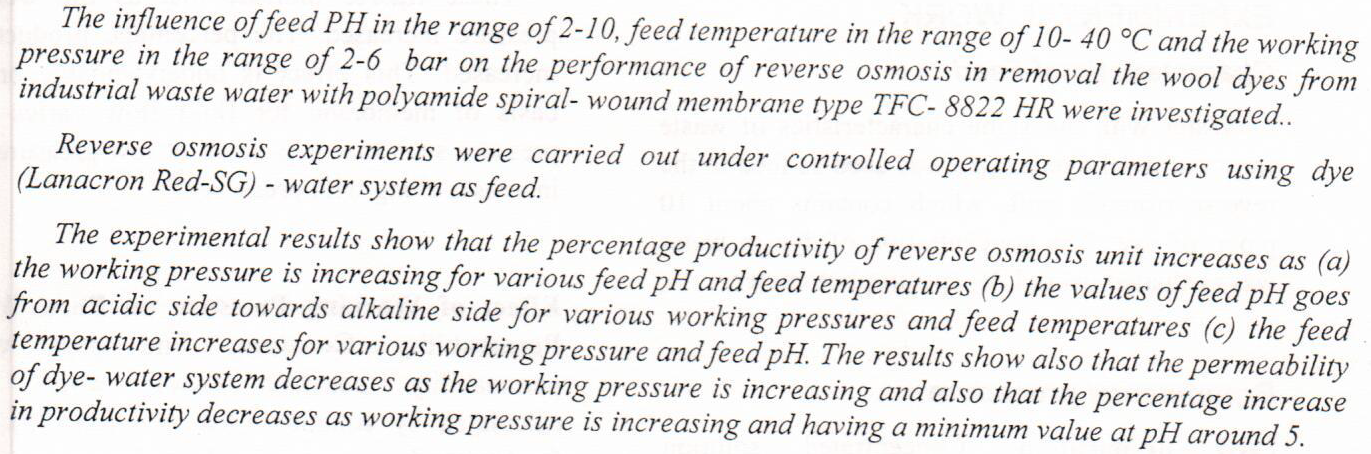
Removal of Wool Dyes from Industrial Wastewater by Reverse Osmosis Process

Abstract
This paper concerned with study the effect of a graphite micro powder mixed in the kerosene dielectric fluid during powder mixing electric discharge machining (PMEDM) of high carbon high chromium AISI D2 steel. The type of electrode (copper and graphite), the pulse current and the pulse-on time and mixing powder in kerosene dielectric fluid are taken as the process main input parameters. The material removal rate MRR, the tool wear ratio TWR and the work piece surface roughness (SR) are taken as output parameters to measure the process performance. The experiments are planned using response surface methodology (RSM) design procedure. Empirical models are developed for MRR, TWR and SR, using the analysis
... Show More (3)
(3)

 (1)
(1)


Abstract This study investigated the treatment of textile wastewater contaminated with Acid Black 210 dye (AB210) using zinc oxide nanoparticles (ZnO NPs) through adsorption and photocatalytic techniques. ZnO NPs were synthesized using a green synthesis process involving eucalyptus leaves as reducing and capping agents. The synthesized ZnO NPs were characterized using UV-Vis spectroscopy, SEM, EDAX, XRD, BET, Zeta potential, and FTIR techniques. The BET analysis revealed a specific surface area and total pore volume of 26.318 m2/g. SEM images confirmed the crystalline and spherical nature of the particles, with a particle size of 73.4 nm. A photoreactor was designed to facilitate the photo-degradation process. The study investigated the inf
... Show More
(11)
(3)
This work studies the impact of input machining parameters of Electrical Discharge Machining (EDM) on the machining process performance. Tool steel O1 was selected as the workpiece material, copper as the electrode material, and kerosene as the dielectric medium. Experimental runs have been carried out with a Design of Experiment (DOE) technique. Twenty tests are accomplished with the current range of (18 to 24 Ampere), a pulse duration range of (150 to 200 µs), and a pulse-off time range of (25 to 75 µs). Based upon the experimental study's output results, the EDM parameter's effect (voltage of power supply, discharge current, pulse duration, and pulse pause interval) on the responses of the process represented by sur
... Show More
The study involved the effectiveness of Iraqi attapulgite (IQATP) clay as an environmentally friendly material that easily adsorbs brilliant green (BG) dye from water systems and is identified by various complementary methods (e.g., FTIR, SEM‐EDS, XRD, ICP‐OES, pHpzc, and BET), where the result reported that the IQATP specific surface area is 29.15 m2/g. A systematic analysis was selected to evaluate the impact of different effective adsorption performance variables on BG dye decontamination. These variables included IQATP dosage (0.02–0.8 g/L), solution pH (3.05–8.15), contact time (ranging from 2 to 25 min), and initial BG dye concentration from 20 to 80 mg/L. The parameter
... Show More
(1)
(1)
(8)
(8)
Abstract
This work is considered the first study for the components of the Iraqi Leucaena leucocephala plant, where the different phytochemical compounds that present in the aerial parts were identified by using the gas chromatography/mass spectrometry technique (GC/MS). The type of the components and their concentration will differ according to the part of the plant used and the method of extraction (hot and cold). This study made a comparison in lupeol concentration that was identified and isolated from petroleum ether fractions of Leucaena leucocephala by using Gas Chromatography/Mass Spectrometry (GC/MS), High-performance thin-layer chromatography (HPTLC), and Preparative High-Performance Li
... Show More
(14)
The pretreatment process can be considered one of the important processes in wastewater treatment, especially coagulation process to decrease the strength of many pollutants. This paper focused on using powdered date seeds as natural coagulant in addition to chemical coagulants (alum and ferric chloride) to find the optimum dosage of each coagulant that makes efficient removal of turbidity and chemical oxygen demand (COD) from domestic wastewater as a pretreatment process, then finding the optimum combined dosages of date seeds with alum, date seeds with ferric chloride that make efficient removal for both pollutants. Concerning turbidity, the optimum dosage for date seeds, alum and ferric chloride were 40 mg/l (79%), 70
... Show More