Removal of Wool Dyes from Industrial Wastewater by Reverse Osmosis Process
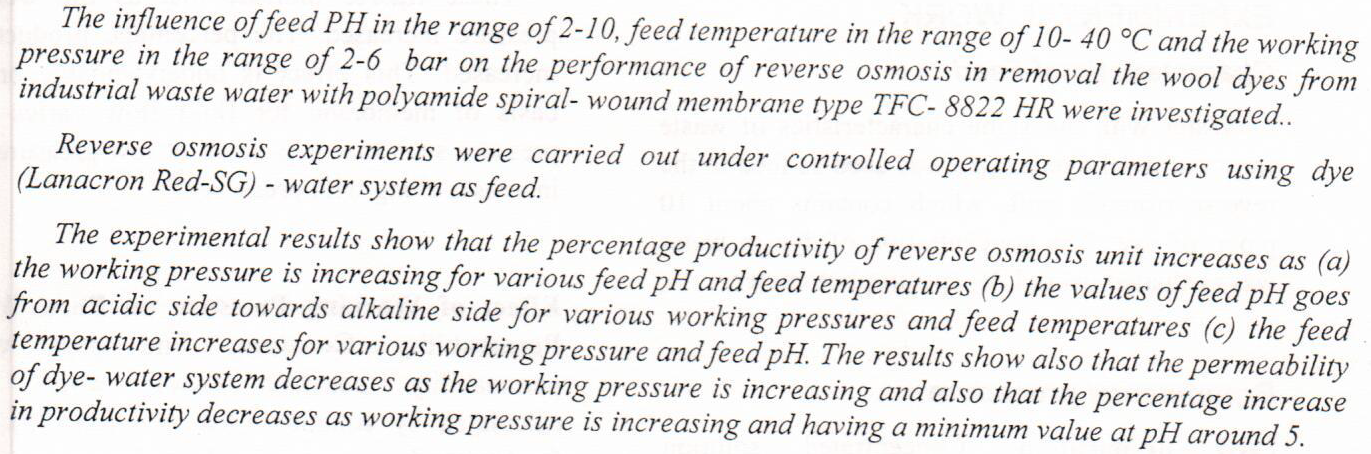

 (6)
(6)
 (4)
(4)



In many industries especially oil companies in Iraq consumed large quantities of water which will produce oil-contaminated water which can cause major pollution in agricultural lands and rivers. The aim of the present work is to enhance the efficiency of dispersed air flotation technique by using highly effective and cost-efficient coagulant to treating gas oil emulsion. The experimental work was carried out using bubble column made of Perspex glass (5cm I.D, 120cm height). A liquid was at depth of 60cm. Different dosage of sawdust +bentonite at ratio 2:1 (0.5+ 0.25; 1+ 0.5 and 2+1) gm and alum at concentration (10,20and30mg/l) at different pH ( 4 and 7) were used to determine optimum dosages of coagulant. Jar test exper
... Show MoreThis study aimed to assess the efficiency of Nerium oleander in removing three different metals (Cd, Cu, and Ni) from simulated wastewater using horizontal subsurface flow constructed wetland (HSSF-CW) system. The HSSF-CW pilot scale was operated at two hydraulic retention times (HRTs) of 4 and 7 days, filled with a substrate layer of sand and gravel. The results indicated that the HSSF-CW had high removal efficiency of Cd and Cu. A higher HRT (7 days) resulted in greater removal efficiency reaching up to (99.3% Cd, 99.5% Cu, 86.3% Ni) compared to 4 days. The substrate played a significant role in removal of metals due to adsorption and precipitation. The N. oleander plant also showed a good tolerance to the uptake of Cd, Cu, and Ni ions fr
... Show More
(21)
This study aimed to assess the efficiency of Nerium oleander in removing three different metals (Cd, Cu, and Ni) from simulated wastewater using horizontal subsurface flow constructed wetland (HSSF-CW) system. The HSSF-CW pilot scale was operated at two hydraulic retention times (HRTs) of 4 and 7 days, filled with a substrate layer of sand and gravel. The results indicated that the HSSF-CW had high removal efficiency of Cd and Cu. A higher HRT (7 days) resulted in greater removal efficiency reaching up to (99.3% Cd, 99.5% Cu, 86.3% Ni) compared to 4 days. The substrate played a significant role in removal of metals due to adsorption and precipitation. The N. oleander plant also showed a good tolerance to the uptake of Cd, Cu, and Ni ions fr
... Show More
(23)
(21)
In this paper, split-plate airlift electrochemical reactor as an apparatus with new configuration for wastewater treatment was provided. Two aluminum plates were fixed inside the reactor and present two functions; first it works as split plates for internal loop generation of the airlift system (the zone between the two plates acts as riser while the other two zones act as downcomer) and second it works as two electrodes for electrocoagulation process. Simulated wastewater contaminated with zinc ions was used to test the performance of this apparatus for zinc removal by studying the effect of different experimental variables such as initial concentration of zinc (50-800 ppm), electrical current density (2.67-21.4 mA/cm2), init
... Show More
The electrospun nanofibers membranes have gained considerable interest in water filtration applications. In this work, the fabrication and characterization of the electrospun polyacrylonitrile-based nonwoven nanofibers membrane are reported. Then, the membrane's performance and antifouling properties were evaluated in removing emulsified oil using a cross flow filtration system. The membranes were fabricated with different polyacrylonitrile (PAN) concentrations (8, 11, and 14 wt. %) in N, N-Dimethylformamide (DMF) solvent resulted in various average fiber sizes, porosity, contact angle, permeability, oil rejection, and antifouling properties. Analyses of surface morphology of the fabricated membranes before and after oil removal revealed
... Show More
(21)
(11)
The nanostructured Manganese dioxide/Carbon fiber (CF) composite electrode was prepared galvanostatically using a facile method of anodic electrodeposition by varying the reaction time and MnSO4 concentration of the electrochemical solution. The effects of these parameters on the structures and properties of the prepared electrode were evaluated. For determining the crystal characteristics, morphologies, and topographies of the deposited MnO2 films onto the surfaces of carbon fibers, the X-ray diffraction (XRD), field emission scanning electron microscopy (FESEM), and atomic force microscopy (AFM) techniques were used, respectively. It found that the carbon fibers were coated with γ-MnO2 with a density that increased with increasing the de
... Show More
(3)
(2)
(16)
(5)
This paper reports the synthesis and use of a novel metal-organic framework (MOF), named Zr-BADS, within the thin-film nanocomposite (TFN) membranes for reverse osmosis (RO) applications. Two types of zirconium-based MOFs, Zr-BADS-1 and Zr-BADS-2, were synthesized via a solvothermal method using bicinchoninic acid disodium salt as a linker and either dimethylformamide or ethanol as solvent, respectively. TFN membranes were prepared by embedding these MOFs within the polyamide thin film supported by a polysulfone support sheet. The specific surface area of Zr-BADS-1 and Zr-BADS-2 was determined to be 396.1 and 278.6 m2/g, respectively, indicating significant surface area conducive to water permeation. Scanning electron microscopic analysis r
... Show More