Preferred Language
Articles
/
ijcpe-632
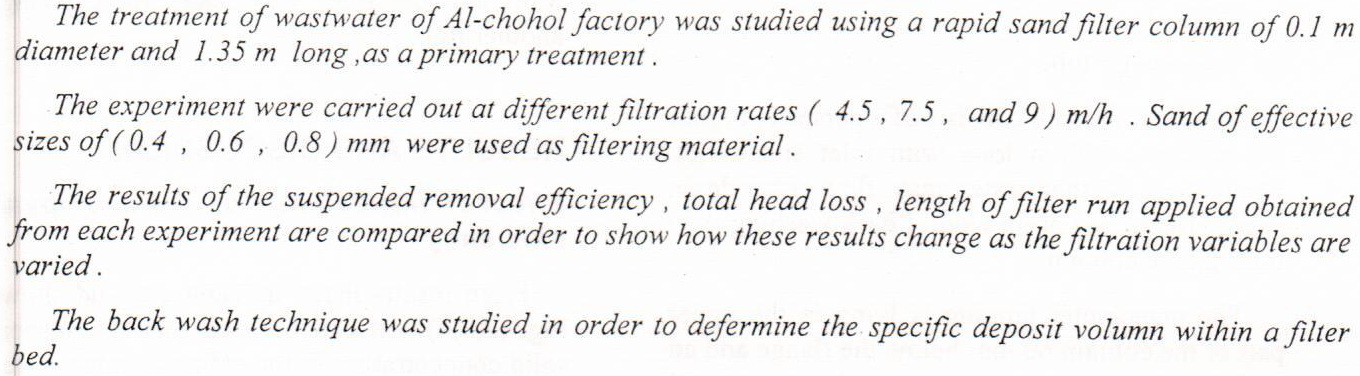
The Treatment of Wastewater of Alcohol Factory by Filtration as Primary Treatment
...Show More Authors

View Publication Preview PDF
Quick Preview PDF
Publication Date
Sun Jan 01 2023
Journal Name
Chemical Engineering And Processing - Process Intensification
Optimization of a combined electrocoagulation-electro-oxidation process for the treatment of Al-Basra Majnoon Oil field wastewater: Adopting a new strategy
...Show More Authors

View Publication
Scopus (44)
Crossref (36)
Scopus Clarivate Crossref
Publication Date
Sun Jan 01 2023
Journal Name
Chemical Engineering And Processing - Process Intensification
Optimization of a combined electrocoagulation-electro-oxidation process for the treatment of Al-Basra Majnoon Oil field wastewater: Adopting a new strategy
...Show More Authors

The performance of a synergistic combination of electrocoagulation (EC) and electro-oxidation (EO) for oilfield wastewater treatment has been studied. The effect of operative variables such as current density, pH, and electrolyte concentration on the reduction of chemical oxygen demand (COD) was studied and optimized based on Response Surface Methodology (RSM). The results showed that the current density had the highest impact on the COD removal with a contribution of 64.07% while pH, NaCl addition and other interactions affects account for only 34.67%. The optimized operating parameters were a current density of 26.77 mA/cm2 and a pH of 7.6 with no addition of NaCl which results in a COD removal efficiency of 93.43% and a specific energy c

... Show More
View Publication Preview PDF
Scopus (44)
Crossref (36)
Scopus Clarivate Crossref
Publication Date
Wed Jan 01 2014
Journal Name
Our Dermatology Online
Treatment of active acne vulgaris by chemical peeling using 88% lactic acid
...Show More Authors

KE Sharquie, AA Noaimi, EA Al-Janabi, Our Dermatology Online, 2014 - Cited by 11

View Publication
Publication Date
Tue Nov 17 2020
Journal Name
Journal Of Physics: Conference Series
A trial treatment of Hydatidosis in white mice by Immunization and Chemicals
...Show More Authors

The present study was conducted as atrial to treat secondary hydatidosis in white mice of species Mus musculus. (Balb/c strain), experimentally infected with secondary hydatid cysts of sheep origin. The immunization process was carried by using CF/PS antigen which consist hydatid cyst fluid (CF) antigen, and protoscolices (PS) antigen mixed together and by using two concentrations 7.5, 15 mg/ml. Then derivatives of Benzimidazole, Mebendazole (M) and drugs Albendazole (A) were used 10 and 40 μm/gm body weight respectively. The mixture of drugs was used one week after challenged dose. Criteria taken into consideration to define the activity of the immunization and chemotherapy in this study were reduction in the numeral of cysts, the coeffic

... Show More
View Publication Preview PDF
Scopus (2)
Scopus
Publication Date
Tue Aug 31 2021
Journal Name
Cureus
Treatment of Acne Vulgaris by Topical Spironolactone Solution Compared With Clindamycin Solution
...Show More Authors

View Publication
Crossref (5)
Crossref
Publication Date
Fri Oct 01 2010
Journal Name
Iraqi Board For Medical Specializations In Dermatology And Venereology
Treatment of Cutaneous Leishmaniasis by Topical 25% Podophyllin Solution (Case-Controlled Study)
...Show More Authors

KE Sharquie, AA Noaimi, AG Al-Ghazzi, 2010 - Cited by 2

View Publication
Publication Date
Fri Feb 08 2019
Journal Name
Iraqi Journal Of Laser
Enhancement of Episiotomy Healing Using (790-805) nm Diode Laser as a Supplementary Treatment
...Show More Authors

To show the impact of 790-805 nm diode laser irradiations on wound healing as a supplementary treatment in women underwent episiotomies, and to assess the laser parameters that were used .Material and methods: Eighteen female patients were included in this study; all of them underwent mediolateral episiotomy. Ten patients received laser therapy- diode laser (K Laser) (790-805) nm in CW mode of operation (and eight patients were the control group. Spot size of 8mm, time for exposure for each spot was 30 seconds. The power used was 0.6 W .The power density for each spot of treatment was 1.19 W/cm2 per session (non contact mode of application of laser therapy).The group studied received 2 sessions of laser radiation, day 4, and day 8 after

... Show More
View Publication Preview PDF
Publication Date
Thu Jun 30 2016
Journal Name
Al-kindy College Medical Journal
Secondary skull tumors: Prevalence, MRI findings as a diagnostic tool, and treatment
...Show More Authors

Background: Skull secondary tumors are malignant bone tumors which are increasing in incidence.Objective: The objectives of this study were to present clinical features , asses the outcome of patients with secondary skull tumors ,characterize the MRI features, locations, and extent of secondary skull tumors to determine the frequency of the symptomatic disease.Type of the study: This is a prospective study.Methods: This is a prospective study from February 2000 to February 2008. The patients were selected from five neurosurgical centers and one oncology hospital in Baghdad/Iraq. The inclusion criteria were MRI study of the head(either as an initial radiological study or following head CT scan when secondary brain tumor is suspected , vis

... Show More
View Publication Preview PDF
Publication Date
Sun Jan 01 2012
Journal Name
Indian Journal Of Dermatology
Lactic acid as a new therapeutic peeling agent in the treatment of lifa disease (frictional dermal melanosis)
...Show More Authors

View Publication
Scopus (7)
Crossref (14)
Scopus Crossref
Publication Date
Sat Jun 01 2024
Journal Name
Progress In Color, Colorants And Coatings
The Potential of Gundelia Seeds Waste as an Emerging Sustainable Adsorbent for Methylene Blue-Polluted Water Treatment
...Show More Authors

Gundelia, a genus of flowering plants native to the Mediterranean region, particularly in Iraq, holds promise as a sustainable adsorbent for the treatment of dye-polluted water. This study explores the potential of Gundelia seeds (GS) waste as a biobased adsorbent for removing methylene blue dye from synthesized wastewater. Utilizing various analytical techniques, including scanning electron microscopy (SEM), Fourier transform infrared (FTIR) spectroscopy, and X-ray diffraction analysis (XRD), we assessed GS as an active adsorbent with performance comparable to fabricated and expensive composites. Key parameters such as pH (3-11), pH at the point of zero charge, temperature (298-328 K), dose (0.02-0.1 g), dye concentration (10-50 ppm), and

... Show More