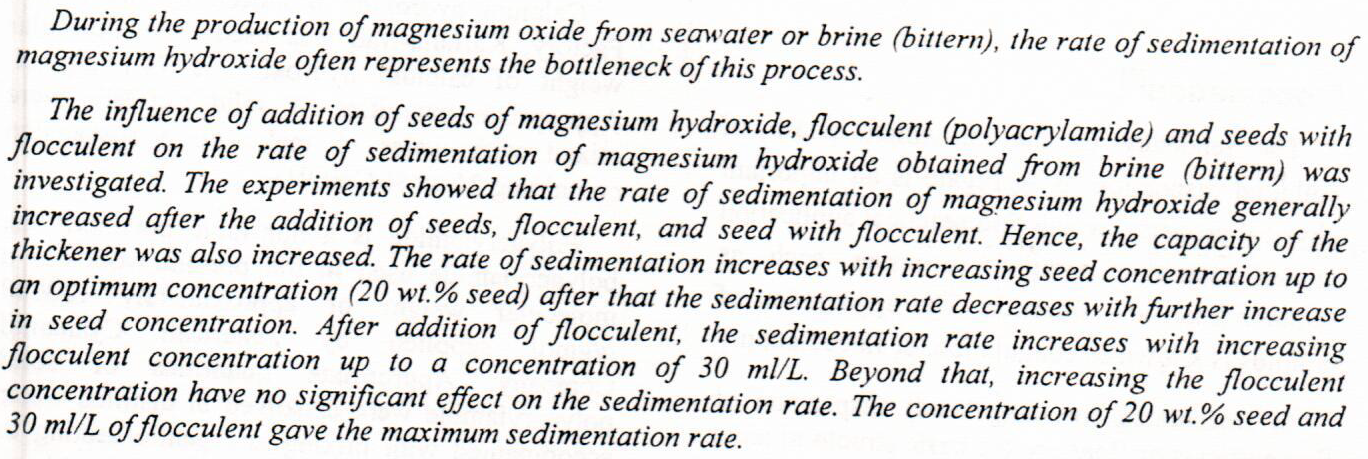
A study of the Rate of Sedimentation of Magnesium Hydroxide Obtained from Bittern

Herein, date palm (Phoenix dactylifera) bunch (DPB) waste was transformed into activated carbon (DPAC) adsorbent by using microwaveinduced ZnCl2 activation for 15 min at a power of 600 W. Several analytical methods were used to explain the physicochemical parameters of DPBAC including XRD, pHpzc, BET, SEM–EDX, and FTIR. Afterwards, the adsorptive performance of DPBAC was thoroughly investigated for the removal of two structurally different organic dyes namely methyl violet (MV) and fuchsin basic (FB). The key adsorption parameters, including the dose of DPBAC (A: 0.02–0.06 g), the solution pH (B: 4–10), and the contact time (C: 2–20 min) were statistically optimized using the Box-Behnken design with response surface methodology (RSM
... Show More (3)
(3)
 (2)
(2)

 (5)
(3)
(5)
(3)
 (5)
(3)
(5)
(3)
Two Schiff bases, namely, 3-(benzylidene amino) -2-thioxo-6-methyl 2,5-dihydropyrimidine-4(3H)-one (LS])and 3-(benzylidene amino)-6-methyl pyrimidine 4(3H, 5H)-dione(LA)as chelating ligands), were used to prepare some complexes of Cr(III), La(III), and Ce(III)] ions. Standard physico-chemical procedures including metal analysis M%, element microanalysis (C.H.N.S) , magnetic susceptibility, conductometric measurements, FT-IR and UV-visible Spectra were used to identify Metal (III) complexes and Schiff bases (LS) and (LA). According to findings, a [Cr(III) complex] showed six coordinated octahedral geometry, while [La(III), and Ce(III) complexes]were structured with coordination number seven. Schiff's bases a
... Show More
(13)
(2)
In present work, new tetra-dentate ligand, titled 3,5-bis ((E)-5-Bromo-2-hydroxy benzylidene amino) benzoic acid (H3L), was prepared via an acid-catalyzed condensation process. New four metallic ligand complexes with Co(II), Ni(II), Cu(II) and Zn(II) ions, were also prepared from the refluxing of equivalent moles. Ligand's structure and its complexes; were confirmed by numerous characterization methods, including Ultraviolet-Visible, Infrared, Mass Spectrometer, 1H and 13C Nuclear Magnetic Resonance spectra, atomic absorption, magnetic moments, and molar conductivity measurements. The results of the spectroscopic analyzes proved that the prepared ligand acts as tetradentate bi-ionic ligand and it was bond
... Show More
(7)
(1)
(38)
(11)
2-benzamide benzothiazole complexes of Pd(II) , Pt(IV) and Au(III) ions were prepared by microwave assisted radiation. The ligand and the complexes were isolated and characterized in solid state by using FT-IR, UV-Vis spectroscopy, flame atomic absorption, elemental analysis CHNS , magnetic susceptibility measurements , melting points and conductivity measurements. The nature of complexes in liquid state was studied by following the molar ratio method which gave results approximately identical to those obtained from isolated solid state; also, stability constant of the prepared complexes were studied and found that they were stable in molar ratio 1:1.The complexes have a sequar planner geometry except Pt(IV) complex has octahedral .
... Show More
(1)
Hypoxic training, which in turn is one of the methods adopted in sports training methods, especially in activities that depend on the aerobic system in its performance, which includes training with a lack of oxygen by reducing its molecular pressure, since this method targets functional organs and works temporary responses during training and permanent responses After training as an adaptation to these devices as a result of training in this way, the study aimed to identify the effect of hypoxic exercises using the training mask and the extent of the change in some biochemical indicators, in addition to that to identify the effect of these exercises on the indicator of energy expenditure and )VMA) and the achievement of the effectiveness of
... Show MoreThis work represents study the rock facies and flow unit classification for the Mishrif carbonate reservoir in Buzurgan oil Field, which located n the south eastern Iraq, using wire line logs, core samples and petrophysical data (log porosity and core permeability). Hydraulic flow units were identified using flow zone indicator approach and assessed within each rock type to reach better understanding of the controlling role of pore types and geometry in reservoir quality variations. Additionally, distribution of sedimentary facies and Rock Fabric Number along with porosity and permeability was analyzed in three wells (BU-1, BU-2, and BU-3). The interactive Petrophysics - IP software is used to assess the rock fabric number, flow zon
... Show More
(1)