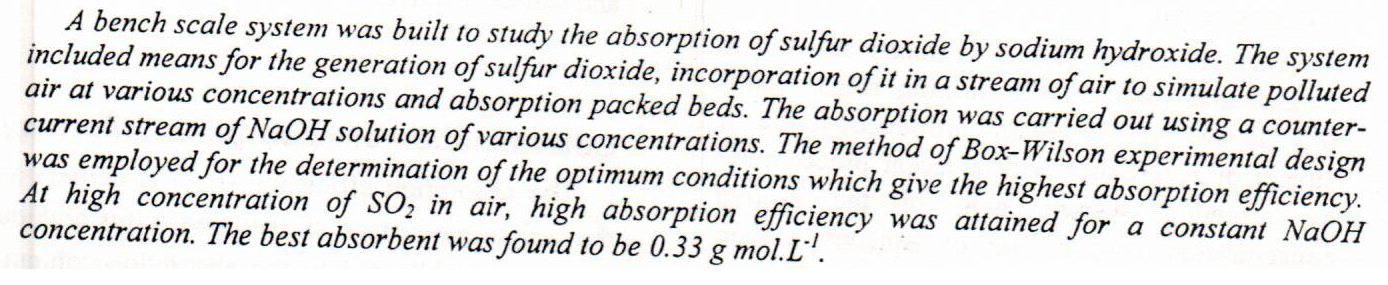
Removal of Sulfur Dioxide from Sulfuric Acid Plant Emissions

Verrucae vulgares are commonly encountered. The present work is designed in an attempt to build a systematic procedure for treating warts by carbon dioxide laser regarding dose parameters, application parameters and laser safety.
Patients and Methods: The study done in the department of dermatology in Al-Najaf Teaching Hospital in Najaf, Iraq. Forty-two patients completed the study and follow up period for 3 months. Recalcitrant and extensive warts were selected to enter the study. Carbon dioxide laser in a continuous mode, in non-contact application, with 1 mm spot size was used. The patients were divided into two groups. The first group of patients consisted of 60 lesions divided to 6 equal groups, in whom we use different outputs a
 (9)
(9)
 (5)
(5)
 (26)
(21)
(26)
(21)


The availability of low- cost adsorbent namely Al-Khriet ( a substance found in the legs of Typha Domingensis) as an agricultural waste material, for the removal of lead and cadmium from aqueous solution was investigated. In the batch tests experimental parameters were studied, including adsorbent dosage between (0.2-1) g, initial metal ions concentration between (50-200) ppm (single and binary) and contact time (1/2-6) h. The removal percentage of each ion onto Al-Khriet reached equilibrium in about 4 hours. The highest adsorption capacity was for lead (96%) while for cadmium it was (90%) with 50 ppm ions concentration, 1 g dosage of adsorbent and pH 5.5. Adsorption capacity in the binary mixture were reduce at about 8% for lead a
... Show MoreNew schiff bases series (VIII) a-e and 1,3-thiazolidin-4-one derivatives (IX) a-e containing the 1,2,4-triazole and 1,3,4-thiazazole rings were synthesized and screening their biological activities. These compounds were identified via Fourier transform infrared (FT-IR) spectra, some via Proton nuclear magnetic resonance (1H-NMR) and mass spectra. The biological results indicated that all of these compounds did not reveal antibacterial effectiveness against (Escherichia coli and Klebsiella species) (G-). Some of these compounds showed moderate antibacterial activity against (Staphylococcus aureus, and Staphylococcus epidermidis) (G+), and all compounds exhibited moderate activity against Candida albicans.
(1)
Biodiesel production process was attracted more attention recently due to the surplus quantity of glycerol (G) as a byproduct from the process. Glycerol Utilization must take in to consideration to fix this issue also, to ensure biodiesel industry sustainability. Highly amount of Glycerol converted to more benefit material Glycerol carbonate (GC) was one of the most allurement compound derived from glycerol by transesterification of glycerol with dimethyl carbonate (DMC). Various parameters have highly impact on transesterification was investigated like catalyst loading (1-5) %wt., molar ratio of DMC: glycerol (5:1 – 1:1), reaction time (30 - 150) min and temperature (40 – 80) ᴼC. The Optimum glycerol carbonate yie
... Show More
This paper studied kinetics of flotation of emulsified paraffine in water in bubble column with sodium .dodecylsulphate as a collector agent. The effects of oil drops and air bubble diameters on the flotation rate constant were studied. The removal rate for each oil drop size was first order with respect to oil drop concentration. An experimental procedure permitting determination of the first order rate constants for removal due to bubble/drop interaction was developed, decreasing bubble diameter by adding NaCl and increasing oil drop diameter increased the rate constants. A comparison between the experimental and theoretical rate constants showed
... Show MoreThe research discussed the possibility of adsorption of Brilliant Blue Dye (BBD) from wastewater using 13X zeolite adsorbent, which is considered a byproduct of the production process of potassium carbonate from Iraqi potash raw materials. The 13X zeolite adsorbent was prepared and characterized by X-ray diffraction that showed a clear match with the standard 13X zeolite. The crystallinity rate was 82.15% and the crystal zeolite size was 5.29 nm. The surface area and pore volume of the obtained 13X zeolite were estimated. The prepared 13X zeolite showed the ability to remove BBD contaminant from wastewater at concentrations 5 to 50 ppm and the removal reached 96.60% at the lower pollutant concentration. Adsorption measurements versus tim
... Show More
(9)
(61)
(44)