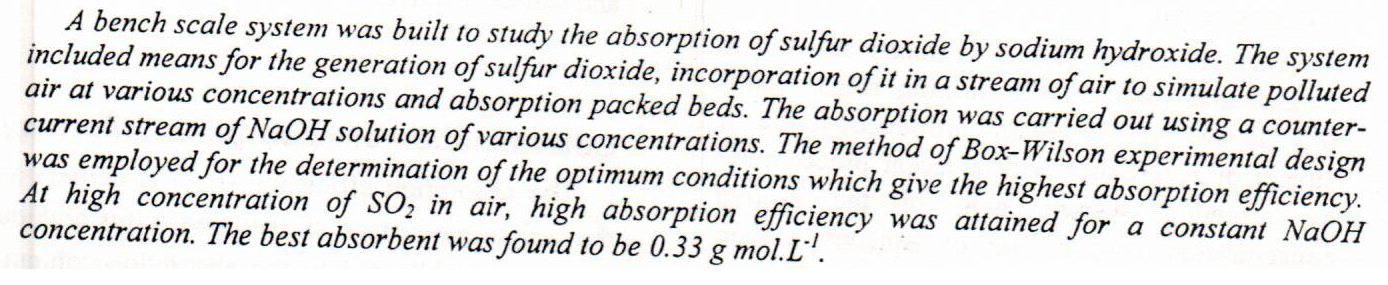
Removal of Sulfur Dioxide from Sulfuric Acid Plant Emissions

The kinetics of removing cadmium from aqueous solutions was studied using a bio-electrochemical reactor with a packed bed rotating cylindrical cathode. The effect of applied voltage, initial concentration of cadmium, cathode rotation speed, and pH on the reaction rate constant (k) was studied. The results showed that the cathodic deposition occurred under the control of mass transfer for all applied voltage values used in this research. Accordingly, the relationship between logarithmic concentration gradient with time can be represented by a first-order kinetic rate equation. It was found that the rate constant (k) depends on the applied voltage, the initial cadmium concentration, the pH and the rotational speed of cathode. It
... Show More (2)
(2)

Free water surface constructed wetlands (FSCWs) can be used to complement conventional waste water treatment but removal efficiencies are often limited by a high ratio of water volume to biofilm surface area (i.e. high water depth). Floating treatment wetlands (FTWs) consist of floating matrices which can enhance the surface area available for the development of fixed microbial biofilms and provide a platform for plant growth (which can remove pollutants by uptake). In this study the potential of FTWs for ammoniacal nitrogen (AN) removal was evaluated using experimental mesocosms operated under steady-state flow conditions with ten different treatments (two water depths, two levels of FTW mat coverage, two different plant densities and
... Show More (10)
(11)
(10)
(11)


Abstract Background: One of the most important methods to replace lost teeth is dental implants. In order to increase the strength of connection of the implant with the jaw bone to provide early loading after placement, implant is coated by different coating materials that achieved that purpose. The aim of this study was to evaluate the influence of coating CP Ti implant with calcium carbonate on the strength of bone-implant interface after two and six weeks of implantation in rabbit femur bone by torque removal test, histological and histomorphometric analysis. Materials and methods: Coating the surface of commercially pure titanium screws with extra pure synthetic calcium carbonate via electrophoretic deposition method (EPD) was done. The
... Show More
(3)
(2)
The objective of this study was to investigate the drought stress and plant density possibility on water productivity and grain yield of maize (Zea mays L.) (Planting Baghdad 3 synthetic varieties), Field experiment was conducted at Abu Ghraib Research Station (Baghdad) during spring and Autumn seasons of 2016 using a randomized complete block design arranged in split plot with three replications. Three irrigation treatment included: irrigation after depletion 50% of available water (T1), irrigation after depletion 75% of available water (T2) and irrigation after depletion 90% of available water (T3) in the main plots and three plant density which were: 1 seeds hill-1 (D1) giving a uniform plant density of 66666 plants ha-1 , 2 seeds hill1
... Show MoreAfter harvesting, Alfalfa plant was washed, dried and ground to get fine powder used in treatment water. We used alfalfa plant with ethanol to made alcoholic extract and characterized it applying (GC-Mass, FTIR, UV) spectroscopy to determine active compounds. Alcoholic extract was used to prepare zinc nanoparticle. We characterized Zinc nanoparticles by using FTIR, UV, SEM, EDX Zeta potential and AFM. Zinc nanoparticle with Alfalfa extract and alfalfa powder was used to treat pollutant water with pesticides and negative ions by two methods, namely Batch and continuous processing. Batch process was used two times firstly, with Alfalfa plant to treat water affected by pesticides and negative ions, after 1h pesticides (glyphosate 44.76%, sulfo
... Show MoreEmulsion Liquid Membrane (ELM) is an emerging technology that removes contaminants from water and industrial wastewater. This study investigated the stability and extraction efficiency of ELM for the removal of Chlorpyrifos Pesticide (CP) from wastewater. The stability was studied in terms of emulsion breakage. The proposed ELM included n-hexane as a diluent, span-80 as a surfactant, and hydrochloric acid (HCl) as a stripping agent. Parameters such as mixing speed, aqueous feed solution pH, internal-to-organic membrane volume ratio, and external-to-emulsion volume ratio were investigated. A minimum emulsion breakage of 0.66% coupled with a maximum chlorpyrifos extraction and stripping efficiency were achieved at 96.1% and 95.7% at b
... Show More
(7)
(1)
(1)
(48)
(43)
Thirty uropathogenic E. coli isolates were isolated from hospitalized and non hospitalized patients, complaining of urinary tract infections, of Al-Kadhymia Teaching Hospital and subjected to tRNA extraction. A method of tRNA extraction was modified by adding sodium dodecyl sulfate (SDS) instead of urea. Polyacrylamide gel electrophoresis and two methods of staining, ethidium bromide staining and silver staining, as well as spectrophotometric detection were used.