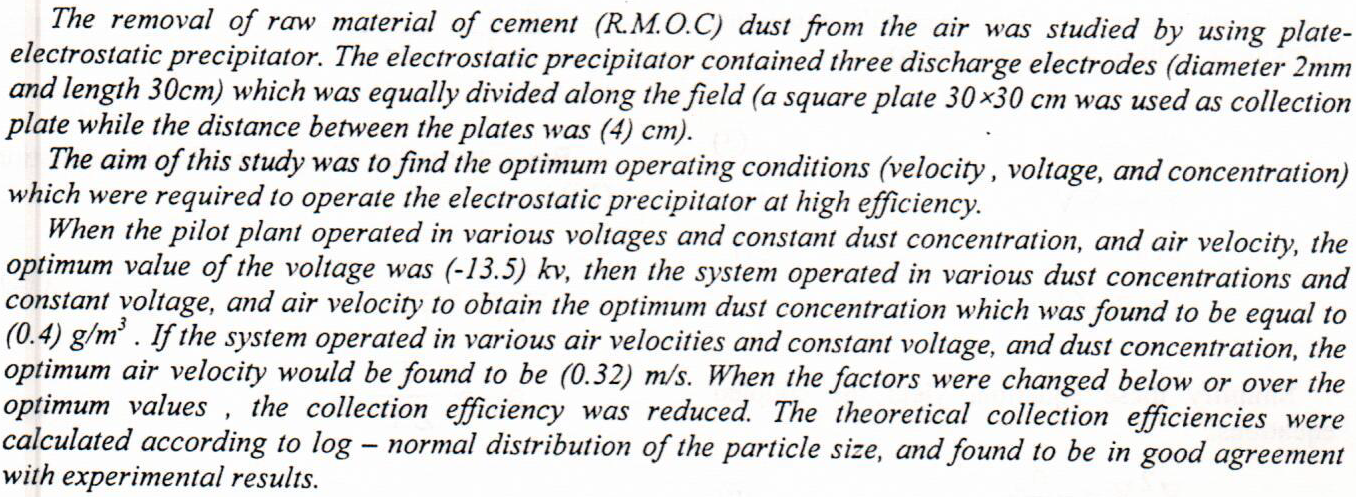
Performance of Plate-Electrostatic Precipitator for Removal of R.M.O.C. Dust

This study aimed to assess the efficiency of Nerium oleander in removing three different metals (Cd, Cu, and Ni) from simulated wastewater using horizontal subsurface flow constructed wetland (HSSF-CW) system. The HSSF-CW pilot scale was operated at two hydraulic retention times (HRTs) of 4 and 7 days, filled with a substrate layer of sand and gravel. The results indicated that the HSSF-CW had high removal efficiency of Cd and Cu. A higher HRT (7 days) resulted in greater removal efficiency reaching up to (99.3% Cd, 99.5% Cu, 86.3% Ni) compared to 4 days. The substrate played a significant role in removal of metals due to adsorption and precipitation. The N. oleander plant also showed a good tolerance to the uptake of Cd, Cu, and Ni ions fr
... Show More (21)
(21)

This work presents an investigation on the fabrication and characterization of Fe doped zeolitic imidazolate framework (ZIF-8) of 1:1 M ratio of Zn:Fe (Fe/Zn-ZIF-8) and adsorption performances of acquired materials. The synthesized Zn-ZIF-8, Fe-ZIF-8, and Fe/Zn-ZIF-8 materials were characterized for the phase structure, morphology, elemental analysis and surface area by using X-ray diffraction (XRD), Field emission scanning electron microscope (FESEM), Energy Dispersive X-Ray (EDX), and BET surface area, respectively. The results revealed the adsorption capacity was enhanced by incorporation of Fe into ZIF-8 structure. The CR dye adsorption capacities were 287, 219, and 412 mg/g for Zn-ZIF-8, Fe-ZIF-8, and Fe/Zn-ZIF-8 adsorbers, respectivel
... Show More (9)
(6)
(9)
(6)

In this paper, a procedure to establish the different performance measures in terms of crisp value is proposed for two classes of arrivals and multiple channel queueing models, where both arrival and service rate are fuzzy numbers. The main idea is to convert the arrival rates and service rates under fuzzy queues into crisp queues by using graded mean integration approach, which can be represented as median rule number. Hence, we apply the crisp values obtained to establish the performance measure of conventional multiple queueing models. This procedure has shown its effectiveness when incorporated with many types of membership functions in solving queuing problems. Two numerical illustrations are presented to determine the validity of the
... Show More
The study aims to use the European Excellence Model (EFQM) in assessing the institutional performance of the National Center for Administrative Development and Information Technology in order to determine the gap between the actual reality of the performance of the Center and the standards adopted in the model, in order to know the extent to which the Center seeks to achieve excellence in performance to improve the level of services provided and the adoption of methods Modern and contemporary management in the evaluation of its institutional performance.
The problem of the study was the absence of an institutional performance evaluation system at the centre whereby weaknesses (areas of improvement) and st
... Show More
The aim of the research is to identify the impact of the dimensions of the European Excellence Model in evaluating the performance of the bank of the research sample, as well as to interpret which dimensions are more important to the banks of the research sample. Based on the dimensions of this model, the United Bank for Investment and Finance has chosen a research community, and has met with officials of the United Bank for Investment and Finance at various administrative levels to measure the practices of excellence management in the European model, and the analytical approach has been the case study and the construction of the checklist as a tool to collect information. The research has reached the most important results There is a discr
... Show More
(2)
(2)
Municipal wastewater sources are becoming increasingly important for reuse, for irrigation purposes, so they must be treated to meet environmentally friendly local or global standards. The aim of this study is to establish, calibrate, and validate a model for predicting chemical oxygen demand for the pilot plant of mobile biofilm reactors operating from municipal wastewater in Maaymyrh located in Hilla city Using the approach of dimensional analysis. The approach of Buckingham's theorem was used to derive a model of dimensional analysis design for the forecast of (COD) in the pilot plant. The effluent concentration (COD) It has been derived as a result of the influential concentration of (COD), dissolved oxygen (DO), volume of pilot plant
... Show More
The purpose of this study was to evaluate the anesthetic effectiveness of a buccal infiltration technique combined with local massage (using 2% lidocaine) in the extraction of mandibular premolars to be utilized as an alternative to the conventional inferior alveolar nerve block.
Patients eligible included any subject with a clinical indication for tooth extraction of the mandibular 1st or 2nd premolars. All patients were anesthetized buccally by local infiltration technique followed by an external pressure applied for 1 min directly over the injection area. In each case, another local
(8)
The green method was chosen for the preparation of nano iron oxide due to its simplicity, ease of preparation, and purity, compared to other methods. Nano iron oxide was made using a substance that causes precipitation and a coating from the alcoholic extract of orange leaves from Iraq. It was examined structurally and spectrally using several techniques, including X-ray diffraction, Fourier transform infrared spectroscopy, field-emission scanning microscopy (FESEM), energy-dispersive X-ray spectroscopy, and UV-Vis spectroscopy. The diagnosis proved that the nano iron oxide was successfully prepared in a spherical form and with an average size of 71.1 nm. The nano iron oxide particles were tested for their ability to remove crystal
... Show More
An innovative desalination method called electrosorption or capacitive deionization (CDI) has significant benefits for wastewater treatment. This process is performed by using a carbon fiber electrode as a working electrode to remove hexavalent chromium ions from an aqueous solution. The pH, NaCl concentration, and cell voltage were optimized using the Box-Behnken experimental design (BDD) in response surface methodology (RSM) to study the effects and interactions of selected variables. To attain the relationship between the process variables and chromium removal, the experimental data were subjected to an analysis of variance and fitted with a quadratic model. The optimum conditions to remove Cr(VI) ions were: pH of 2, a cell voltage of 4.
... Show More
(10)
(9)
