Preferred Language
Articles
/
ijcpe-623
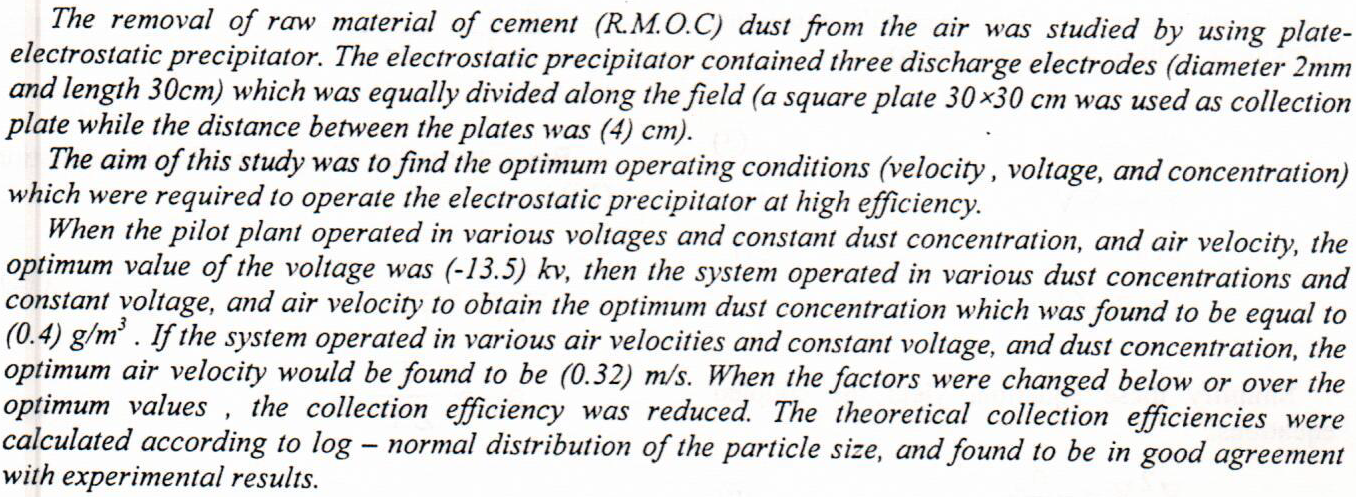
Performance of Plate-Electrostatic Precipitator for Removal of R.M.O.C. Dust
...Show More Authors

View Publication Preview PDF
Quick Preview PDF
Publication Date
Fri Dec 01 2017
Journal Name
Journal Of Accounting And Financial Studies ( Jafs )
Integration between value chain analysis and balanced scorecard to for performance evaluation
...Show More Authors

The performance evaluation process requires a set of criteria and for the purpose of measuring the level of performance achieved by the Unit and the actual level of development of its activities, and in view of the changes and of rapid and continuous variables surrounding the Performance is a reflection of the unit's ability to achieve its objectives, as these units are designed to achieve the objectives of exploiting a range of economic resources available to it, and the performance evaluation process is a form of censorship, focusing on the analysis of the results obtained from the achievement All its activities with a view to determining the extent to which the Unit has achieved its objectives using the resources available to it and h

... Show More
View Publication
Crossref (1)
Crossref
Publication Date
Sun Oct 20 2024
Journal Name
Chemical Papers
Response surface methodology for optimizing crude oil desalting unit performance in iraq
...Show More Authors

View Publication
Scopus (4)
Crossref (2)
Scopus Clarivate Crossref
Publication Date
Sun Dec 01 2019
Journal Name
Baghdad Science Journal
Preparation and Characterization of (Hyacinth plant / Chitosan) Composite as a Heavy Metal Removal
...Show More Authors

In this study, the preparation and characterization of hyacinth plant /chitosan composite, as a heavy metal removal, were done. Water hyacinth plant (Eichhorniacrasspes) was collected from Tigris river in Baghdad. The root and shoot parts of plant were ground to powder. Composite materials were prepared at different ratios of plant part (from 2.9% to 30.3%, wt /wt) which corresponds to (30-500mg) of hyacinth plant (root and shoot) and chitosan. The results showed that all examined ratios of plant parts have an excellent absorption to copper (Cu (II)). Moreover, it was observed that 2.9% corresponds (30mg) of plant root revealed highest removal (82.7%) of Pb (II), while 20.23% of shoot removed 61% of Cd (II) within 24 hr

... Show More
View Publication Preview PDF
Scopus (9)
Crossref (6)
Scopus Clarivate Crossref
Publication Date
Wed Apr 15 2015
Journal Name
Iraqi Journal Of Science
Removal of Lead and Chromium From Industrial Wastewater by Locally Citrobacter spp. Isolates
...Show More Authors

Biosorption is an effective method to remove toxic metals from wastewaters. In this study biosorption of lead and chromium ions from solution was studied using Citrobacter freundii and Citrobacter kosari isolated from industrial wastewater. The experimental results showed that optimum grwoth temperature for both bacteria is 30oC and the optimum pH is 7 &6 for C. freundii and C. kosari respectively. While the optimum incubation period to remove Pb and Cr for C. freundii and C. kosari is 4 days and 3days respectively. Also the biosorption of Pb and Cr in mixed culture of bacteria and mixed culture of Pb and Cr was investigated. Result indicate that uptake of Cr and Pb for C.freundii, C. kosari and in mixes culture of both bacteria is 58%, 53%

... Show More
Publication Date
Mon Mar 30 2020
Journal Name
Iraqi Journal Of Chemical And Petroleum Engineering
Optimization of Hole Cleaning and Cuttings Removal in High Inclined Till Horizontal Well
...Show More Authors

The goal of this experimental study is to determine the effects of different parameters (Flow rate, cuttings density, cuttings size, and hole inclination degree) on hole cleaning efficiency. Freshwater was used as a drilling fluid in this experiment. The experiments were conducted by using flow loop consist of approximately 14 m (46 ft) long with transparent glass test section of 3m (9.84 ft.) long with 4 inches (101.6 mm) ID, the inner metal drill pipe with 2 inches (50.8 mm) OD settled with eccentric position positive 0.5. The results obtained from this study show that the hole cleanings efficiency become better with high flow rate (21 m3/hr) and it increase as the hole inclination angles increased from 60 to 90 degree due to dominated

... Show More
View Publication Preview PDF
Crossref (3)
Crossref
Publication Date
Tue Dec 01 2020
Journal Name
Journal Of Engineering
Removal of Cadmium from Simulated Wastewaters Using a Fixed Bed Bio-electrochemical Reactor
...Show More Authors

In this research, the removal of cadmium (Cd) from simulated wastewater was investigated by using a fixed bed bio-electrochemical reactor. The effects of the main controlling factors on the performance of the removal process such as applied cell voltage, initial Cd concentration, pH of the catholyte, and the mesh number of the cathode were investigated. The results showed that the applied cell voltage had the main impact on the removal efficiency of cadmium where increasing the applied voltage led to higher removal efficiency. Meanwhile increasing the applied voltage was found to be given lower current efficiency and higher energy consumption.  No significant effect of initial Cd concentration on the removal efficie

... Show More
View Publication Preview PDF
Crossref (8)
Crossref
Publication Date
Wed Jun 18 2014
Journal Name
Desalination And Water Treatment
Removal of zinc from contaminated groundwater by zero-valent iron permeable reactive barrier
...Show More Authors

Scopus (22)
Crossref (24)
Scopus Clarivate Crossref
Publication Date
Fri Aug 28 2020
Journal Name
2 Nd Al-noor International Conference For Science And Technology
Removal of Sulfur Compounds in Iraqi Kerosene Using 1-Ethyl -3- Methyllimidazolium Acetate
...Show More Authors

In the present study, 1-ethyl -3-methyllimidazolium acetate ionic liquid is introduced for extractive desulfurization of Iraqi kerosene (1622ppm) and compared with 1-ethyl -3- methyllimidazolium tetrafloroborate. The effect of ionic liquid/ fuel ratio (1/9, 1/4, 1/2), temperature (25, 30,40oC), stirring speed (300,450rpm) and time (10, 30, 90, 180, 360 min) were studied. Sulfur compound analysis was performed using X-Ray fluorescence. The ionic liquid with acetate anion (OAc) showed better performance than tetrafloborate (BF4). The maximum extraction efficiency was 32% achieved at 1/2 IL/Fuel and 40oC after 90min. The oxidation step using hydrogen peroxide (8ml/200ml), catalyzed by acetic acid (2ml) and followed by ionic liquid extraction h

... Show More
Publication Date
Wed Nov 01 2023
Journal Name
Journal Of Dentistry
The in-vitro development of novel enzyme-based chemo-mechanical caries removal agents
...Show More Authors

Objectives Bromelain is a potent proteolytic enzyme that has a unique functionality makes it valuable for various therapeutic purposes. This study aimed to develop three novel formulations based on bromelain to be used as chemomechanical caries removal agents. Methods The novel agents were prepared using different concentrations of bromelain (10–40 wt. %), with and without 0.1–0.3 wt. % chloramine T or 0.5–1.5 wt. % chlorhexidine (CHX). Based on the enzymatic activity test, three formulations were selected; 30 % bromelain (F1), 30 % bromelain-0.1 % chloramine (F2) and 30 % bromelain-1.5 % CHX (F3). The assessments included molecular docking, Fourier-transform infrared spectroscopy (FTIR), viscosity and pH measurements. The efficiency

... Show More
View Publication
Scopus (9)
Crossref (9)
Scopus Clarivate Crossref
Publication Date
Thu Nov 21 2013
Journal Name
Korean Journal Of Chemical Engineering
Removal of 4-nitro-phenol from wastewater using synthetic zeolite and kaolin clay
...Show More Authors

Adsorption techniques are widely used to remove certain classes of pollutants from wastewater. Phenolic compounds represent one of the problematic groups. Na-Y zeolite has been synthesized from locally available Iraqi kaolin clay. Characterization of the prepared zeolite was made by XRD and surface area measurement using N2 adsorption. Both synthetic Na-Y zeolite and kaolin clay have been tested for adsorption of 4-Nitro-phenol in batch mode experiments. Maximum removal efficiencies of 90% and 80% were obtained using the prepared zeolite and kaolin clay, respectively. Kinetics and equilibrium adsorption isotherms were investigated. Investigations showed that both Langmuir and Freundlich isotherms fit the experimental data quite well. On the

... Show More
View Publication
Scopus (24)
Crossref (19)
Scopus Clarivate Crossref


