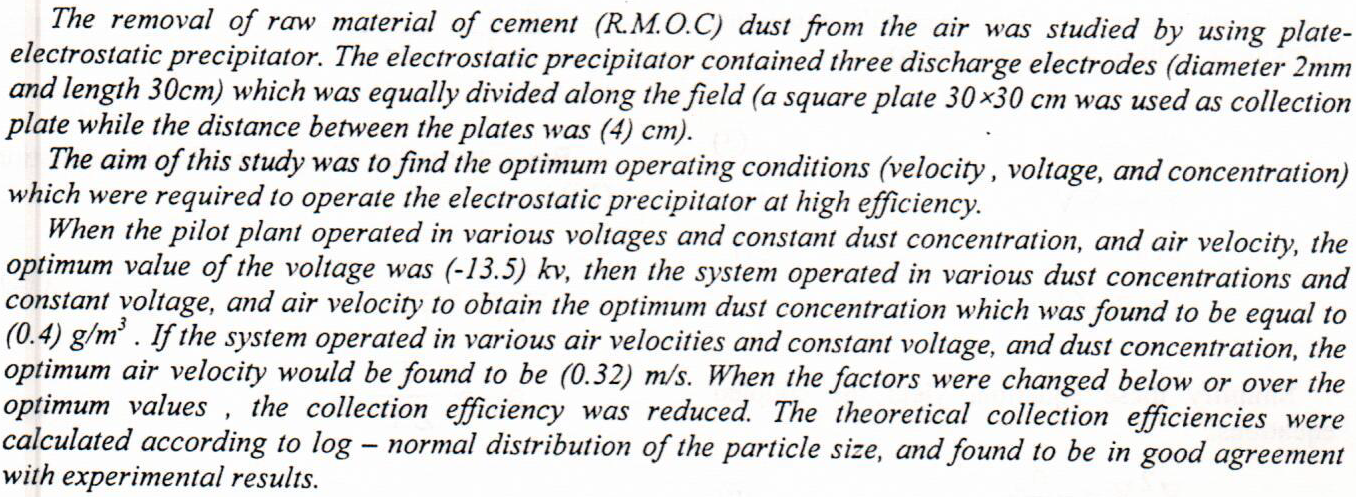
Performance of Plate-Electrostatic Precipitator for Removal of R.M.O.C. Dust

The removal of boron from aqueous solution was carried out by electrocoagulation (EC) using magnesium electrodes as anode and stainless steel electrodes as cathode. Several operating parameters on the removal efficiency of boron were investigated, such as initial pH, current density, initial boron ion concentration, NaCl concentration, spacing between electrodes, electrode material, and presence of carbonate concentration. The optimum removal efficiency of 91. 5 % was achieved at a current density of 3 mA/cm² and pH = 7 using (Mg/St. St. ) electrodes, within 45 min of operating time. The concentration of NaCl was o. 1 g/l with a 0.5cm spacing between the electrodes. First and second order rate equation were applied to study adsorp
... Show More (1)
(1)

This study focused on treating wastewater to remove phosphorus by adsorption onto naturaland local materials. Burned kaolin, porcelinite, bauxite and limestone were selected to be testedas adsorption materials.The adsorption isotherms were evaluated by batch experiments, studyingthe effects of pH, temperature and initial phosphorus concentration. The results showed that at pH6, temperature 20°C and 300 mg/l initial phosphorus concentration; the sorption capacity was0.61, 9, 10 and 13 mg/g at 10 h contact time, for burned kaolin, porcelanite, limestone and bauxiterespectively. As the pH increased from 2 to 10 the removal efficiency for the materials differs inbehaviour. The removal efficiency increased from 40 to 90 % for limestone, and dec
... Show More
(3)
The presence of dyes in wastewater has become a major issue all over the world. The discharge of dyes in the environment is concerned for both toxicological and esthetical reasons. In this study, the removal of dyes from aqueous solution by electrocoagulation using aluminum electrodes as cathode and anode were investigated with the electrocoagulation cell of 1litter. The study included: the impact of various operating parameters on the dyes removal efficiency like pH, NaCl concentration, distance between electrodes, voltage, initial dyes concentration and type of electrodes. The dye (congo red) concentrations were (50, 100, 150, and 200 ppm), stirring speed was 120 rpm at room temperature. pH used was maintained constant
... Show More
(9)
The present study aims to remove nickel ions from solution of the simulated wastewater using (Laminaria saccharina) algae as a biosorbent material. Effects of experimental parameters such as temperature at (20 - 40) C⁰, pH at (3 - 7) at time (10 - 120) min on the removal efficiency were studied.
Box-Wilson method was adopted to obtain a relationship between the above three experimental parameters and removal percentage of the nickel ions. The experimental data were fitted to second order polynomial model, and the optimum conditions for the removal process of nickel ions were obtained.
The highest removal percentage of nickel ions obtained was 98.8 %, at best operating conditions (Temperature 35 C⁰, pH 5 and Time 10 min).
The performance of a batch undivided electrochemical reactor with a rotating cylinder electrode of woven-wire (60 mesh size), stainless steel 316, is examined for the removal of copper from synthetic solution of o.5 M sodium chloride containing 125 ppm at pH ≈ 3.5. The effect of total applied current, rotation speed on the figures of merit of the reactor is analyzed. For an applied current of 300 mA at 100 rpm, the copper concentration decreased from 125 to mg l-1 after 60 min of electrolysis with a specific energy consumption of 1.75 kWh kg-1 and a normalized space velocity of 1.62 h-1. The change in concentration was higher when the total applied currents were increased because of the turbulence
... Show More (60)
(59)
(60)
(59)


Background: Irrigation of the canal system permits removal of residual tissue in the canal anatomy that cannot be reached by instrumentation of the main canals so the aim of this study was to compare and evaluate the efficiency of conventional irrigation system, endoactivator sonic irrigation system,P5 Newtron Satelec passive ultrasonic irrigation and Endovac irrigation system in removing of dentin debris at three levels of root canals and to compare the percentage of dentin debris among the three levels for each irrigation system. Materials and methods: Forty extracted premolars with approximately straight single root canals were randomly distributed into 4 tested groups of 10 teeth each. All canals were prepared with Protaper Universal ha
... Show More
(1)
(3)
(6)
(7)
