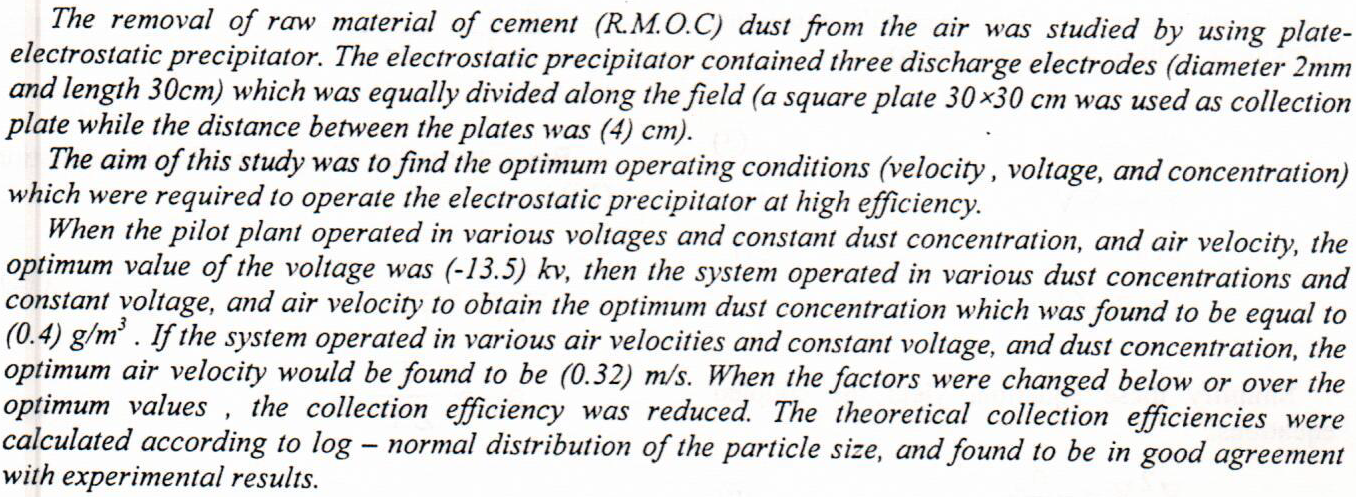
Performance of Plate-Electrostatic Precipitator for Removal of R.M.O.C. Dust

 (12)
(12)
 (14)
(14)


 (11)
(8)
(11)
(8)
Toxic substances have been released into water supplies in recent decades because of fast industrialization and population growth. Fenton electrochemical process has been addressed to treat wastewater which is very popular because of its high efficiency and straightforward design. One of the advanced oxidation processes (AOPs) is electro-Fenton (EF) process, and electrode material significantly affects its performance. Nickel foam was chosen as the source of electro-generated hydrogen peroxide (H2O2) due to its good characteristics. In the present study, the main goals were to explore the effects of operation parameters (FeSO4 concentration, current density, and electrolysis time) on the catalytic performance that was optimized by r
... Show More
(6)
Toxic substances have been released into water supplies in recent decades because of fast industrialization and population growth. Fenton electrochemical process has been addressed to treat wastewater which is very popular because of its high efficiency and straightforward design. One of the advanced oxidation processes (AOPs) is electro-Fenton (EF) process, and electrode material significantly affects its performance. Nickel foam was chosen as the source of electro-generated hydrogen peroxide (H2O2) due to its good characteristics. In the present study, the main goals were to explore the effects of operation parameters (FeSO4 concentration, current density, and electrolysis time) on the catalytic perform
... Show More
(6)
(5)
(1)
The current study investigated the stability and the extraction efficiency of emulsion liquid membrane (ELM) for Abamectin pesticide removal from aqueous solution. The stability was investigated in terms of droplet emulsion size distribution and emulsion breakage percent. The proposed ELM included a mixture of corn oil and kerosene (1:1) as a diluent, Span 80 (sorbitan monooleate) as a surfactant and hydrochloric acid (HCl) as a stripping agent without utilizing a carrier agent. Parameters such as homogenizer speed, surfactant concentration, emulsification time and internal to organic volume ratio (I/O) were evaluated. Results show that the lower droplet size of 0.9 µm and higher stable emulsion in terms of breakage percent of 1.12 % were
... Show More
(5)
Electrochemical Grinding (ECG) process is a mechanically assisted electrochemical process for material processing. The process is able to successfully machine electrically conducting harder materials at faster rate with improved surface finish and dimensional control. This research studies the effect of applied current, electrolyte concentration, spindle speed and the gap between workpiece and tool on hardness and material removal rate during electrochemical grinding for stainless steel 316. The characteristic features of the electrochemical grinding process are explored through Taguchi-design-based experimental studies. The better hardness can be obtained at 10 A of the current, 150 g/l of the electrolyte concentration, 0.3 mm of gap an
... Show More
(8)
(8)
(5)
The current study investigated the stability and the extraction efficiency of emulsion liquid membrane (ELM) for Abamectin pesticide removal from aqueous solution. The stability was investigated in terms of droplet emulsion size distribution and emulsion breakage percent. The proposed ELM included a mixture of corn oil and kerosene (1:1) as a diluent, Span 80 (sorbitan monooleate) as a surfactant and hydrochloric acid (HCl) as a stripping agent without utilizing a carrier agent. Parameters such as homogenizer speed, surfactant concentration, emulsification time and internal to organic volume ratio (I/O) were evaluated. Results show that the lower droplet size of 0.9 µm and higher stable emulsion in terms of breakage percent of 1.12 % we
... Show More
(5)