Preferred Language
Articles
/
ijcpe-623
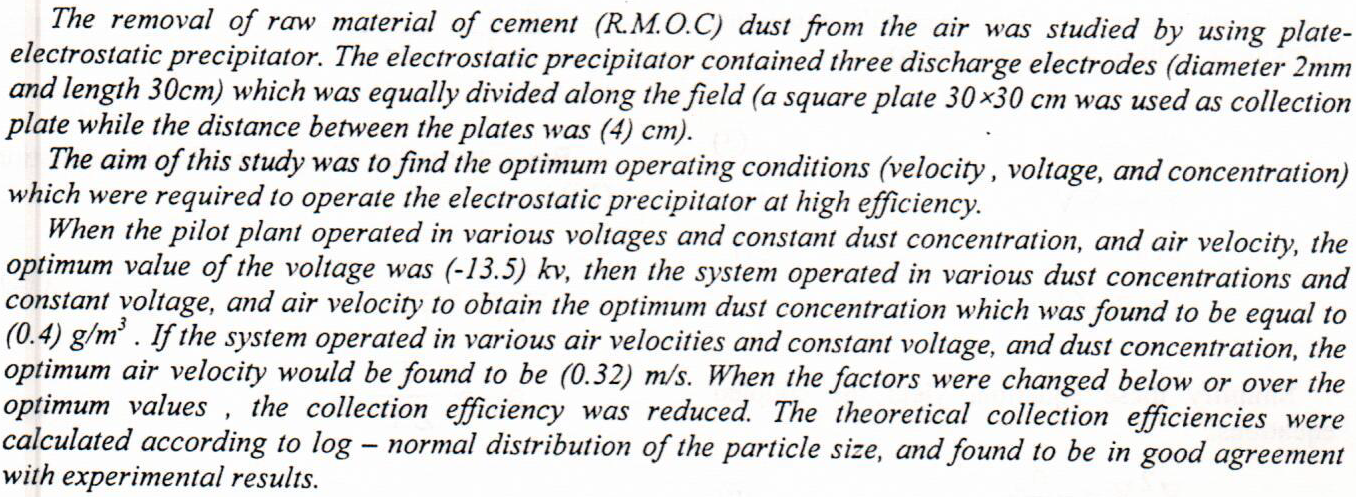
Performance of Plate-Electrostatic Precipitator for Removal of R.M.O.C. Dust
...Show More Authors

View Publication Preview PDF
Quick Preview PDF
Publication Date
Wed May 01 2019
Journal Name
Journal Of Engineering
Non-Destructive Damage Assessment of Five Layers Fiber Glass / Polyester Composite Materials Laminated Plate by Using Lamb Waves Simulation
...Show More Authors

Composite materials are widely used in the engineered assets as aerospace structures, marine and air navigation owing to their high strength/weight ratios. Detection and identification of damage in the composite structures are considered as an important part of monitoring and repairing of structural systems during the service to avoid instantaneous failure. Effective cost and reliability are essential during the process of detecting. The Lamb wave method is an effective and sensitive technique to tiny damage and can be applied for structural health monitoring using low energy sensors; it can provide good information about the condition of the structure during its operation by analyzing the propagation of the wave in the

... Show More
View Publication Preview PDF
Crossref (1)
Crossref
Publication Date
Mon Oct 12 2020
Journal Name
Molecules
Phase Change Process in a Zigzag Plate Latent Heat Storage System during Melting and Solidification
...Show More Authors

Applying a well-performing heat exchanger is an efficient way to fortify the relatively low thermal response of phase-change materials (PCMs), which have broad application prospects in the fields of thermal management and energy storage. In this study, an improved PCM melting and solidification in corrugated (zigzag) plate heat exchanger are numerically examined compared with smooth (flat) plate heat exchanger in both horizontal and vertical positions. The effects of the channel width (0.5 W, W, and 2 W) and the airflow temperature (318 K, 323 K, and 328 K) are exclusively studied and reported. The results reveal the much better performance of the horizontal corrugated configuration compared with the smooth channel during both melti

... Show More
View Publication
Scopus (41)
Crossref (39)
Scopus Clarivate Crossref
Publication Date
Fri Feb 01 2019
Journal Name
Environmental Technology & Innovation
The use of Artificial Neural Network (ANN) for modeling of Cu (II) ion removal from aqueous solution by flotation and sorptive flotation process
...Show More Authors

View Publication
Scopus (35)
Crossref (37)
Scopus Clarivate Crossref
Publication Date
Sat Apr 01 2017
Journal Name
2017 International Conference On Environmental Impacts Of The Oil And Gas Industries: Kurdistan Region Of Iraq As A Case Study (eiogi)
Inverse fluidized bed for chromium ions removal from wastewater and produced water using peanut shells as adsorbent
...Show More Authors

View Publication
Scopus (5)
Crossref (1)
Scopus Crossref
Publication Date
Thu Jun 29 2023
Journal Name
Iraqi Journal Of Chemical And Petroleum Engineering
Emulsion Liquid Membrane for Pesticides Removal from Aqueous Solution: Emulsion Stability, Extraction Efficiency and Mass Transfer Studies
...Show More Authors

The current study investigated the stability and the extraction efficiency of emulsion liquid membrane (ELM) for Abamectin pesticide removal from aqueous solution. The stability was investigated in terms of droplet emulsion size distribution and emulsion breakage percent. The proposed ELM included a mixture of corn oil and kerosene (1:1) as a diluent, Span 80 (sorbitan monooleate) as a surfactant and hydrochloric acid (HCl) as a stripping agent without utilizing a carrier agent. Parameters such as homogenizer speed, surfactant concentration, emulsification time and internal to organic volume ratio (I/O) were evaluated. Results show that the lower droplet size of 0.9 µm and higher stable emulsion in terms of breakage percent of 1.12 % were

... Show More
Crossref (5)
Crossref
Publication Date
Sun Dec 01 2019
Journal Name
Al-khwarizmi Engineering Journal
An Experimental Study on Electrochemical Grinding Parameters on Hardness and Material Removal Rate for Stainless Steel 316
...Show More Authors

Electrochemical Grinding (ECG) process is a mechanically assisted electrochemical process for material processing. The process is able to successfully machine electrically conducting harder materials at faster rate with improved surface finish and dimensional control. This research studies the effect of applied current, electrolyte concentration, spindle speed and the gap between workpiece and tool on hardness and material removal rate during electrochemical grinding for stainless steel 316. The characteristic features of the electrochemical grinding process are explored through Taguchi-design-based experimental studies. The better hardness can be obtained at 10 A of the current, 150 g/l of the electrolyte concentration, 0.3 mm of gap an

... Show More
View Publication Preview PDF
Publication Date
Thu Jun 29 2023
Journal Name
Iraqi Journal Of Chemical And Petroleum Engineering
Emulsion Liquid Membrane for Pesticides Removal from Aqueous Solution: Emulsion Stability, Extraction Efficiency and Mass Transfer Studies
...Show More Authors

The current study investigated the stability and the extraction efficiency of emulsion liquid membrane (ELM) for Abamectin pesticide removal from aqueous solution. The stability was investigated in terms of droplet emulsion size distribution and emulsion breakage percent. The proposed ELM included a mixture of corn oil and kerosene (1:1) as a diluent, Span 80 (sorbitan monooleate) as a surfactant and hydrochloric acid (HCl) as a stripping agent without utilizing a carrier agent. Parameters such as homogenizer speed, surfactant concentration, emulsification time and internal to organic volume ratio (I/O) were evaluated. Results show that the lower droplet size of 0.9 µm and higher stable emulsion in terms of breakage percent of 1.12 % we

... Show More
View Publication Preview PDF
Crossref (5)
Crossref
Publication Date
Thu Apr 01 2021
Journal Name
Journal Of Engineering Science And Technology
Applying box-behnken design with statistical optimization for removal vat orange dye from aqueous solution using kaolin
...Show More Authors

Scopus (5)
Scopus
Publication Date
Tue Jan 08 2019
Journal Name
Iraqi Journal Of Physics
Photocatalytic removal of methylene blue dye by using of ZnS and CdS
...Show More Authors

Photocatalytic degradation of methylene blue was studied using CdS and ZnS as catalyst. The photocatalytic activity of the specimen was studied by exposing to UV-radiation. The result shows that the degradation efficiency of the dye for CdS micro-particles was 92% after 7 hours and for ZnS micro-particles was 88.29% for the same time interval.

View Publication Preview PDF
Crossref (4)
Crossref
Publication Date
Fri Jun 30 2017
Journal Name
Iraqi Journal Of Chemical And Petroleum Engineering
Statistical Analysis of the Removal of Acid Fuchsin Dye Using Zeolite 5A
...Show More Authors

Investigation of the adsorption of acid fuchsin dye (AFD) on Zeolite 5A is carried out using batch scale experiments according to statistical design. Adsorption isotherms, kinetics and thermodynamics were demonstrated.  Results showed that the maximum removal efficiency was using zeolite at a temperature of 93.68751 mg/g. Experimental data was found to fit the Langmuir isotherm and pseudo second order kinetics with maximum  removal of about 95%.  Thermodynamic analysis showed an endothermic adsorption. Optimization was made for the most affecting operating variables and a model equation for the predicted efficiency was suggested.

View Publication Preview PDF


