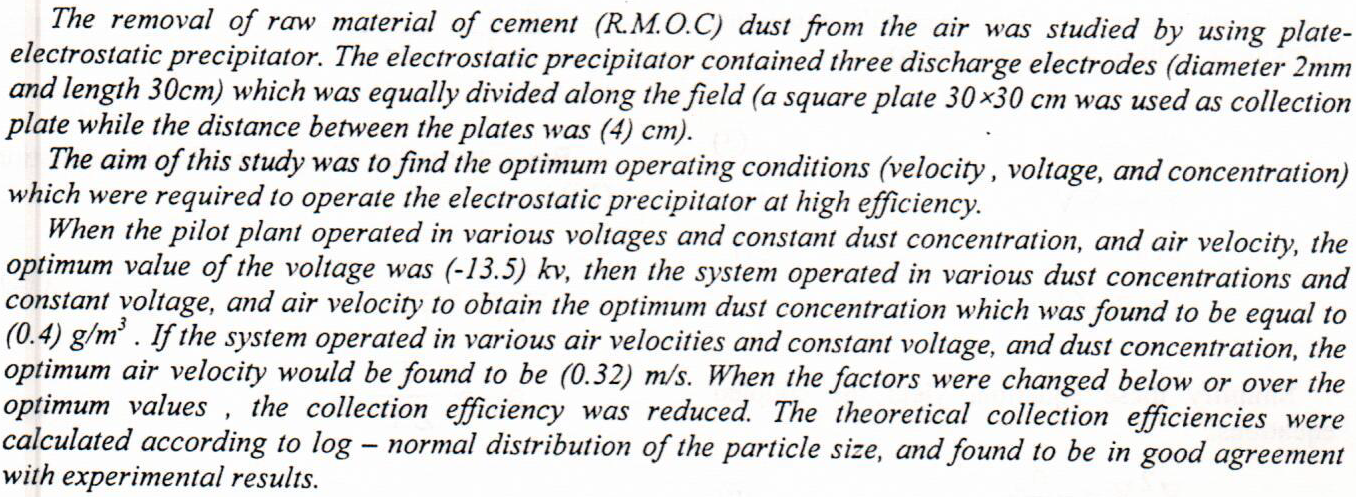
Performance of Plate-Electrostatic Precipitator for Removal of R.M.O.C. Dust

Two samples of (Ag NPs-zeolite) nanocomposite thin films have been prepared by easy hydrothermal method for 4 hours and 8 hours inside the hydrothermal autoclave at temperatures of 100°C. The two samples were used in a photoelectrochemical cell as a photocatalyst inside a cell consisting of three electrodes: the working electrode photoanode (AgNPs-zeolite), platinum as a cathode electrode, and Ag/AgCl as a reference electrode, to study the performance of AgNPs-zeolite under dark current and 473 nm laser light for water splitting. The results show the high performance of an eight-hour sample with high crystallinity compared with a four-hour sample as a reliable photocatalyst to generate hydrogen for renewable energies.

In this work, an anti-reflection coating was prepared in the region (400-1000) nm of wavelength, with a double layer of silicon dioxide (SiO2) as an inner layer and the second layer of the mixture (SiO2) and titanium dioxide (TiO2) with certain ratios, as an outer layer using the chemical spraying method with a number of 6 sprays of layer SiO2 and 12 sprays of layer SiO2 - TiO2. Using the method of chemical spraying deposited on the glass as a substrate with a different number of sprays of SiO2, and a fixed number of TiO2-SiO2. The optical and structural properties were determined using UV-Vis spectroscopy and atomic force mi
... Show More (7)
(7)
Search Results at the International Journal of Science and Research (IJSR)
 (3)
(3)


The removal of commercial orange G dye from its aqueous solution by adsorption on tobacco leaves (TL) was studied in respect to different factor that affected the adsorption process. These factors including the tobacco leaves does, period of orange G adsorption, pH, and initial orange G dye concentration .Different types of isotherm models were used to describe the orange G dye adsorption onto the tobacco leaves. The experimental results were compared using Langmuir, and frundlich adsorption isotherm, the constants for these two isotherm models was determined. The results fitted frundlich model with value of correlation coefficient equal to (0.981). The capacity of adsorption for the orange G dye was carried out using various kinetic models
... Show More
(7)
In this paper activated carbon adsorbents produced from waste tires by chemical activation methods and application of microwave assisted KOH activation. The influence of radiation time, radiation power, and impregnation ratio on the yield and oil removal which is one of the major environmental issues nowadays and considered persistent environmental contaminants and many of them are suspected of being carcinogenic. Based on Box-Wilson central composite design, polynomial models were developed to correlate the process variables to the two responses. From the analysis of variance the significant variables on each response were identified. Optimum conditions of 4 min radiation time, 700 W radiation power and 0.5 g/g impregnation ratio
... Show More
(14)
(8)
(16)
(18)
(2)
(2)