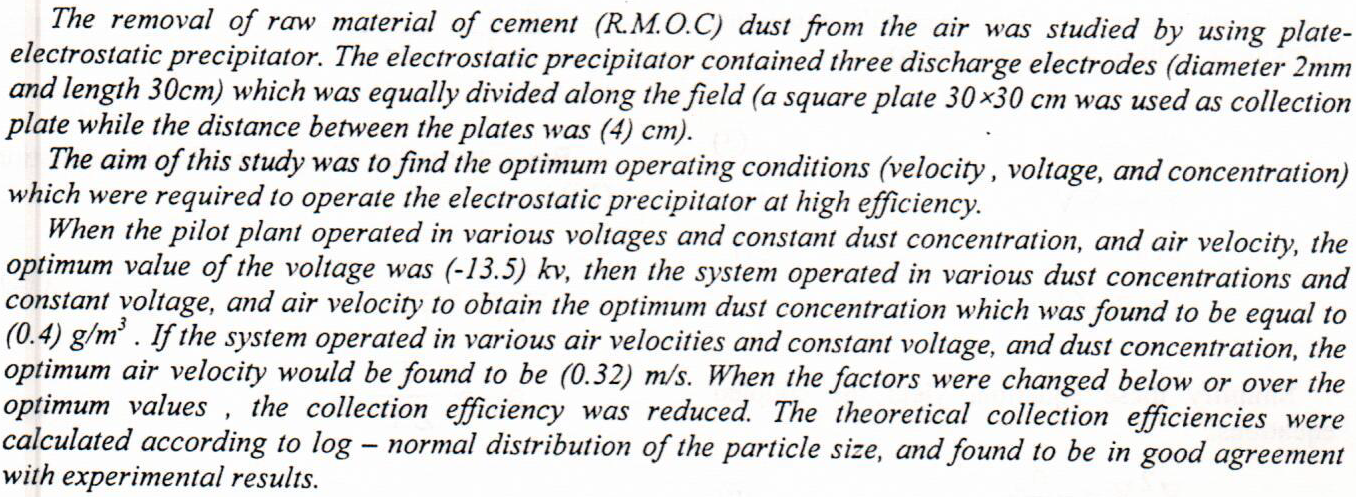
Performance of Plate-Electrostatic Precipitator for Removal of R.M.O.C. Dust

Solar energy usage in Iraq is facing many issues; one of those is the accumulation “of the dust on the surface of the solar module which” would highly lower its efficiency. The present work study the effect of dust accumulation” on installing fixed solar modules with different inclined angles 15o, 33o, 45o, 60o. Evaluation of the solar modules performance under different circumstance conditions such as rain, wind and humidity are considered in study of dust effect on solar module performance. The results show that the lowest output average efficiencies of solar modules occurs at 15o horizontally inclined angle are 7.4% , 6.7% , 8.0% , 8.1%, and 8.4% for the cor
... Show MoreAbstract
The use of electronic valves is commonly available. yet, the most
common is the techniques of communications as prod casting transmitter that
are used by these valves in addition to their use in communication tools as far
distance telephone, electronic measuring techniques , and others.
In this study, an attempt is endeavored for improving the efficiency of the
vacuum micro- valves(GI-19b) through activating their internal surfaces by the
use of ionic pumping which is used for treating valves which are out of order
(because of sedimentation some materials and oxide on its poles). The
existence of these materials and oxide increase the sum of current leakage
moving in between. The use of ionic pumpin
Objective: To determine the functional and radiological outcomes of lower third tibia closed fractures fixed by nail or plate osteosynthesis. Methodology: This randomized controlled trial included 20 patients presenting with closed fracture lower third tibia in Al-Kindy teaching hospital, Baghdad, Iraq. The patients were divided as every other one into two equal groups; group I had fractures fixed by 3.5 mm locked plate and group II by intramedullary locking nail. We followed all patients for 24 weeks to assess surgical complications, fracture union, alignment and functional outcome based on Knee society score (KSS). Results: The mean union time in both groups was 10.2 ± 1.48 and 9.3 ± 1.77 weeks, respectively (p = 0.003). Mean KSS in bot
... Show More

Adsorption is one of the most important technologies for the treatment of polluted water from dyes. Theaim of this study is to use a low-cost adsorbent for this purpose. A novel and economical adsorbent was used to remove methyl violet dye (MV) from aqueous solutions. This adsorbent was prepared from bean peel, which is an agricultural waste. Batch adsorption experiments were conducted to study the ability of the bean peel adsorbent (BPA) to remove the methyl violet (MV) dye. The effects of different variables, such as weight of the adsorbent, pH of the MV solution, initial concentration of MV, contact time and temperature, on the adsorption behaviour were studied. It was found experimentally that the time required to achieve equilibrium
... Show More (33)
(33)
 (27)
(27)

This work investigates removing the Malachite Green (MG) dye, the poly acrylic hydrogel beads used as a surface to adsorb the dye, the isotherm of adsorption was examined and aspects that influence it, like increasing heat, adding salt, the influence of dry beads and effect of shaking. according to the results, the effect of the adsorption has been found that it is matched to the Friendlish equation much more than Langmuir and Temkin equations. A positive relationship between the adsorption process and the increase in temperature is found that adsorption increases when the temperature increase. Also, the adsorption increased when the salt was added at a temperature (of 20 C0). As that the adsorption doesn’t budge by adding either
... Show More
(11)
Several industrial wastewater streams may contain heavy metal ions, which must be effectively removal
before the discharge or reuse of treated waters could take place. In this paper, the removal of copper( II)
by foam flotation from dilute aqueous solutions was investigated at laboratory scale. The effects of
various parameters such as pH, collector and frother concentrations, initial copper concentration, air flow
rate, hole diameter of the gas distributor, and NaCl addition were tested in a bubble column of 6 cm inside
diameter and 120 cm height. Sodium dodecylsulfate (SDS) and Hexadecyl trimethyl ammonium bromide
(HTAB) were used as anionic and cationic surfactant, respectively. Ethanol was used as frothers and the
(4)
The ability of pulverized walnut-shell to remove oil from aqueous solutions has been studied. It involves two-phase process which consists of using walnut-shell as a filtering bed for the accumulation and adsorption of oil onto its surface. Up to 96% oil removal from synthetic wastewater samples was achieved while tests results showed that 75% of oil can be removed from the actual wastewater discharged from Al- Duara refinery in the south of Baghdad.
Crude soybean peroxidase (SBP), isolated from soybean seed coats (hulls) at unusually low concentrations, catalyses the oxidative polymerisation of hazardous aqueous benzidine and its 3,3′-dichloro, 3,3′-dimethyl and 3,3′-dimethoxy derivatives in the presence of hydrogen peroxide. The optimum operating conditions for oxidation of 0·10 mM benzidine were investigated. At pH 5, the hydrogen peroxide-to-substrate concentration ratio was 1·5 and the minimum SBP concentration required to achieve at least 95% conversion of the benzidine in synthetic wastewater was 0·43 mU/ml. Progress curves were established for the conversion of the four substrates, and apparent first-order rate constants were derived. Enzyme-catalysed polym
... Show More
(13)
(11)
