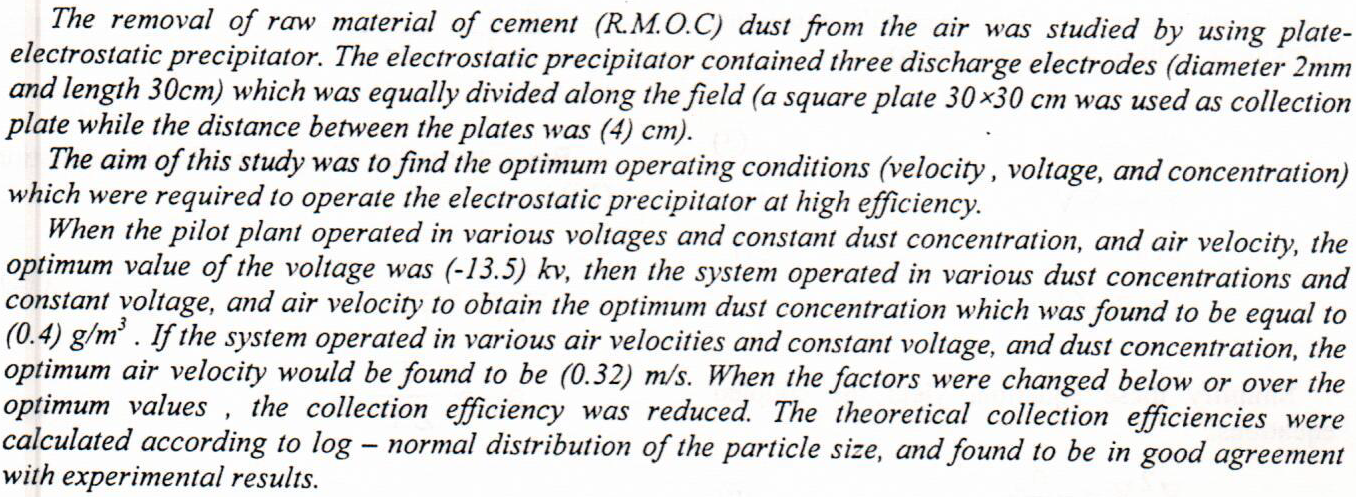
Performance of Plate-Electrostatic Precipitator for Removal of R.M.O.C. Dust

Herein, date palm (Phoenix dactylifera) bunch (DPB) waste was transformed into activated carbon (DPAC) adsorbent by using microwaveinduced ZnCl2 activation for 15 min at a power of 600 W. Several analytical methods were used to explain the physicochemical parameters of DPBAC including XRD, pHpzc, BET, SEM–EDX, and FTIR. Afterwards, the adsorptive performance of DPBAC was thoroughly investigated for the removal of two structurally different organic dyes namely methyl violet (MV) and fuchsin basic (FB). The key adsorption parameters, including the dose of DPBAC (A: 0.02–0.06 g), the solution pH (B: 4–10), and the contact time (C: 2–20 min) were statistically optimized using the Box-Behnken design with response surface methodology (RSM
... Show More (3)
(3)
 (2)
(2)


This work was conducted to study the ability of locally prepared Zeolite NaY for the reduction of sulfur compounds from Iraqi natural gas by a continuous mode adsorption unit. Zeolite Y was hydrothermally synthesized using abundant kaolin clay as aluminum precursor. Characterization was made using chemical analysis, XRD and BET surface area. Results of the adsorption experiments showed that zeolite Y is an active adsorbent for removal H2S from natural gas and other gas streams. The effect of temperature was found inversely related to the removal efficiency. Increasing bed height was found to increase the removal efficiency at constant flow rate of natural gas. The adsorption capacity was evaluated and its maximum uptake was 5.345 mg H2S/g z
... Show MoreThe removal of turbidity from produced water by chemical coagulation/flocculation method using locally available coagulants was investigated. Aluminum sulfate (alum) is selected as a primary coagulant, while calcium hydroxide (lime) is used as a coagulant aid. The performance of these coagulants was studied through jar test by comparing turbidity removal at different coagulant/ coagulants aid ratio, coagulant dose, water pH, and sedimentation time. In addition, an attempt has been made to examine the relationship between turbidity (NTU) and total suspended solids (mg/L) on the same samples of produced water. The best conditions for turbidity removal can be obtained at 75% alum+25% lime coagulant at coagulant dose of 80 m
... Show MoreThe present work aimed to study the efficiency of nanofiltration (NF) and reverse osmosis (RO) membrane for heavy metal removal from wastewater and study the factors affecting the performance of these two membranes: feed concentrations for heavy metal ions, pressure, and flow rate. The experimental results showed, heavy metals concentration in permeate increase with raise in feed concentrations, decline with increase in flow rate. The raise of pressure, heavy metals concentration decreases for RO membrane, but for NF membrane the concentration decrease and then at high pressure increase. The rejection percentage for chromium in NF and RO is 99.7% and 99.9%, for copper is 98.4% and 99.3%, for zinc is 97.9% and 99.5%, for nickel is 97.2% and
... Show More
(3)
This work was conducted to study the ability of locally prepared Zeolite NaY for the reduction of sulfur compounds from Iraqi natural gas by a continuous mode adsorption unit. Zeolite Y was hydrothermally synthesized using abundant kaolin clay as aluminum precursor. Characterization was made using chemical analysis, XRD and BET surface area. Results of the adsorption experiments showed that zeolite Y is an active adsorbent for removal H2S from natural gas and other gas streams. The effect of temperature was found inversely related to the removal efficiency. Increasing bed height was found to increase the removal efficiency at constant flow rate of natural gas. The adsorption capacity was evaluated and its maximum uptake was 5.345 mg H2S/g z
... Show More
(3)
Abstract This study investigated the treatment of textile wastewater contaminated with Acid Black 210 dye (AB210) using zinc oxide nanoparticles (ZnO NPs) through adsorption and photocatalytic techniques. ZnO NPs were synthesized using a green synthesis process involving eucalyptus leaves as reducing and capping agents. The synthesized ZnO NPs were characterized using UV-Vis spectroscopy, SEM, EDAX, XRD, BET, Zeta potential, and FTIR techniques. The BET analysis revealed a specific surface area and total pore volume of 26.318 m2/g. SEM images confirmed the crystalline and spherical nature of the particles, with a particle size of 73.4 nm. A photoreactor was designed to facilitate the photo-degradation process. The study investigated the inf
... Show More
(11)
(3)
The potential application of granules of brick waste (GBW) as a low-cost sorbent for removal of Ni+2ions from aqueous solutions has been studied. The properties of GBW were determined through several tests such as X-Ray diffraction (XRD), Energy dispersive X-ray (EDX), Scanning electron microscopy (SEM), and BET surface area. In batch tests, the influence of several operating parameters including contact time, initial concentration, agitation speed, and the dose of GBW was investigated. The best values of these parameters that provided maximum removal efficiency of nickel (39.4%) were 1.5 hr, 50 mg/L, 250 rpm, and 1.8 g/100mL, respectively. The adsorption data obtained by batch experiments subjected to the Three i
... Show More
(12)
Concerns about the environment, the cost of energy, and safety mean that low-energy cold-mix asphalt materials are very interesting as a potential replacement for present-day hot mix asphalt. The main disadvantage of cold bituminous emulsion mixtures is their poor early life strength, meaning they require a long time to achieve mature strength. This research work aims to study the protentional utilization of waste and by-product materials as a filler in cold emulsion mixtures with mechanical properties comparable to those of traditional hot mix asphalt. Accordingly, cold mix asphalt was prepared to utilize paper sludge ash (PSA) and cement kiln dust (CKD) as a substitution for conventional mineral filler with percentages ranging fro
... Show More
(32)
(30)

Modified algae with nano copper oxide (CuO) were used as adsorption media to remove tetracycline (TEC) from aqueous solutions. Functional groups, morphology, structure, and percentages of surfactants before and after adsorption were characterised through Fourier-transform infrared (FTIR), X-ray diffraction (XRD), scanning electron microscopy (SEM), and energy-dispersive spectroscopy (EDS). Several variables, including pH, connection time, dosage, initial concentrations, and temperature, were controlled to obtain the optimum condition. Thermodynamic studies, adsorption isotherm, and kinetics models were examined to describe and recognise the type of interactions involved. Resultantly, the best operation conditions were at pH 7, contact time
... Show More
(36)
(35)