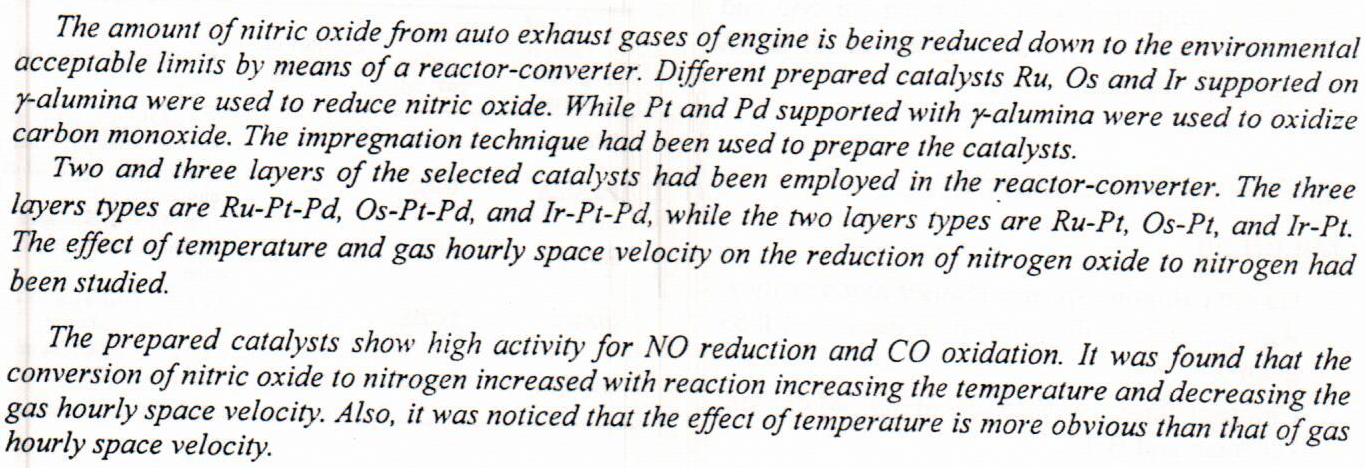
Catalytic Reduction of Nitric Oxide in Automobile Exhaust Gases

This work is focused on studying the effect of liquid layer level (height above a target material) on zinc oxide nanoparticles (ZnO and ZnO2) production using liquid-phase pulsed laser ablation (LP-PLA) technique. A plate of Zn metal inside different heights of an aqueous environment of cetyl trimethyl ammonium bromide (CTAB) with molarity (10-3 M) was irradiated with femtosecond pulses. The effect of liquid layer height on the optical properties and structure of ZnO was studied and characterized through UV-visible absorption test at three peaks at 213 nm, 216 nm and 218 nm for three liquid heights 4, 6 and 8 mm respectively. The obtained results of UV–visible spectra test show a blue shift accomp
... Show More (2)
(2)
 (1)
(1)


Nanoparticles of humic acid and iron oxide were impregnated on the inert sand to produce sorbent for treating groundwater contained of cadmium and copper ions by technology of permeable reactive barrier (PRB). Sewage sludge was the source of the humic acid to prepare the coated sand by humic acid—iron oxide (CSHAIO) sorbent; so, this work is consistent with sustainable development. For 10 mg/L metal concentration, batch tests at speed of 200 rpm signified that the removal efficiencies are greater than 90% at sorbent dosage 0.25 g/ 50 mL, pH 6 and contact time 1 h. The kinetic data was well described by the Pseudo first-order model indicating that physicosorption is the predominant mechanism. The maximum adsorption capacities (qmax) were c
... Show More
(12)
Electronic properties such as density of state, energy gap, HOMO (the highest occupied molecular orbital) level, LUMO (the lowest unoccupied molecular orbital) level and density of bonds, as well as spectroscopic properties like infrared (IR), Raman scattering, force constant, and reduced masses for coronene C24, reduced graphene oxide (rGO) C24O5and interaction between C24O5and NO2gas molecules were investigated. Density functional theory (DFT) with the exchange hybrid function B3LYP with 6-311G** basis sets through the Gaussian 09 W software program was used to do these calculations. Gaussian view 05 was em
... Show More
(7)
(1)

Activated carbon derived from Ficus Binjamina agro-waste synthesized by pyro carbonic acid microwave method and treated with silicon oxide (SiO2) was used to enhance the adsorption capability of the malachite green (MG) dye. Three factors of concentration of dye, time of mixing, and the amount of activated carbon with four levels were used to investigate their effect on the MG removal efficiency. The results show that 0.4 g/L dosage, 80 mg/L dye concentration, and 40 min adsorption duration were found as an optimum conditions for 99.13% removal efficiency. The results also reveal that Freundlich isotherm and the pseudo-second-order kinetic models were the best models to describe the equilibrium adsorption data.
(7)
(3)
Green synthesis is depending on preparation of nano composited SiO2/V2O5 by using the modified sol-gel method depending on rice husk ash as a source for the extraction of silica gel and the product powder of nano composited SiO2/V2O5 characterization by many techniques such as X-ray diffraction spectroscopy (XRD), field emission scanning electron microscopy (FESEM), and N2 adsorptions/desorption isotherms (BET). This study also includs the biological effectiveness of SiO2/V2O5 and its effect on inhibiting bacterial growth after the prepared nanomaterial was applied to wound dressings, which gave a promising result for its use as
... Show More
(6)
(3)
Development of improved methods for the synthesis of metal oxide nanoparticles are of high priority for the advancement of material science and technology. Herein, the biosynthesis of ZnO using hydrahelix of beta vulgaris and the seed of abrus precatorius as an aqueaus extracts adduced respectivily as stablizer and reductant reagent. The support are characterized by spectroscopic methods ( Ft-IR, Uv-vis ).The FTIR confirmed the presence of ZnO band. The Uv-visible showed absorption peak at corresponds to the ZnO nanostructures. X-ray diffraction, scaning electron microscopy (SEM), dispersive X-ray spectroscopy (EDX) techniques are taken to investigation the size, structure and composition of synthesised ZnO nanocrystals. The XRD pattern mat
... Show More
(22)
(24)
(3)
Sludge from stone-cutting (SSC) factories and stone mines cannot be used as decorative stones, stone powder, etc. These substances are left in the environment and cause environmental problems. This study aim is to produce artificial stone composite (ASC) using sludge from stone cutting factories, cement, unsaturated resin, water, silicon carbide nanoparticles (SiC-NPs), and nano-graphene oxide (NGO) as fillers. Nano graphene oxide has a hydrophobic plate structure that water is not absorbed due to the lack of surface tension on these plates. NGO has a significant effect on the properties of artificial stone due to its high specific surface area and low density in the composite. Its uniform distribution in ASC is very low due to its hydropho
... Show More
(5)
(4)
This study uses an environmentally friendly and low-cost synthesis method to manufacture zinc oxide nanoparticles (ZnO NPs) by using zinc sulfate. Eucalyptus leaf extract is an effective chelating and capping agent for synthesizing ZnO NPs. The structure, morphology, thermal behavior, chemical composition, and optical properties of ZnO nanoparticles were studied utilizing FT-IR, FE-SEM, EDAX, AFM, and Zeta potential analysis. The FE-SEM pictures confirmed that the ZnO NPs with a size range of (22-37) nm were crystalline and spherical. Two methods were used to prepare ZnO NPs. The first method involved calcining the resulting ZnO NPs, while the second method did not. The prepared ZnO NPs were used as adsorbents for removing acid black 210
... Show More
(6)
(4)