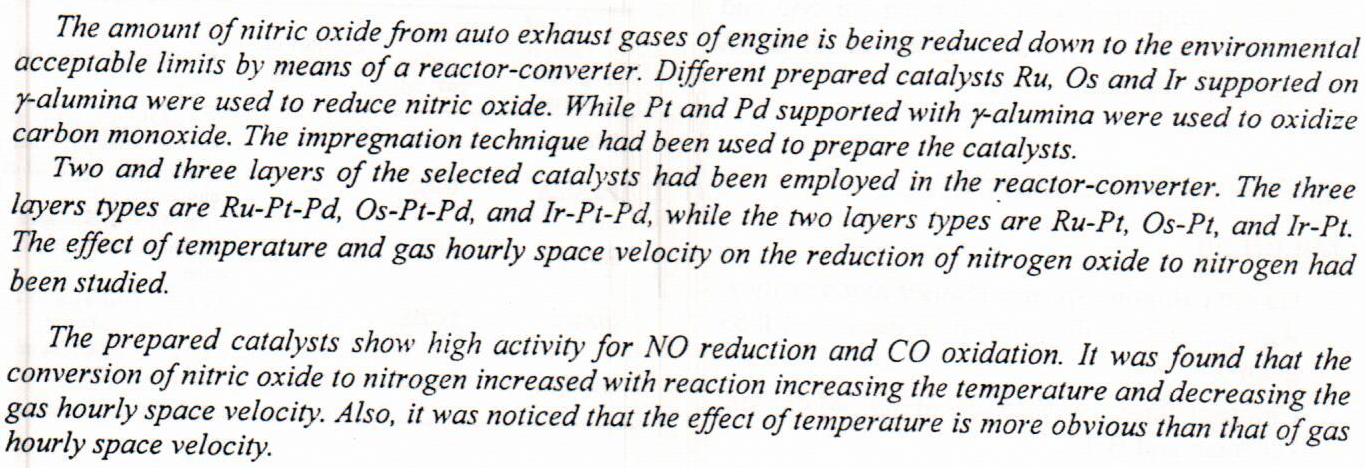
Catalytic Reduction of Nitric Oxide in Automobile Exhaust Gases

Magnetic nanoparticles (MNPs) of iron oxide (Fe3O4) represent the most promising materials in many applications. MNPs have been synthesized by co-precipitation of ferric and ferrous ions in alkaline solution. Two methods of synthesis were conducted with different parameters, such as temperature (25 and 80 ̊C), adding a base to the reactants and the opposite process, and using nitrogen as an inert gas. The product of the first method (MNPs-1) and the second method (MNPs-2) were characterized by x-ray diffractometer (XRD), Zeta Potential, atomic force microscope (AFM) and scanning electron microscope (SEM). AFM results showed convergent particle size of (MNPs-1) and (MNPs-2) with (86.01) and (74.14)
... Show More (47)
(47)

In this work, pure and Ag-doped nickel oxide (NiO) thin films were deposited on glass substrates with different dopant concentrations (0.1, 0.2, 0.3 and 0.4 wt.%) by pulsed-laser deposition (PLD) technique at room temperature. These films were annealed at temperature of 450 °C. The structural and optical properties of the prepared thin films were studied. It was found that annealing process has lead to increase the transmittance of the deposited films. Also, the transmittance was found to increase with doping concentration of silver in the deposited NiO films. The optical energy gap was decreased from 3.5 to 3.2 eV as the doping concentration was increased to 0.4 %.
 (32)
(29)
(32)
(29)


In this work we used the environmentally friendly method to prepared ZrO2 nanoparticles utilizing the extract of Thyms plant In basic medium and at pH 12, the ZrO2 NPs was characterized by different techniques such as FTIR, ultraviolet visible, Atomic force microscope, Scanning Electron Microscopy, X-ray diffraction and Energy dispersive X-ray. The average crystalline size was calculated using the Debye Scherres equation in value 7.65 nm. Atomic force microscope results showed the size values for ZrO2 NPs were 45.11nm, and there are several distortions due to the presence of some large sizes. Atomic force microscope results showed the typical size values for ZrO2 NPs were 45.11 nm, and there are several distortions due to the presence of so
... Show More
(15)
The research aims to study the effect of adding (Li2O) to an alkaline glaze containing (K2O, Na2O). Although all the alkaline oxides have common properties, each oxide has something that distinguishes it. The molecular weight of (Li2O) is two times less than that of (Na2O) and three times that of (K2O). Therefore, it is added in small proportions. In addition, it is a very strong flux, so it is not used alone, but rather replaces a part of other alkaline oxides. It was added to an alkali glass that matured at a temperature of 980CO in proportions (2.0,1.4,1.2,0.8,0.4%) instead of (Na2O), using lithium carbonate (Li2CO3) as an oxide source. The glazes mixtures were applied to a white pottery body, and the samples were fired and cooled acc
... Show More
The effect of metal nanoparticles on the anaerobic digestion of sludge and the sludge bacterial community are still not well-understood, and both improvements and inhibitions have been reported. This study investigated the impact of 2, 10, and 30 mg/g TS silver and copper oxide nanoparticles (AgNPs and CuONPs) on the mesophilic anaerobic digestion of sludge and the bacterial community structure. The reactors were monitored for changes in tCOD, sCOD, TS, VS, biogas generation, and cell viability. Also, the relative abundance and taxonomic distribution of the bacterial communities were analyzed at the phylum and genus levels, including the genera involved in anaerobic digestion. Both AgNPs and CuONPs exhibited some inhibition on anaer
... Show More
(4)
(5)
AlO-doped ZnO nanocrystalline thin films from with nano crystallite size in the range (19-15 nm) were fabricated by pulsed laser deposition technique. The reduction of crystallite size by increasing of doping ratio shift the bandgap to IR region the optical band gap decreases in a consistent manner, from 3.21to 2.1 eV by increasing AlO doping ratio from 0 to 7wt% but then returns to grow up to 3.21 eV by a further increase the doping ratio. The bandgap increment obtained for 9% AlO dopant concentration can be clarified in terms of the Burstein–Moss effect whereas the aluminum donor atom increased the carrier's concentration which in turn shifts the Fermi level and widened the bandgap (blue-shift). The engineering of the bandgap by low
... Show More
(1)
Objective This study evaluated the effects of adding titanium oxide (TiO2) nanofillers on the tear strength, tensile strength, elongation percentage, and hardness of room-temperature-vulcanized (RTV) VST50F and high-temperature-vulcanized (HTV) Cosmesil M511 maxillofacial silicone elastomers. Methods Two types of maxillofacial elastomers, VST50F RTV and Cosmesil M511 HTV, were used. Nano-TiO2 powder was applied as a nanofiller. A total of 120 specimens were fabricated, 60 each of VST50F and Cosmesil M511. The specimens of each type of elastomer were divided into three equal groups on which tests were conducted for tear strength, tensile strength, and hardness i.e., 20 specimens were used for each test. Each group of 20 specimens was further
... Show More
(33)
(13)
Green nanotechnology is a thrilling and rising place of technology and generation that bracesthe ideas of inexperienced chemistry with ability advantages for sustainability, protection, andthe general protection from the race human. The inexperienced chemistry method introduces aproper technique for the production, processing, and alertness of much less dangerous chemicalsubstances to lessen threats to human fitness and the environment. The technique calls for inintensity expertise of the uncooked materials, particularly in phrases in their creation intonanomaterials and the resultant bioactivities that pose very few dangerous outcomes for peopleand the environment. In the twenty-first century, nanotechnology has become a systematic
... Show More
(12)
Undoped and Co-doped zinc oxide (CZO) thin films have been prepared by spray pyrolysis technique using solution of zinc acetate and cobalt chloride. The effect of Co dopants on structural and optical properties has been investigated. The films were found to exhibit maximum transmittance (~90%) and low absorbance. The structural properties of the deposited films were examined by x-ray diffraction (XRD). These films, deposited on glass substrates at (400? C), have a polycrystalline texture with a wurtzite hexagonal structure, and the grain size was decreased with increasing Co concentration, and no change was observed in lattice constants while the optical band gap decreased from (3.18-3.02) eV for direct allowed transition. Other parameters
... Show More