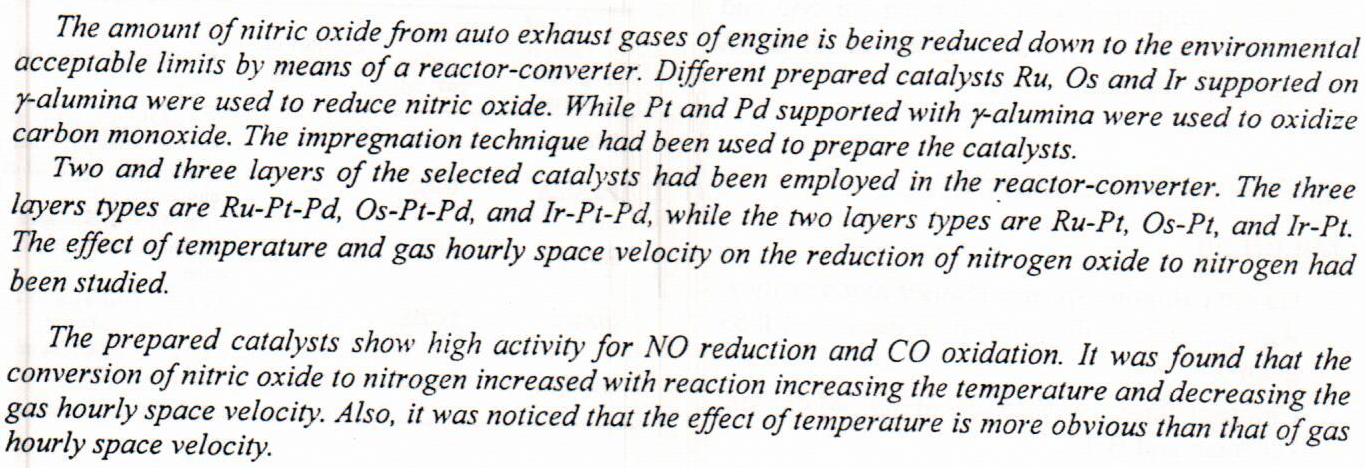
Catalytic Reduction of Nitric Oxide in Automobile Exhaust Gases

In this work, lead oxide nanoparticles were prepared by laser ablation of lead target immersed in deionized water by using pulsed Nd:YAG laser with laser energy 400 mJ/pulse and different laser pulses. The chemical bonding of lead oxide nps was investigated by Fourier Transform Infrared (FTIR); surface morphology and optical properties were investigated by Scanning Electron Microscope (SEM) and UV-Visible spectroscopy respectively, and the size effect of lead oxide nanoparticles was studied on its antibacterial action against two types of bacteria Gram-negitive (Escherichia coli) and Gram-positive (Staphylococcusaurus) by diffusion method. The antibacterial property results show that the antibacterial activity of the Lead oxide NPs was
... Show More (21)
(21)
 (13)
(13)


Aims: This study was conducted to assess the effect of the addition of yttrium oxide (Y2O3) nanoparticles on the tensile bond strength, tear strength, shore A hardness, and surface roughness of soft-denture lining material. Materials and Methods: Y2O3 NPs with 1.5 and 2 wt.% were added into acrylic-based heat-cured soft-denture liner. A total of 120 specimens were prepared and divided into four groups according to the test to be performed (tensile bond strength, tear strength, surface hardness, and surface roughness). Results: There was a highly significant increase in tensile bond strength between the soft liner and the acrylic denture base, tear strength, and hardness at both concentrations as compared to the control group, whereas ther
... Show More
(16)
(12)

Background: Poly (methyl methacrylate) has been widely utilized for fabrication of dentures for many years as it has good advantages but not achieved all demands of the mechanical properties such as low transverse strength, low impact strength, low surface hardness, high water solubility and high water sorption. Material and method: To provide bonding between ZrO2 nanoparticles and PMMA matrix, the ZrO2 Nano-fillers were surface-treated with a saline coupling agent. Plasma surface treatment of polyethylene (PE) fiber was done to change surface fiber by using DC- glow discharge system. For characterization of interring any functional groups, the (FTIR) spectrum were done .then the mechanical properties studied to choose the appropriate perc
... Show More
(31)
(11)
This paper presents the effect of Cr doping on the optical and structural properties of TiO2 films synthesized by sol-gel and deposited by the dip- coating technique. The characteristics of pure and Cr-doped TiO2 were studied by absorption and X-ray diffraction measurement. The spectrum of UV absorption of TiO2 chromium concentrations indicates a red shift; therefore, the energy gap decreases with increased doping. The minimum value of energy gap (2.5 eV) is found at concentration of 4 %. XRD measurements show that the anatase phase is shown for all thin films. Surface morphology measurement by atomic force microscope (AFM) showed that the roughness of thin films decrease with doping and has a minimum value with 4 wt % doping ratio.
(5)
Copper (Cu) is an essential trace element for the efficient functioning of living organisms. Cu can enter the body in different ways, and when it surpasses the range of biological tolerance, it can have negative consequences. The use of different nanoparticles, especially metal oxide nanoparticles, is increasingly being expanded in the fields of industry and biomedical materials. However, the impact of these nanoparticles on human health is still not completely elucidated. This comparative study was conducted to evaluate the impacts of copper oxide nanoparticles (CuO NPs) and copper sulphate (CuSO4 0.5 (H2O)) on infertility and reproductive function in male albino mice BALB/c. Body weight, the weight of male reproductive organs, mal
... Show More
(32)
(25)
The removal of SO2 from simulated gas stream (SO2 + air) in a fixed bed reactor using Modified Activated Carbon (MAC) catalysts was investigated. All the experiments were conducted at atmospheric pressure, initial SO2 concentration of 2500 ppm and bed temperature of 90oC. MAC was prepared by loading a series of nickel and copper oxides 1, 3, 5, 7, and 10 w
... Show MoreABSTRACT Background: Improving the properties of heat- cured and self-cured acrylic resin have been studied by many researchers. However, little studies concerned with visible light cured resin (VLCR) improved through addition of nanofiller are available. The purpose of this study was to evaluate some properties of (VLCR) after addition of SiO2 nanofiller. Materials and Methods: SiO2 nanofiller were added to (VLCR) tray material after being dissolved in tetrahydrofuran (THF) solvent. According to the pilot study 2% SiO2 nanofiller addition exhibited better properties than the other percentages (1%, 3%). The main study conducted involved (100) specimens divided into 5 groups according to the test included. (20) Specimens were selecte
... Show More
(3)
ATTAPULGITE clay was modified in this study by the graphene oxide sheets and the clay was diagnosed before and after modification using several techniques (Fourier-transform infrared spectroscopy FT-IR, X-ray powder diffraction XRD, Scanning electron microscope SEM , energy dispersive spectroscopy EDX ) ,The surface of the attapulgite clay (before (Ata) after modification by graphene oxide (Ata-GO) ) was applied to adsorption of the Alizarin dye from its water solutions through the application of several kinetic models (pseudo first-order model , pseudo second -order model , intraparticle diffusion model ),It was found that the practical results follow pseudo second -order model. The process of modification on the surface of the mud has imp
... Show MoreThe objective of the research is to shed light on the nature of the impact of the activities of the national strategy for poverty alleviation in achieving the goals of sustainable development, and the research problem was represented by Is there an effect of the activities of the national strategy for poverty reduction in achieving the goals of sustainable development? and represents the field of research in the Ministry of Labor and Social Affairs For the years (2012-2016) and the results of the sustainable development goals indicators for the years (2012-2016), the ready-made statistical program (SPSS ver.10) was used to calculate the percentages, multiple linear regression equation, the F test and the R2 coefficient, and the research
... Show More