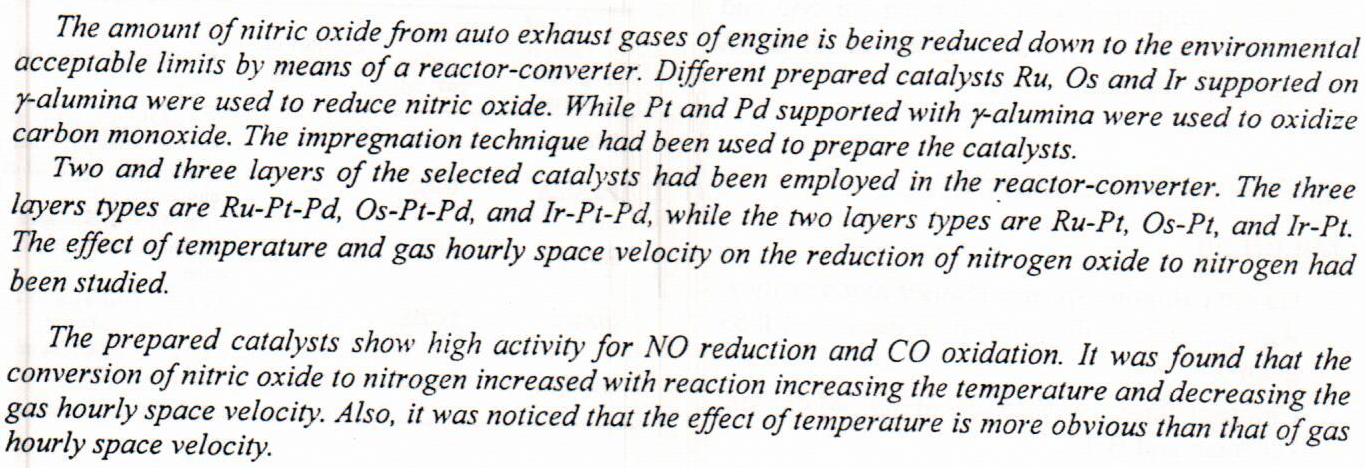
Catalytic Reduction of Nitric Oxide in Automobile Exhaust Gases

Dental implants can be made of various materials, and amongst them, titanium and titanium alloy were the materials of choice for dental implants for many years because of their biocompatibility. The two alloys have a high level of biocompatibility, a lower modulus of elasticity, and better corrosion resistance than other alloys. Thus, they are frequently utilized in biomedical applications and mostly replace stiff fabrics. The latest advances in a new strontium oxide–cp titanium composite alloy are the main topic of this research. With regard to biomedical applications, additions of strontium oxide were synthesized at three distinct weight percentages (2%, 4%, and 6% by wt%). Powder metallurgy was used to create the alloys, which
... Show More (4)
(4)
 (4)
(4)



In this research, a novel synthesis of CaONPs has been developed via an environmentally friendly, green method. Garlic extract (Allium sativum) was used as a green-reducing and stabilizing agent for CaONPs. The average particle size of CaONPs was approximately 24.42 nm. The synthesized CaONPs were identified by using Fourier transform infrared (FT-IR) spectroscopy, U.V.-vis spectrum, X-ray diffraction (XRD), Field Emission-Scanning Electron Microscopy (FE-SEM), Transmission Electron Microscopy, transmission electron microscopy (TEM), Energy Dispersive X-ray spectroscopy (EDX), Atomic Force Microscopy (AFM), and zeta potential (Zp) analysis. The current study highlights the notable applications for CaONPs. First, an antimicrobial assay revea
... Show More
(4)
(4)
(12)
(10)
A competitive adsorption of Cu2+, Ni2+, and Cd2+ ions from a synthetic wastewater onto nanomaterial was studied.(Fe3O4) nanoparticles obtained from US Research Nanomaterials, Inc., Houston, TX 77084, (USA), was used as nanosorbent. Experimental parameters included pH, initial metal concentrations, and temperature were studied for nanosorbent. The uptake capacity 11.5, 6.07 and 11.1 mg/g for Cu2+, Ni2+and Cd2+, respectively, onto nanosorbent . The optimum pH values was 6 and the contact time was 50 min. for Cu2+, Ni2+and Cd2+, respectively. The equilibrium isotherm for
... Show MoreNano-crystalline iron oxide nanoparticles (magnetite) was synthesized by open vessel ageing process. The iron chloride solution was prepared by mixing deionized water and iron chloride tetrahydrate. The product was characterized by X-Ray, Surface area and pore volume by Brunauer-Emmet-Teller, Atomic Force Microscope (AFM) and Fourier Transform Infrared Spectroscopy(FTIR) . The results showed that the XRD in compatibility of the prepared iron oxide (magnetite) with the general structure of standard iron oxide, and in Fourier Transform Infrared Spectroscopy, it is strong crests in 586 bands, because of the expansion vibration manner related to the metal oxygen absorption band (Fe–O bonds in the crystals of iron ox
... Show MoreFunctionalized-multi wall carbon nanotubes (F-MWCNTs) and functionalized-single wall carbon nanotubes (F-SWCNTs) were well enhanced using CoO Nanoparticles. The sensor device consisted of a film of sensitive material (F-MWCNTs/CoONPs) and (F-SWCNTs/CoO NPs) deposited by drop- casting on an n-type porous silicon substrate. The two sensors perform high sensitivity to NO2 gas at room temperatures. The analysis indicated that the (F-MWCNTs/CoONPs) have a better performance than (F-SWCNTs/CoONPs). The F-SWCNTs/CoONPs gas sensor shows high sensitivity (19.1 %) at RT with response time 17 sec, while F-MWCNTs/CoONPs gas sensor show better sensitivity (39 %) at RT with response time 13 sec. The device shows a very reproducible sensor p
... Show More
(6)
In this study, Zinc oxide nanostructures were synthesized via a hydrothermal method by using zinc nitrate hexahydrate and sodium hydroxide as a precursor. Three different annealing temperatures were used to study their effect on ZnO NSs properties. The synthesized nanostructure was characterized by X-ray diffraction (XRD), field emission scanning electron microscopy (FESEM), Atomic force microscope (AFM), and Fourier Transform Infrared Spectroscopy (FTIR). Their optical properties were studied by using UV -visible spectroscopy. The XRD analysis confirms that all ZnO nanostructures have the hexagonal wurtzite structure with average crystallite size within the range of (30.59 - 34
... Show More
(1)
In this study, aluminum nanoparticles (Al NPs) were prepared using explosive strips method in double-distilled deionized water (DDDW), where the effect of five different currents (25, 50, 75, 100 and 125 A) on particle size and distribution was studied. Also, the explosive strips method was used to decorate zinc oxide particles with Al particles, where Al particles were prepared in suspended from zinc oxide with DDDW. Transmission electron microscopy (TEM), UV-visible absorption spectroscopy, and x-ray diffraction are used to characterize the nanoparticles. XRD pattern were examined for three samples of aluminum particles and DDDW prepared with three current values (25, 75 and 125 A) and three samples prepared with the same currents for zin
... Show More
Indium oxide In2O3 thin films fabricated using thermal evaporation of indium metal in vacuum on a glass substrate at 25oC using array mask, after deposition the indium films have been subjected to thermal oxidation at temperature 400 °C for 1h. The results of prepared Indium oxide reveal the oxidation method as a strong effect on the morphology and optical properties of the samples as fabricated. The band gap (Eg) of In2O3 films at 400 °C is 2.7 eV. Then, SEM and XRD measurements are also used to investigate the morphology and structure of the indium oxide In2O3 thin films. The antimicrobial activity of indium oxide In2O3 thin films was assessed against gram-negative bacterium using inhibition zone of bacteria which improved higher ina
... Show More
(5)