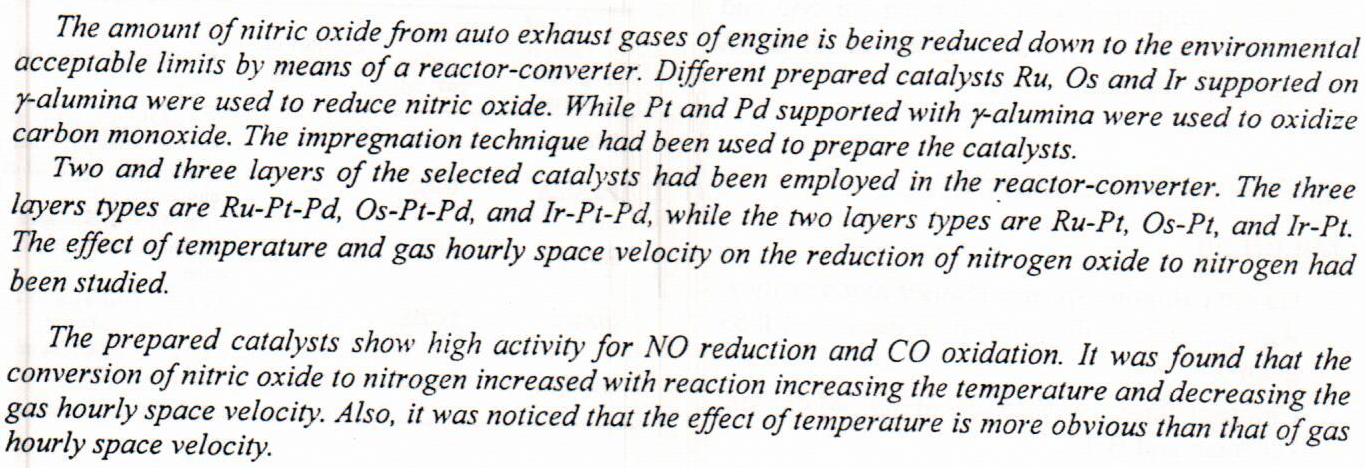
Catalytic Reduction of Nitric Oxide in Automobile Exhaust Gases

The green synthesis of nickel oxide nanoparticles (NiO-NP) was investigated using Ni(NO3)2 as a precursor, olive tree leaves as a reducing agent, and D-sorbitol as a capping agent. The structural, optical, and morphology of the synthesized NiO-NP have been characterized using ultraviolet–visible spectroscopy (UV-Vis), X-ray crystallography (XRD) pattern, Fourier transform infrared spectroscopy (FT-IR) and scanning electron microscope (SEM) analysis. The SEM analysis showed that the nanoparticles have a spherical shape and highly crystalline as well as highly agglomerated and appear as cluster of nanoparticles with a size range of (30 to 65 nm). The Scherrer relation has been used to estimate the crystallite size of NiO-NP which ha
... Show More (33)
(33)
 (28)
(28)



Objectives: The study aims at identifying the nurses’ knowledge about peritoneal dialysis complications, to
construct an education program for nurses in peritoneal dialysis units, to determine the effectiveness of the
education program upon the nurses' knowledge about complications of peritoneal dialysis, and to identify the
relationship between the nurses’ knowledge and their demographic characteristics of level of education and
years of experience.
Methodology: A quasi-experimentai study was carried out at the peritoneal dialysis units of Baghdad teaching
hospitals, from April 2004 to April 2006.
٨ purposive sample of (50) nurse was selected from Baghdad teaching hospitals. These nurses working at the
perit
Background: One of the most important complications of fixed orthodontic treatment is formation of white spots, which are initial carious lesions. Addition of antimicrobial agents into orthodontic adhesive material might be wise solution for prevention of white spots formation. The aim of this study was to evaluate the antibacterial properties of orthodontic adhesive primer against S. Mutans after adding the three different types of nanoparticles (Ag, ZnO, or TiO2). Materials and methods: Discs were prepared using empty insulin syringe approximately 2 mm×2 mm rounded in shape specimens (40 discs) were divided into four groups (ten discs for each group): The first group was the control (made from primer only), the second group (10 dis
... Show More
(16)
(14)
This paper presents a comparison between the electroencephalogram (EEG) channels during scoliosis correction surgeries. Surgeons use many hand tools and electronic devices that directly affect the EEG channels. These noises do not affect the EEG channels uniformly. This research provides a complete system to find the least affected channel by the noise. The presented system consists of five stages: filtering, wavelet decomposing (Level 4), processing the signal bands using four different criteria (mean, energy, entropy and standard deviation), finding the useful channel according to the criteria’s value and, finally, generating a combinational signal from Channels 1 and 2. Experimentally, two channels of EEG data were recorded fro
... Show More
(13)
(12)
(1)
(1)
The increase globally fossil fuel consumption as it represents the main source of energy around the world, and the sources of heavy oil more than light, different techniques were used to reduce the viscosity and increase mobility of heavy crude oil. this study focusing on the experimental tests and modeling with Back Feed Forward Artificial Neural Network (BFF-ANN) of the dilution technique to reduce a heavy oil viscosity that was collected from the south- Iraq oil fields using organic solvents, organic diluents with different weight percentage (5, 10 and 20 wt.% ) of (n-heptane, toluene, and a mixture of different ratio
... Show More
(6)
Background: The potential use of zinc oxide and other metal oxide nanoparticles in biomedical are gaining interest in the scientific and medical communities, largely due to the physical and chemical properties of these nanomaterials. The present work revealed the effect of zinc oxide nanoparticles (ZnONPs) on the total salivary peroxidase enzyme activity of human saliva in comparison to de-ionized water. Materials and methods: Forty eight unstimulated saliva samples were collected from dental students/University of Baghdad 18-22 years. Then measure the total salivary peroxidase activity first without any addition to human saliva as a control, second with dilution the saliva with de-ionized water, and third with zinc oxide nanoparticles in c
... Show More
We have studied the effect of applying an external magnetic field on the characteristics of iron oxide (IO) nanoparticles (NPs) synthesized by pulsed laser ablation in dimethylformamide (DMF). The NPs synthesized with and without applying of magnetic field were characterized by Fourier transformation infrared spectroscopy (FT-IR), UV–Vis absorption, scanning electron microscope (SEM), atomic force microscope (AFM), and X-ray diffraction (XRD). SEM results confirmed that the particle size was decreased after applying magnetic field.
(17)
(19)
Promoting the production of industrially important aromatic chloroamines over transition-metal nitrides catalysts has emerged as a prominent theme in catalysis. This contribution provides an insight into the reduction mechanism of p-chloronitrobenzene (p-CNB) to p-chloroaniline (p-CAN) over the γ-Mo2N(111) surface by means of density functional theory calculations. The adsorption energies of various molecularly adsorbed modes of p-CNB were computed. Our findings display that, p-CNB prefers to be adsorbed over two distinct adsorption sites, namely, Mo-hollow face-centered cubic (fcc) and N-hollow hexagonal close-packed (hcp) sites with adsorption energies of −32.1 and −38.5 kcal/mol, respectively. We establish that the activation of nit
... Show More
(18)
(18)