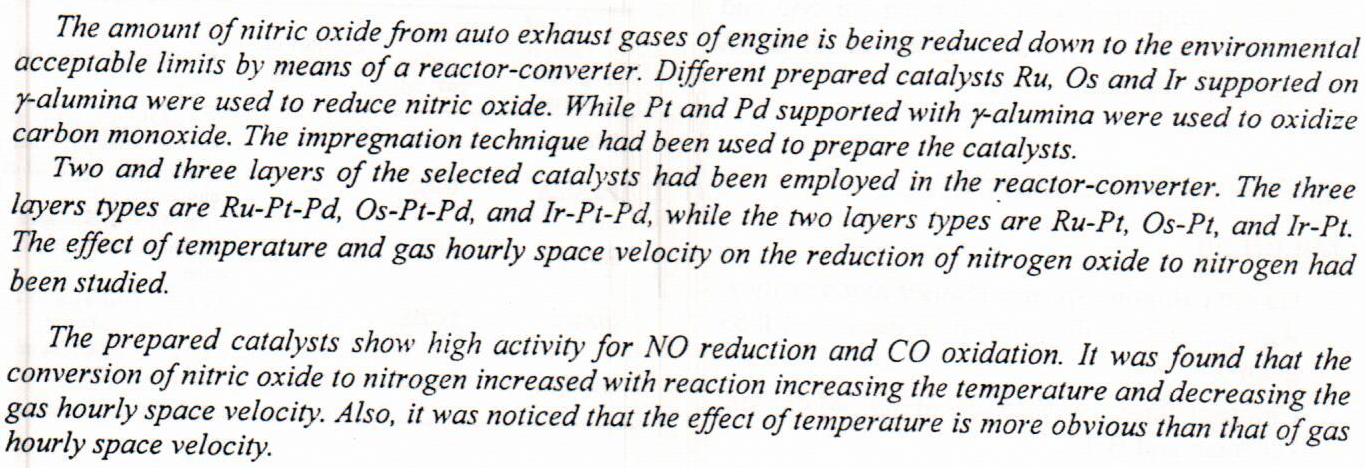
Catalytic Reduction of Nitric Oxide in Automobile Exhaust Gases

An electrolytic process for the removal of Zn(II) from aqueous solution using a parallel amalgamated copper screens cathode operated in the flow through mode is proposed. The current-potential curves recorded at a rotating amalgamated copper disc electrode were used to determine diffusion coefficient of Zn(II). The performance of electrolytic reactor was investigated by using different flow rates at initial zinc ion concentration(48 mg/L). Taking into account the residential Zn(II) concentration, the best results were obtained for cathode potential of (-1.35 V vs. SCE) at flow rate (320 L/h). Zinc ion concentration was found to decrease from 48 mg/L to 1 mg/L during 120 min. of electrolysis. The experimental data are well correlate
... Show More
Graphene oxide (GO) was prepared from graphite (GT) with Hammer method, the GO was reduced with hydrazine hydrate to produce a reduced graphene oxide (RGO). The RGO was reacted with thiocarbohydrazide (TCH) to functionalize the RGO with 4-amino-3-symbol-1h-1, 2, 4-triazol-5 (4H) –thion group and to obtain (RGOT). All the prepared nanomaterial and the product of the functionalization RGOT were characterized with Fourier transformer infrared (FT-IR) spectroscopy, X-ray diffraction (XRD) analysis. RGOT mixed with ultrasonic device at different pH values of phosphate buffer solution (PBS), the mixture used to modifying a screen printed carbon electrodes SPCE and with cyclic voltammetry the sensitivity of selectivity of the new modifying elect
... Show More (10)
(10)
 (7)
(7)

Background: Radial neck fractures in children account for 5 to 10% of all elbow fractures in children. They are extra-articular fractures of the radius proximal to the bicipital tuberosity. The physis is typically involved as a Salter-Harris I or II pattern. Alternatively, the fracture sometimes is extraphyseal, through the metaphysis. In children there is considerable potential for remodeling after these fractures. Up to 30° of radial head tilt and up to 3 mm of transverse displacement are acceptable. Many modalities of treatment are available regarding Surgical &Non-Surgical treatments. Objectives: To evaluate the functional outcome after surgical percutaneous joystick reduction therapy of severely angulated radial neck fracture i
... Show MoreBackground: Radial neck fractures in children account for 5 to 10% of all elbow fractures in children. They are extra-articular fractures of the radius proximal to the bicipital tuberosity. The physis is typically involved as a Salter-Harris I or II pattern. Alternatively, the fracture sometimes is extraphyseal, through the metaphysis. In children there is considerable potential for remodeling after these fractures. Up to 30° of radial head tilt and up to 3 mm of transverse displacement are acceptable. Many modalities of treatment are available regarding Surgical &Non-Surgical treatments. Objectives: To evaluate the functional outcome after surgical percutaneous joystick reduction therapy of severely angulated radial neck fracture i
... Show MoreTemporomandibular Disorders (TMD) refer to a group of symptoms where pain is the most leading cause to demand a treatment by the patient. Light therapies are of great importance at current times due to its biosafety and non-invasive quality when used for the management of TMD symptoms. This study aimed to evaluate the efficacy of red LED light with low-level LASER in treating TMD patients.
A double-blind randomized clinical study was conducted and included 60 patients along 3 groups (20 for e
(18)
Removing hazardous organic pollutants, such as 4-nitrophenol (4-NP) and Congo red (CR) dyes from aqueous media and CO2 from the atmospheric medium remains a significant challenge. Herein, we report a facile in-situ synthetic approach for fabricating CuO-ZnO heterostructure photocatalysts through the surfactant-assisted co-precipitation method. The catalytic results demonstrate that the Cu1O-ZnO photocatalyst exhibits excellent activity under direct sunlight irradiation, owing to the heterostructure formation between the CuO and ZnO. The Cu1O-ZnO photocatalyst showed higher reaction rate constant (k) values of 0.20 min−1 for 4-NP and 0.09 min−1 for CR compared to previous reports. Additionally, efficient CO2 reduction was also achiev
... Show More
(2)
Anaerobic digestion (AD) is the most common process for dealing with primary and secondary wastewater sludge. In the present work, four pre-treatment methods (ultrasonic, chemical, thermal, and thermo-chemical) are investigated in Al-Rustumya Wastewater Treatment plant in order to find their effect on biogas production and volatile solid removal efficiency during anaerobic digestion.
Two frequencies of ultrasonic wave were used 30 KHz and 50 KHz during the pre-treatment. Sodium hydroxide was added in different amounts to give three pH values of 9, 10 and 11 in chemical pre-treating processes. The sludge was heated at 60oC and 80oC through thermal pre-treatment experiment. Also, the sludge was treated thermo-chemically at 80 oC and pH
(2)

This work deals with the production of light fuel cuts of (gasoline, kerosene and gas oil) by catalytic cracking treatment of secondary product mater (heavy vacuum gas oil) which was produced from the vacuum distillation unit in any petroleum refinery. The objective of this research was to study the effect of the catalyst -to- oil ratio parameter on catalytic cracking process of heavy vacuum gas oil feed at constant temperature (450 °C). The first step of this treatment was, catalytic cracking of this material by constructed batch reactor occupied with auxiliary control devices, at selective range of the catalyst –to- oil ratio parameter ( 2, 2.5, 3 and 3.5) respectively. The conversion of heavy vacuum gas
... Show More