Study of the Factors Affecting the Efficiency of Reverse Osmosis Process

This study was concerned with using ozone gas in drinking water treatment plant at Ibn-Sina Company. The main purpose of this research is to find the best contactor for ozone unit proposed. An investigation was conducted to study the absorption of ozone by water in two type of absorber. The effects of the process variables (such as height of water column, contact time, and pH) on the amount of ozone absorbed were investigated. Box-Wilson central composite rotatable design is used to design the experimental work for the mentioned variables. It was found that the optimum value of the variables studied was:
i) Height of water column (90 cm)
ii) Contact time (17-18 min)
iii) PH (7 - 7.5)
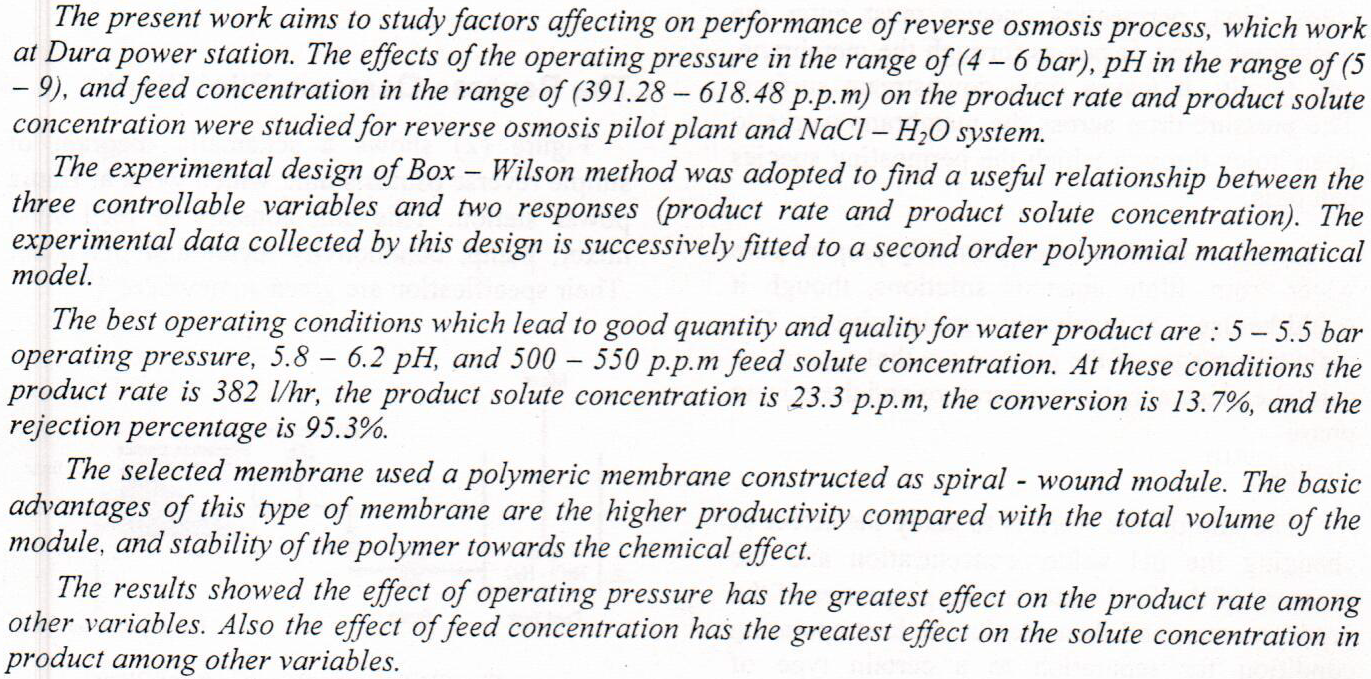
The increasing drinking water demand in many countries leads to an increase in the use of desalination plants, which are considered a great solution for water treatment processes. Reverse osmosis (RO) and electro-dialysis (ED) systems are the most popular membrane processes used to desalinate water at high salinity. Both systems work by separating the ionic contaminates and disposing of them as a brine solution, but ED uses electrical current as a driving force while RO uses osmotic pressure. A direct comparison of reverse osmosis and electro-dialysis systems is needed to highlight process development similarities and variances. This work aims to provide an overview of previous studies on reverse osmosis and electro-dial
... Show More (22)
(22)
 (22)
(22)


Raising children occupies a prominent place in Islam as a step paving the way for the success of reform projects on the level of diverse human life, and for this reason the recommendation for education was mentioned in the mission entrusted to the Prophet (PBUH), the Almighty said:
(( هُوَ الَّذِي بَعَثَ فِي الْأُمِّيِّينَ رَسُولًا مِّنْهُمْ يَتْلُو عَلَيْهِمْ آيَاتِهِ وَيُزَكِّيهِمْ وَيُعَلِّمُهُمُ الْكِتَابَ وَالْحِكْمَةَ وَإِن كَانُوا مِن قَبْلُ لَفِي ضَلَالٍ مُّبِينٍ)) Jumaa verse /38
The topic of the research that is in your hands deals with the
... Show MoreThe present work aims to study the removal of dyes from wastewater by reverse osmosis process. Two dyes were used direct blue 6, and direct yellow. Experiments were performed with feed concentration (75 – 450 ppm), operation temperature (30 – 50 oC) and time (0.2 – 2.0 hr). The membrane used is thin film composite membrane (TFC). It was found that modal permeate concentration decreases with increasing feed concentration and time operating, while permeate concentration increases with increasing feed temperature. Also it was found that product rate increase with increasing temperature, but it decrease with increasing feed concentration and time. The concentration of reject solution showed an increase with increasing feed concentratio
... Show MoreThe aim of this study was to investigate the effect of operating variables on, the percentage of removed sludge (PSR) obtained during re-refining of 15W-40 Al-Durra spent lubricant by solvent extraction-flocculation treatment method. Binary solvents were used such as, Heavy Naphtha (H.N.): MEK (N:MEK), H.N. : n-Butanol (N:n-But), and H.N. : Iso-Butanol (N:Iso:But). The studied variables were mixing speed (300-900, rpm), mixing time (15-60, min), and operating temperature (2540, oC). This study showed that the studied operating variables have effects where, increasing the mixing time up to 45 min for H.N.: MEK, H.N.: n-Butanol and 30 min for H.N.: Iso-Butanol increased the PSR, after that percentage was decreased; increasing the
... Show More
(2)
The aim of this study was to investigate the effect of operating variables on, the percentage of removed sludge (PSR) obtained during re-refining of 15W-40 Al-Durra spent lubricant by solvent extraction-flocculation treatment method. Binary solvents were used such as, Heavy Naphtha (H.N.): MEK (N:MEK), H.N. : n-Butanol (N:n-But), and H.N. : Iso-Butanol (N:Iso:But). The studied variables were mixing speed (300-900, rpm), mixing time (15-60, min), and operating temperature (2540, oC). This study showed that the studied operating variables have effects where, increasing the mixing time up to 45 min for H.N.: MEK, H.N.: n-Butanol and 30 min for H.N.: Iso-Butanol increased the PSR, after that percentage was decreased; increasing t
... Show MoreThis paper was aimed to study the efficiency of forward osmosis (FO) process as a new application for the treatment of wastewater from textile effluent and the factors affecting the performance of forward osmosis process.
The draw solutions used were magnesium chloride (MgCl2), and aluminum sulphate (Al2 ( SO4)3 .18 H2O), and the feed solutions used were reactive red, and disperse blue dyes.
Experimental work were includes operating the forward osmosis process using thin film composite (TFC) membrane as flat sheet for different draw solutions and feed solutions. The operating parameters studied were : draw solutions concentration (10 – 90 g/l), feed solutions concentration (5 – 30 mg/l), draw solutions flow rate (10 – 50 l/hr
(3)
Carbamazepine is an anticonvulsant agent which acts on the central nervous system and used for the treatment of epilepsy. Carbamazepine was formulated as an oral extended release tablets using ethyl cellulose as retardant substance. Different types of tablets additives such as cellulose materials (sodium carboxymethyl cellulose and microcrystalline cellulose ), lactose, calcium phosphate and solubilizing agents ( sodium lauryl sulphate and polyethylene glycol 6000) were utilized to study their effect on the release profile of drug from ethyl cellulose matrices. It was found that sodium carboxymethyl cellulose increased the carbamazepine release and the same effect was obtained when the same amount of microcrystalline cellulose used
... Show More
