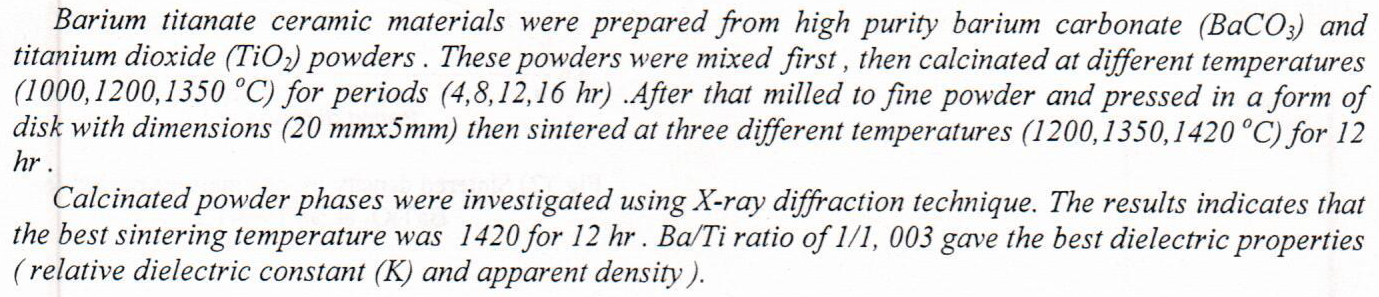
Preparation, Characterization, and Properties of Barium Titanate

Nanocomposite was prepared using unsaturated polyester (UP) resin as a matrix and graphene nanoparticles as a reinforcement material in six percentage weights (0, 0.1, 0.2, 0.3, 1 and 1.5%). Mechanical, calorimetric and thermal studies were performed on the (UP) resin/graphene nanocomposite. All tests showed a clear improvement of all mechanical properties examined (hardness, flexural strength (F.S), impact strength (I.S) and tensile strength (T.S)) with increasing graphene percentage. In addition, the temperature of glass transition and thermal conductivity of this composite increased with increasing graphene content.
 (5)
(5)
 (4)
(4)


Therapeutically and prophylactically using Microspheres containing doxycycline isolated from shell of shrimp. Low molecule weight poly lactic acid was prepared. In this study, Poly lactic acid (PLA)/ poly vinyl alcohol (PVA)/poly ethyleneglycol(PEG) loading doxycycline blend solutions was prepared. Also Poly lactic acid (PLA)-Tannin blend via solvent evaporation method was prepared. Microspheres of chitosan/gelatin microsphere loading doxycycline was prepared by emulsion crosslinking technique. Both microsphere and blends were characterized by Fourier transform infrared (FTIR) spectrophotometer. The FTIR spectra were shown distinguish bands. The in vitro release of doxcycline from its matrix at pH 7 was studied. The prophylactic
... Show More
The composites were manufactured and study the effect of addition of filler (nanoparticles SiO2 treated with silane) at different weight ratios (1, 2, 3, 4 and 5) %, on electrical, mechanical and thermal properties. Materials were mixed with each other using an ultrasound, and then pour the mixture into the molds to suit all measurements. The electrical characteristics were studied within a range of frequencies (50-1M) Hz at room temperature, where the best results were shown at the fill ratio (1%), and thermal properties at (X=3 %), the mechanical properties at the filler ratio (2%).
(11)
ZnTe possesses the proper optoelectronic properties as a candidate for device development. The structure and optical properties of ZnTe semiconductor thin films of 500 nm were studied using thermal evaporation technique. The influence of annealing temperatures on ZnTe thin films in the range ( R.T - 473 K). XRD and surface morphological analyses are used to examine the films. The ZnTe films are comparatively polycrystalline and cubic in phase, according to the XRD analysis. with a lattice constant of 0.61 nm upon an (111) orientation. The intensities of all the peaks rapidly increase though they show the same tendencies; it shows the crystallinity of the films becomes higher crystal size diameters (from 8.41 to 12.18nm) both increas
... Show More
4-methylaniline and its Schiff base derivative were intercalated into the Bentonite clay interlayers in a solid state reaction followed by a condensation reaction to produce two organo-clay composites. X-ray diffraction was used to identify the changes in basal spacing of montmorillonite layers which exhibited noticeable alteration before and after the formation of the composites. FT-IR spectra, on the other hand, were utilized for identifying the structural compositions of the prepared materials as well as the formation of the intercalated Schiff base derivative. The surface morphology of the composites was examined by Scanning Electron Microscopy SEM and Atomic Force Microscope AFM, which reflected some differences in the surface of prepa
... Show More
(2)

To learn how the manner of preparation influences film development, this study examined film expansion under a variety of deposition settings. To learn about the membrane’s properties and to ascertain the optimal pretreatment conditions, which are represented by ambient temperature and pressure, Laser pressure of 2.5[Formula: see text]m bar, the laser energy density of 500[Formula: see text]mJ, distortion ratio ([Formula: see text]) as a function of laser pulse count, all achieved with the double-frequency Nd: YAG laser operating in quality-factor mode at 1064[Formula: see text]nm. MgxZn[Formula: see text] films of thickness [Formula: see text][Formula: see text]nm were deposited on glass substrates at pulse
... Show More
(2)
(1)
Polycrystalline ingots of cadmium telluride have been synthesized using the direct
reaction technique, by fusing initial component consisting from pure elements in
stoichiometric ratio inside quartz ampoule is evacuated 10-6 torr cadmium telluride has
been grown under temperature at (1070) oC for (16) hr. was used in this study, the phases
observed in growing CdTe compound depend on the temperature used during the growth
process. Crystallography studies to CdTe compound was determined by X-ray diffraction
technique, which it has zinc blend structure and cubic unit cell, which lattice constants is
a=6.478
oA
In this study, polymeric composites were prepared from unsaturated polyester as a base material with glass powder (fluorescent) in different weight ratios (4, 6, 8, 10,and 11%) as a support material and after comparison before and after reinforcement of the prepared composites, an increase was found. In the values of mechanical properties (hardness, compressive strength), the shock resistance values decreased, but an increase in temperature leads to an increase in the values of shock resistance, as well as the values of compressive strength And it reduces the hardness value.
Due to the advantages over other metallic materials, such as superior corrosion resistance, excellent biocompatibility, and favorable mechanical properties, titanium, its alloys and related composites, are frequently utilized in biomedical applications, particularly in orthopedics and dentistry. This work focuses on developing novel titanium-titanium diboride (TiB2; ceramic material) composites for dental implants where TiB2 additions were estimated to be 9 wt.%. In a steel mold, Ti-TiB2 composites were fabricated using a powder metallurgy technique and sintered for five hours at 1200 °C. Microstructural and chemical properties were analyzed by energy dispersive X-ray spectroscopy (EDX), scanning electron microscopy (SEM), and X-ra
... Show More
(3)
(3)