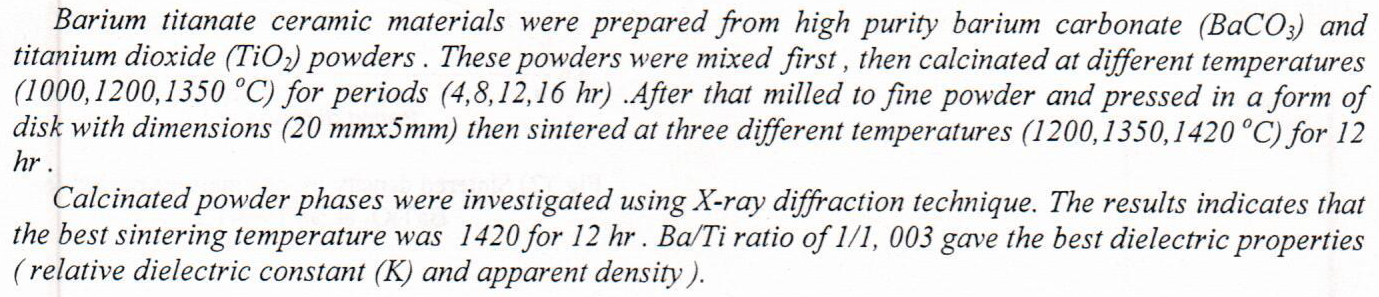
Preparation, Characterization, and Properties of Barium Titanate

A study of characteristics of the lubricant oils and the physical properties is essential to know the quality of lubricant oils. The parameters that lead to classify oils have been studied in this research. Three types of multi-grades lubricant oils were applied under changing temperatures from 25 oC to 78oC to estimate the physical properties and mixture compositions. Kinematic viscosity, viscosity gravity constant and paraffin (P), naphthenes (N) and aromatics (A) (PNA) analysis are used to predict the composition of lubricants oil. Kinematic viscosity gives good behaviors and the oxidation stability for each lubricant oils. PNA analysis predicted fractions of paraffin (XP), naphthenes (XN),
... Show More (2)
(2)

This study was conducted in an orchard pomegranate's Department of Horticulture College of Agriculture, University of Baghdad for two seasons 1999-2000 on cultivars pomegranate Salimi and narrators seedless to study the effect spraying Nizant growth in sex ratio of flowers and recipes flowering and winning was selected 27 trees per class 15 years old planted
The effect of annealing on the structural and optical properties of Antimony trisulfide (Sb2S3) is investigated. Sb2S3 powder is vaporized on clean glass substrates at room temperature under high vacuum pressure to form thin films. The structural research was done with the aid of X-ray diffraction (XRD) and atomic force microscopy (AFM). The amorphous to the polycrystalline transformation of these thin films was shown by X-ray diffraction analysis after thermal annealing. These films' morphology is explained. The absorption coefficient and optical energy gap of the investigated films are calculated using transmission spectra. Both samples have strong absorption in the visible spectrum, according to UV-visible absorption spectra. The optical
... Show More (5)
(2)
(5)
(2)

ABSTRACT: Thin film of CdS has been deposited onto clean glass substrate by using Spray pyrolysis technique. Results of Morphological (AFM) studied; electrical properties and optical conductivity studied are analysis. AFM results show a crystalline nature of the films. From the conductivity measurement at different temperatures, the activation energy of the films was calculated and found to be between 0.188 - 0.124 eV for low temperature regions, and between 1.67-1.19eV for high temperature regions. Hall measurements of electrical properties at room temperature show that the resistivity and mobility of CdS polycrystalline films deposited at 400 C0, were 3.878x10³ . cm and 1.302x104cm2/ (V.s), respectively. The electrical conductivity of th
... Show MoreCadmium Oxide and Bi doped Cadmium Oxide thin films are prepared by using the chemical spray pyrolysis technique a glass substrate at a temperature of (400?C) with volumetric concentration (2,4)%. The thickness of all prepared films is about (400±20) nm. Transmittance and Absorbance spectra are recorded in the wave length ranged (400-800) nm. The nature of electronic transitions is determined, it is found out that these films have directly allowed transition with an optical energy gap of (2.37( eV for CdO and ) 2.59, 2.62) eV for (2% ,4%) Bi doped CdO respectively. The optical constants have been evaluated before and after doping.
(8)
Functionally graded materials (FGMs), with ceramic –ceramic constituents are fabricated using powder technology techniques. In this work three different sets of FGMs samples were designed in to 3 layers, 5 layers and 7 layers. The ceramic constituents were represented by hard ferrite (Barium ferrite) and soft ferrite (lithium ferrite). All samples sintered at constant temperature at 1100oC for 2 hrs. and characterized by FESEM. Some physical properties were measured for fabricated FGMs include apparent density, bulk density, porosity, shrinkage and hardness. The results indicated that the density increase with the increase the number of layer. Lateral shrinkage is one of the important parameter f
... Show More
(1)
The aim of this paper, study the effect of carbon nanotubes on the electrical properties of polyvinylchloride. Samples of polyvinylchloride carbon nanotubes composite prepared by using hot press technique. The weight percentages of carbon nanotubes are 0,5,10 and 20wt.%. Results showed that the D.C electrical conductivity increases with increasing of the weight percentages of carbon nanotubes. Also, the D.C electrical conductivity changed with increase temperature for different concentrations of carbon nanotubes. The activation energy of D.C electrical conductivity is decreased with increasing of carbon nanotubes concentration.
n this study, Cr−Mo−N thin films with different Mo contents were synthesised via closed field unbalanced magnetron sputtering ion plating. The effects of Mo content on the microstructure, chemical bonding state, and optical properties of the prepared films were investigated by X-ray diffraction spectroscopy (XRD), X-ray photoelectron spectroscopy (XPS), field emission scanning electron microscopy, and ultraviolet-visible spectrophotometry. XRD results determined the face centered cubic (fcc) structure of pure CrN film. The incorporation of molybdenum (Mo) in the CrN matrix was confirmed by both XRD and XPS analyses. The CrMoN coatings demonstrate various polycrystalline phases including CrN, γ-Mo2N, Cr with oxides layers of MoO3, CrO3,
... Show More
(4)
(4)

In this study miconazole nitrate was formulated as topically applied emulgel; different formulas were prepared using sodium carboxymethylcellulose (SCMC) and carboxypolymethylene (carbomer 941) as gelling agents. The influence of type of gelling agent and concentration of both oil phase and emulsifying agent on drug release was studied and compared with commercially available miconazole nitrate cream (Mecozalen®). The results of in vitro release showed that SCMC emulgel bases gave better release than carbomer 941 bases and the release of drug increase from both bases as a function of increasing the concentration of emulisifying agent. The oil phase had retardation effect when
... Show More
(7)