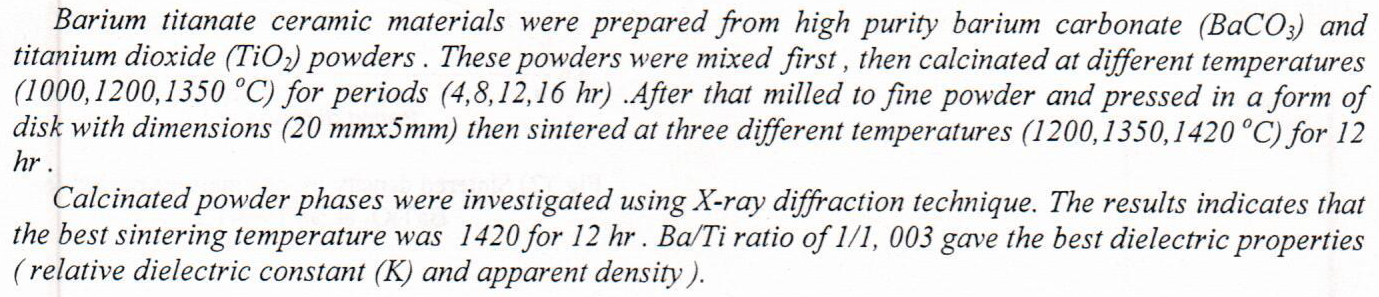
Preparation, Characterization, and Properties of Barium Titanate

ABSTRACT
Naproxen(NPX) imprinted liquid electrodes of polymers are built using polymerization precipitation. The molecularly imprinted (MIP) and non imprinted (NIP) polymers were synthesized using NPX as a template. In the polymerization precipitation involved, styrene(STY) was used as monomer, N,N-methylenediacrylamide (N,N-MDAM) as a cross-linker and benzoyl peroxide (BPO) as an initiator. The molecularly imprinted membranes and the non-imprinted membranes were prepared using acetophenone(AOPH) and di octylphathalate(DOP)as plasticizers in PVC matrix. The slopes and detection limits of the liquid electrodes ranged from)-18.1,-17.72 (mV/decade and )4.0 x 10-
... Show MoreIn this work, the role of s ubs trate temperature in the range (293-423)K on the structure and microstructure of CuInSTe thin films was investigated. The results showed that the structure was amorphous for films prepared at ambient temperature Ts=293Kwhile it was polycrys talline for films prepared at high temperature. The grain s ize and roughness increased with increasing substrate temperature. The frequency and temperature dependencies upon AC conductivity were investigated in the frequency range 100Hz-10MHz and temperature of heat treatment in the range of 303-453K. The AC activation energy was found to increase from 0.1132 to 0.1258 eV with increas ing s ubs trate temperature from 293 to 423K and decreas e to 0.0962 eV with inc
... Show More (6)
(6)


Avery large numbers of articles are made by powder metallurgical methods using electrolytically reduced metal powders. Iron powder is one of these powders which play an important role in this field. Its preparation by electrolytic method is economic in comparison with the traditional methods (Atomization and carbonyl processes).
An electrochemical cell consisting of two electrodes (stainless steel cathode and iron anode, 99.9%) was used to study the electrolytic preparation of iron powder with particle size less than 106µm directly as powde1y form. Ferrous sulphate electrolyte was used containing sodium chloride as a stabilizing agent. The produced powder was thoroughly washed with an acidified distilled water and absolute ethan
... Show More
(10)
 (7)
(7)
In this work, an anti-reflection coating was prepared in the region (400-1000) nm of wavelength, with a double layer of silicon dioxide (SiO2) as an inner layer and the second layer of the mixture (SiO2) and titanium dioxide (TiO2) with certain ratios, as an outer layer using the chemical spraying method with a number of 6 sprays of layer SiO2 and 12 sprays of layer SiO2 - TiO2. Using the method of chemical spraying deposited on the glass as a substrate with a different number of sprays of SiO2, and a fixed number of TiO2-SiO2. The optical and structural properties were determined using UV-Vis spectroscopy and atomic force mi
... Show More
(7)
This study aims at recognizing the levels of comprehension of the students of basic schools to the concepts of mathematical geometric and discovering the existing of the differences among students in the level of understanding of the concepts of mathematical geometrical which is due to the change of gender.
The sample of the study is the students of Basic schools, eight level in the basic school of Erbil city, particularly 7-8-and 9 levels in the academic year 2013-2014. The sample consists of 444 students in both genders238 males and 206 females.
The tool of the study is test sheet included 20 items of multiple choice. The items are valid since are given to a jury of expert
... Show MoreColloidal silver nanoparticles were prepared by single step green synthesis using aqueous extracts of the leaves of thyme as a function of different molar concentration of AgNO3 (1,2,3,4 mM(. The Field Emission Scanning Electron Microscopy (FESEM), UV-Visible and X-ray diffraction (XRD) were used to characterize the resultant AgNPs. The surface Plasmon resonance was observed at wavelength of 444 nm. The four intensive peaks of XRD pattern indicate the crystalline nature and the face centered cubic structure of the AgNPs. The average crystallite size of the AgNPs ranged from 18 to 22 nm. The FESEM image illustrated the well dispersion of the AgNPs and the spherical shape of the nanoparticles with a particle size distribution be
... Show More
(15)
(6)

Alumina thin films have significant applications in the areas of optoelectronics, optics, electrical insulators, sensors and tribology. The novel aspect of this work is that the homogeneous alumina thin films were prepared in several stages to generate a plasma jet. In this paper, aluminium nanoparticles suspended in vinyl alcohol were prepared using exploding wire plasma. TEM analysis was used to determine the size and shape of particles in aluminium and vinyl alcohol suspensions; the TEM images showed that the particle size is 17.2 nm. Aluminium/poly vinyl alcohol (Al/PVA) thin films were prepared using this suspension on quartz substrate by plasma jet technique at room temperature with an argon gas flow rate of 1 L/min. The Al/PV
... Show More
(11)
(7)
Gallium arsenide diamondoids structural and vibrational properties are investigated using density functional theory at the PBE/6-31(d) level and basis including polarization functions. Variation of energy gap as these diamondoids increase in size is seen to follow confinement theory for diamondoids having nearly equiaxed dimensions. Density of energy states transforms from nearly single levels to band structure as we reach larger diamondoids. Bonds of surface hydrogen with As atoms are relatively localized and shorter than that bonded to Ga atoms. Ga-As bonds have a distribution range of values due to surface reconstruction and effect of bonding to hydrogen atoms. Experimental bulk Ga-As bond length (2.45 Å) is within this distribu
... Show More
(10)
(9)
Results of a study of alloys and films with various Pb content have been reported and discussed. Films of of thickness 1.5
(1)
(2)