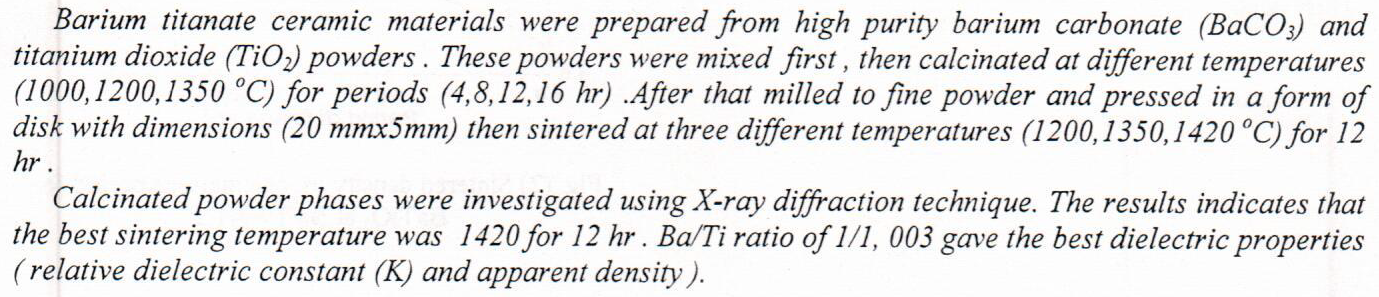
Preparation, Characterization, and Properties of Barium Titanate

Biodegradable polymers have garnered increasing attention as eco-friendly alternatives to conventional petroleum-derived plastics, which pose a global environmental challenge due to their difficult recycling and slow degradation. This study focuses on the preliminary evaluation of surface functional properties of chitosan films reinforced with TiO₂ or ZnO nanoparticles (NPs). These films were prepared at different loading ratios using the solution-casting method. Structural and morphological properties were characterized using FTIR and FESEM, while functional properties were evaluated by surface wettability, UV–Vis spectroscopy, thermogravimetric analysis and antibacterial activity testing. FTIR results showed significant changes in abs
... Show More (1)
 (1)


Recently, many materials have shown that they can be used as alternatives to chemicals materials in order to be used to improve the properties of drilling fluids. Some of these materials are banana peels and corn cobs which both are considered environmentally- friendly materials. The results of the X-ray diffraction examination have proved that the main components of these materials are cellulose and hemicellulose, which contribute greatly to the increasing of the effectiveness of these two materials. Due to their distinct composition, these two materials have improved the rheological properties (plastic viscosity and yield point) and reduced the filtration of the drilling fluids to a large extent. The addition rates used for each o
... Show More
(8)
Denture base materials made using three-dimensional printing (3D printing) have expanded in availability, contributing to the meteoric rise of this innovative dental technique. Despite 3D-printed denture resins having good biocompatibility and esthetics, achieving superior mechanics in these materials is still difficult. This study aimed to find out how adding calcium carbonate (CaCO 3 ) nanoparticles to 3D-printed denture base resin affected its surface hardness, impact strength, and flexural strength. The ninety 3D printed samples were allocated into three groups following the amount of CaCO 3
... Show More
Abstract : Silicone elastomer is widely used as the material of choice for fabricating maxillofacial prosthesis. However, silicone properties are far from ideal; low tear strength, low tensile strength and insufficient elasticity are the most undesirable properties. The purpose of this study was to evaluate the effect of addition of nano SiO2filler on tear strength, tensile strength, elongation at break, hardness and color of Cosmesil M-511 HTV maxillofacial silicone elastomer. Nano SiO2was added to the silicone base in concentrations of 4%, 5% and 6% by weight. Silicone with 0% nano filler served as a control. Tear test was done according to ISO 34-1. Tensile and elongation test was done according to ISO 37. Shore A hardness test was done
... Show More
(12)
The preparation of composite metal oxide to attain high efficiency in removing phenol from wastewater has a great concern. In the present study, the focus would be on adopting antimony-tin oxide coating onto graphite substrates instead of titanium; besides the effect of SbCl3 concentration on the SnO2-Sb2O3 composite would be examined. The performance of this composite electrode as the working electrode in the removal of phenol by sonoelectrochemical oxidation will be studied. The antimony-tin dioxide composite electrode was prepared by cathodic deposition with SnCl2 . 2H2O solution in a mixture of HNO3 and NaNO3, with different concentrations of SbCl3. The SnO2-Sb2O3 deposit layer’s structure and morphology were examined and the 4 g/l Sb
... Show More
(8)
(5)
 (10)
(5)
Four metal compounds mixed ligand of azo dye ligand (L) and metformin.(Met) were produced at aquatic ethanol for (1:1:1) (M:L:Met). The prepared compounds were identified by utilizing atomic absorption flame, FT.IR and UV–Vis spectrum manners as well as conductivity mensuration. These compounds was assayed of the gained datum the octahedral geometry was proposed into whole prepared complexes.Also in this research was studied represented examining the antibacterial and antifungal impact of the azo dye ligand (L), metformin.(Met) and (Co,Ni, Cu and Cd complexes) on four types of pathogenic, clinically isolated bacteria that are resistant to antibiotic, like Staphylococcus aureus, Staphylococcus epidermidis, Escherichia coli, Klebsiella pneu
... Show More
(10)
(5)
New mixed ligand complexes of New Schiff base 4,4'- ((naphthalen-1-ylimino) methylene) dibenzene-1,3-diol and 8-hydroxy quinoline: Synthesis, Spectral Characterization, Thermal studies and Biological Activities
The new 4-[(7-chloro-2,1,3-benzoxadiazole)azo]-4,5-diphenyl imidazole (L) have been synthesized and characterized by micro elemental and thermal analyses as well as 1H.NMR, FT-IR, and UV-Vis spectroscopic techniques. (L) acts as a ligand coordinating with some metal ionsV(IV), Fe(III), Co(II), Ni(II), Cu(II), and Zn(II). Structures of the new compounds were characterized by elemental and thermal analyses as well as FT-IR and UV-Vis Spectra. The magnetic properties and electrical conductivities of metal complexes were also determined. Study of the nature of the complexes formed in ethanol following the mole ratio method.. The work also include a theoretical treatment of the formed complexes in the gas phase, this was done using the (hyperch
... Show More
(3)