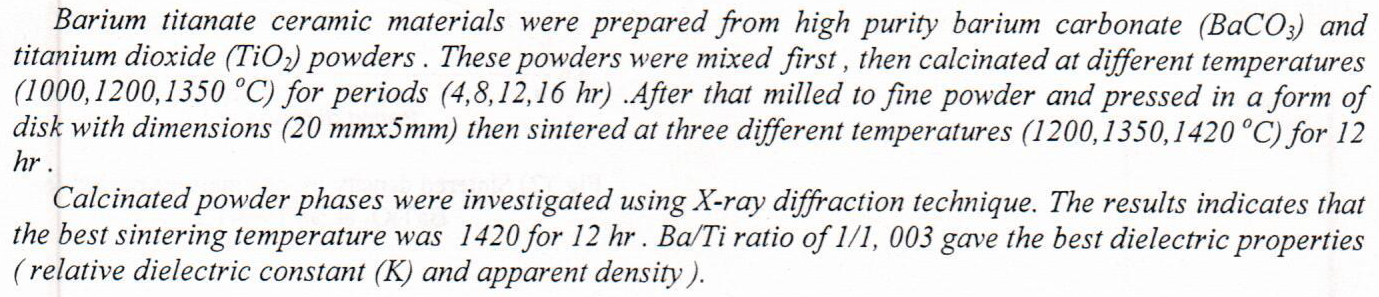
Preparation, Characterization, and Properties of Barium Titanate

This research is focusing on finding more effective polymers that leads to enhance the rheological properties of Water Base Muds. The experiments are done for different types of mud for all substances which are Polyacrylamide, Xanthan gum, CMC (Carboxyl Methyl Cellulose). This study shows the effect of add polymer to red bentonite mud, effect of add polymer to Iraqi bentonite mud, the effect of add bentonite to polymer mud. The mud properties of Iraqi bentonite blank are enhanced after adding the polymers to the blank mix, CMC gives the highest value of plastic viscosity and Gel strength than others; X-anthan gives the highest value of yield point and gel strength than others. For the red bentonite mud, Polyacrylamide has the highes
... Show More (2)
(2)

 (11)
(8)
(11)
(8)


Eco-friendly materials are increasingly used in civil engineering to support sustainable development. Conventional concrete relies heavily on Ordinary Portland Cement (OPC), the production of which contributes significantly to the carbon dioxide (CO₂) emissions. Ground Granulated Blast Furnace Slag (GGBFS) and fly ash can partially replace OPC, thereby reducing the environmental impact. This study investigates the effect of basalt fiber incorporation on the mechanical properties of geopolymer lightweight concrete. The concrete mixtures consisted of fly ash, slag, pumice aggregate, sand, and an alkaline activator prepared by combining sodium hydroxide and sodium silicate. The mix design included an activator-to-binder ratio of 0.45
... Show More
(2)
(2)
(6)
(6)
(20)
A new series of Fe (III) , Co (II) , Ni (II) and Cu (II) complexes of the Schiff base, 5 (2-hydroxy benzylidine) -2-thio ether -1, 3, 4-thiadiazole were prepared and characterized .The imine behaves as a bidentate. The nature of bonding and the stereochemistry of the complexes were deduced from metal analyses, infrared, electronic spectra,magnetic susceptibility and conductivity measurements, an octahedral geometry was suggested for all complexes except the copper complex has a square planar geometry .preliminary in vitro tests for antimicrobial activity show that all the prepared compounds except iron complex display good activity to gram positive Staphelococcus aures and gram negative Escherchia coli.
(10)
(9)
Thin films of (CdO)x (CuO)1-x (where x = 0.0, 0.2, 0.3, 0.4 and 0.5) were prepared by the pulsed laser deposition. The CuO addition caused an increase in diffraction peaks intensity at (111) and a decrease in diffraction peaks intensity at (200). As CuO content increases, the band gap increases to a maximum of 3.51 eV, maximum resistivity of 8.251x 10⁴ Ω.cm with mobility of 199.5 cm2 / V.s, when x= 0.5. The results show that the conductivity is ntype when x value was changed in the range (0 to 0.4) but further addition of CuO converted the samples to p-type.
(9)
(10)
(1)
(1)