Preparation, Characterization, and Properties of Barium Titanate
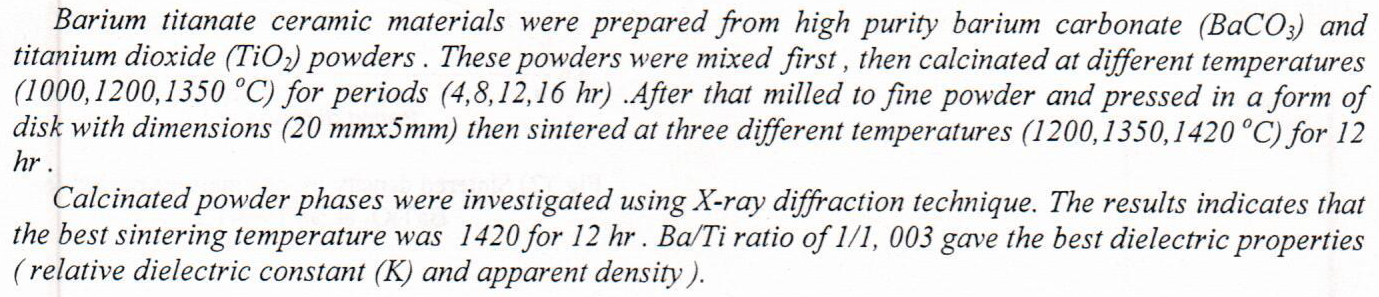

 (6)
(6)
 (4)
(4)

 (7)
(8)
(7)
(8)
The electrochemical polymerization of the monomer sulfanilamide (SAM) in an aqueous solution at room temperature produces polysulfanilamide (PSAM). The Fourier Transform Infrared spectroscopy (FTIR) was used to investigate the properties of the prepared polymer layer that generated on the stainless steel (St.S) surface (working electrode) and Atomic Force Microscope (AFM) was used to characterize the morphology, topology, and detailed surface structure of polymer layer that generated on the surface. The corrosion behavior of uncoated and coated St.S were evaluated by using the electrochemical polarization method in a 0.2 M HCl solution and a temperature range of 293–323 K, the anticorrosion action of the polymer coating on stainless steel
... Show More
(10)

Aims: This study was conducted to assess the effect of the addition of yttrium oxide (Y2O3) nanoparticles on the tensile bond strength, tear strength, shore A hardness, and surface roughness of soft-denture lining material. Materials and Methods: Y2O3 NPs with 1.5 and 2 wt.% were added into acrylic-based heat-cured soft-denture liner. A total of 120 specimens were prepared and divided into four groups according to the test to be performed (tensile bond strength, tear strength, surface hardness, and surface roughness). Results: There was a highly significant increase in tensile bond strength between the soft liner and the acrylic denture base, tear strength, and hardness at both concentrations as compared to the control group, whereas ther
... Show More
(18)
(14)
(25)
(22)
This study investigates the impact of copper sulfate (CuSO4) doping and glycerin plasticization on the structural, electrical, dielectric, and optical properties of poly(vinyl alcohol) (PVA), polyvinyl pyrrolidone (PVP), and glycerin gel polymer electrolytes (GPEs). The GPEs were prepared using a solution casting method with varying CuSO4 concentrations (5 and 10 wt.%). X-ray diffraction analysis revealed the semi-crystalline nature of the polymer blend and also confirmed the presence of CuSO4. Fourier transform infrared spectroscopy confirmed the miscibility of PVA, PVP, and glycerin through interchain hydrogen bonding and indicated the successful incorporation of Cu2+ ions into the polymer blend matrix. The PVA/PVP/glycerin blend containi
... Show More
(3)
(3)
(9)
(5)
(2)
(2)
(19)
(19)