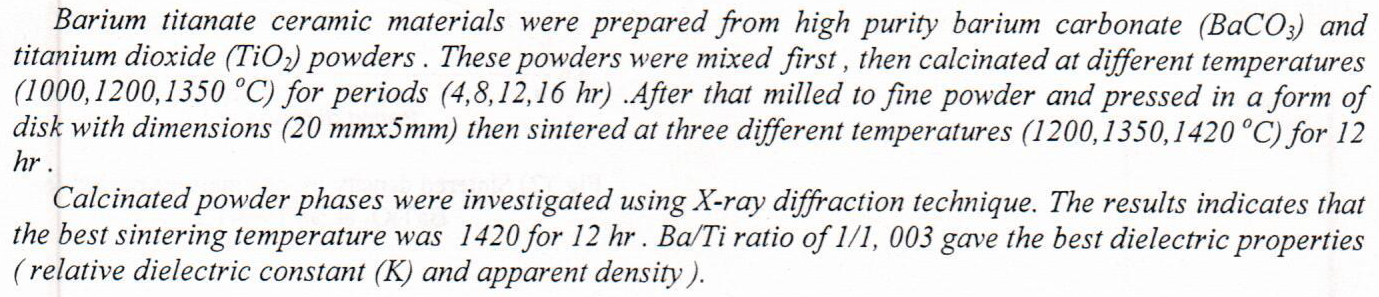
Preparation, Characterization, and Properties of Barium Titanate

In past years, structural pavement solution has been combined with destructive testing; these destructive methods are being replaced by non-destructive testing methods (NDT). Because the destructive test causes damage due to coring conducted for testing and also the difficulty of adequately repairing the core position in the field. Ultrasonic pulse velocity was used to evaluate the strength and volumetric properties of asphalt concrete, of binder course. The impact of moisture damage and testing temperature on pulse velocity has also been studied. Data were analyzed and modeled. It was found that using non-destructive testing represented by pulse velocity could be useful to predict the quality of asphalt c
... Show More (5)
(5)

 (11)
(11)
 (16)
(14)
(16)
(14)
Waste materials might be utilized in various applications, such as sustainable roller compacted concrete pavements (RCCP), to lessen the negative environmental consequences of construction waste. The impacts of utilizing (brick, thermostone, granite, and ceramic) powders on the mechanical characteristics of RCCP are investigated in this study. To achieve this, the waste materials were crushed, grounded, and blended before being utilized as filler in the RCCP. After the mixes were prepared, compressive strength, splitting tensile strength, flexural strength, water absorption, density, and porosity were all determined. According to the research results, adding some of these powders, mainly brick and granite powder, enhances the mechanical
... Show More
(11)
(6)
This study was conducted on the effect of the sedimentary source (the sediments coming from both the Iraqi-Iranian borderline and the Tigris river) on the optical and textural features, especially sphericity and roundness of feldspar minerals (potassium and plagioclase types) in soils of the southern part of the alluvial plain. Eight pedons were selected to represent the study area, five of them represented sediments coming from the borderline, which included pedons of (Badra, Taj Al-Din, Al-Shihabi, Jassan, and Galati), while two of them represent the sediments of the Tigris River (Essaouira, Al-Dabouni), the pedon of Ali Al-Gharbi was represented the mixing area of sediments of all the floods coming from the borderline and the sediments o
... Show More
(3)
This work represents the preparation of the starting material, 3-chloro-2-oxo-1,4-dithiacyclohexane (S) using a new method. This material was reacted with, 4-phenylthiosemicarbazide to give (H3NS3) as a tetradentate ligand H3L. New complex of rhenium (V) with this ligand of the formula [ReO(L)] was prepared. New complexes of the general formula [M(HL)] of this ligand when reacted with some metal ions where: M = Ni(II), Cu(II), Cd(II), Zn(II), Hg(II) have been reported. The ligand and the complexes were characterized by infrared, ultraviolet–visible, mass, 1H nuclear magnetic resonance and atomic absorption spectroscopic techniques and by (HPLC), elemental analysis, and electrical conductivity. The proposed structure for H3L with Re (V) i
... Show More
The reaction of 2-amino benzoic acid with 1,2-dichloroethane under reflux in methanol and KOH as a base to gave the precursor [H4L]. The precursor under reflux and drops of CH3COOH which reacted with (2mole) from salicycaldehyde in methanol to gave a new type N2O4 ligand [H2L], this ligand was reacted with (MCl2) Where [M= Co (II), Ni(II), Cu(II) and Zn(II)] in (1:1) ratio at reflux in methanol using KOH as a base, to give complexes of the general formula [M(L)]. All compounds have been characterized by spectroscopic methods [1H NMR ( just to the ligand), FTIR, uv-vis, atomic absorption], melting point, conductivity, chloride content, as well as magnetic susceptibility measurements. From the above data, the proposed molecular structu
... Show More
(10)
(4)

The compound [L] was produced in the current study through the reaction of 4-aminoacetophenon with 4-methoxyaniline in the cold, concentrated HCl with 10% NaNO2. Curcumin, several transition metal complexes (Ni (II), La (III), and Hg (II)), and compound [L] were combined in EtOH to create new complexes. UV-vis spectroscopy, FTIR, AA, TGA-DSC, conductivity, chloride content, and elemental analysis (CHNS) were used to describe the structure of produced complexes. Biological activities against fungi, S. aureus (G+), Pseudomonas (G-), E. coli (G-), and Proteus (G-) were demonstrated using complexes. Depending on the outcomes of the aforementioned methods, octahedral formulas were given as the geometrical structures for each created comp
... Show More
(3)
The reaction of 2-amino benzoic acid with 1,2-dichloroethane under reflux in methanol and KOH as a base to gave the precursor [H4L]. The precursor under reflux and drops of CH3COOH which reacted with (2mole) from salicycaldehyde in methanol to gave a new type N2O4 ligand [H2L], this ligand was reacted with (MCl2) Where [M= Co (II), Ni(II), Cu(II) and Zn(II)] in (1:1) ratio at reflux in methanol using KOH as a base, to give complexes of the general formula [M(L)]. All compounds have been characterized by spectroscopic methods [1H NMR ( just to the ligand), FTIR, uv-vis, atomic absorption], melting point, conductivity, chloride content, as well as m
... Show More
(2)