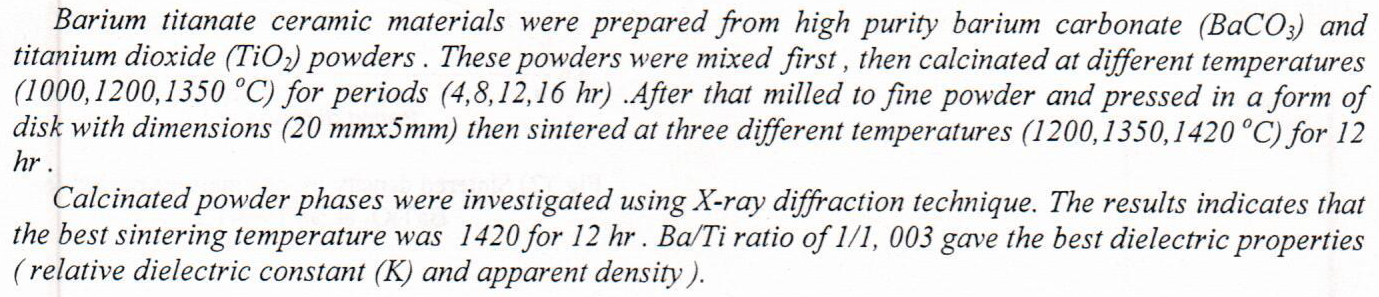
Preparation, Characterization, and Properties of Barium Titanate

This work aimed to study the effect of laser surface treatment on the mechanical characteristics and corrosion behaviour of grey cast iron type A159. Many technical applications used conventional surface treatment, but laser surface hardening has recently been used to enhance the surface properties of many alloys. The mechanical characteristics, including microstructure, microhardness, and wear resistance of A159 grey cast iron, were studied, in addition to corrosion behaviour. The experimental laser parameters in this work were 0.9, 1.2, and 1.5 KW power with continuous wave carbon dioxide lasers with scanning speeds of 10 and 12 mm/s were used. The results found that phase-transitional alterations in microstructure were influenced by lase
... Show More (4)
(4)

In recent years, various methods have been developed to enhance the characteristics of asphalt pavement in order to face the continuous challenges of increasing traffic loads and changing climate conditions. One of the most popular and successful methods is modifying the asphalt mixtures or asphalt binder with the addition of polymers. Therefore, two types of Polyethylene (PE) polymer, High-Density PE (HDPE) and Low-Density PE (LDPE), are used in this research. Two methods were applied to prepare PE-modified asphalt mixtures: Semi-Wet Method (S-WM) and Dry Method (DM). The findings of the investigation indicated that the addition of PE polymer can reduce the wear loss of aggregate. In general, the experimental results revealed that asphalt
... Show More
(5)
 (3)
(3)


A novel technique for nanoparticles with a chemical method and impact for resistance bacteria methicillin-resistant Staphylococcus aureus (MRSA), UV-visible analysis confirmed the by Fourier transform infrared spectroscopy (FT-IR) and Energy dispersive X-Ray (EDX), Scanning electron microscope (SEM) and X-ray diffraction pattern estimation antimicrobial excellent antibacterial activity against MRSA (with zone of inhibition of 11 ± 02 mm , 9 ± 01 mm,8 ± 03 mm and 7.5 ± 02 mm and 6.5 ± 02 mm) at different concentrations (0.5 ,0.25, 0.125, 0.0625, 0.03125) mg/ml while good activity was 16 ± 03 mm at 17 ± 02 mm zone at 0.25, 0.125 mg/mL, respectively. The increase in microorganism resistance to antibiotics a couple of have caused
... Show More
(17)
(12)
(12)
(10)
Pure and Fe-doped zinc oxide nanocrystalline films were prepared
via a sol–gel method using -
C for 2 h.
The thin films were prepared and characterized by X-ray diffraction
(XRD), atomic force microscopy (AFM), field emission scanning
electron microscopy (FE-SEM) and UV- visible spectroscopy. The
XRD results showed that ZnO has hexagonal wurtzite structure and
the Fe ions were well incorporated into the ZnO structure. As the Fe
level increased from 2 wt% to 8 wt%, the crystallite size reduced in
comparison with the pure ZnO. The transmittance spectra were then
recorded at wavelengths ranging from 300 nm to 1000 nm. The
optical band gap energy of spin-coated films also decreased as Fe
doping concentra
(2)
The search involve the synthesis of some new 1,3-oxazepine and 1,3-diazepine derivatives were synthesized from Schiff base. The Schiff base (VIII) prepared from reaction of aldehyde (IV) derived from L-ascorbic acid with aromatic amine ([2-(4- nitrophenyl)-5-(4-aminophenyl)-1,3,4-oxadiazole] (VII). Oxazepine compounds (IX-XI) were synthesized from the cyclic condensation of Schiff base (VIII) with (maleic, phthalic and 3-nitrophthalic) anhydride, compounds (IX-XI) that were reacted with p-methoxyaniline to give diazepine derivatives (XII-XIV). The structures of the new synthesized compounds have been confirmed by physical properties and spectroscopy measurements such as FTIR, and some of them by 1 H-NMR, 13 CNMR, Mass, and evaluated
... Show More
(6)
(2)
In this work, Schiff base ligands L1: N, N-bis (2-hydroxy-1-naphthaldehyde) hydrazine, L2: N, N-bis (salicylidene) hydrazine, and L3:N –salicylidene- hydrazine were synthesized by condensation reaction. The prepared ligands were reacted with specific divalent metal ions such as (Mn2+, Fe2+, Ni2+) to prepare their complexes. The ligands and complexes were characterized by C.H.N, FT-IR, UV-Vis, solubility, melting point and magnetic susceptibility measurements. The results show that the ligands of complexes (Mn2+, Fe2+) have octahedral geometry while the ligands of complexes (Ni2+) have tetrahedral geometry.
(1)
In this work lactone (1) was prepared from the reaction of p-nitro phenyl hydrazine with ethylacetoacetate, which upon treatment with benzoyl chloride afforded the lactame (2). The reaction of (2) with 2-amino phenol produced a new Schiff base (L) in good yield. Complexes of V(IV), Zr(IV), Rh(III), Pd(II), Cd(II) and Hg(II) with the new Schiff base (L) have been prepared. The compounds (1, 2) were characterized by FT-IR and UV spectroscopy, as well as characterizing ligand (L) by the same techniques with elemental analysis (C.H.N) and (1H-NMR). The prepared complexes were identified and their structural geometries were suggested by using elemental analysis (C.H.N), flame atomic absorption technique, FT-IR and UV-Vis spectroscopy, in additio
... Show More
(7)
(6)
The ligand 4-amino-N-(5-methylisoxazole-3-yl)-benzene-sulfonamide(L1) (as a chelating ligand) was treated with Pd(II),Pt (IV) and Au(III) ions in alcoholic medium in order to prepare a series of new metal complexes. Mixed ligand complexes of this primary ligand were prepared in alcoholic medium in presence of the co-ligand 4,4'-dimethyl-2,2'-bipyridyl(L2) with Cu(II) ,Pd(II) and Au(III) ions. The complexes were characterized in solid state using flame atomic absorption, elemental analysis C.H.N.S, FT-IR, UV-Vis Spectroscopy, conductivity and magnetic susceptibility measurements. The nature of some complexes formed in ethanolic solution has been studied following the molar ratio method, also stability constant was studied and the complexes f
... Show More
(3)