Preparation, Characterization, and Properties of Barium Titanate
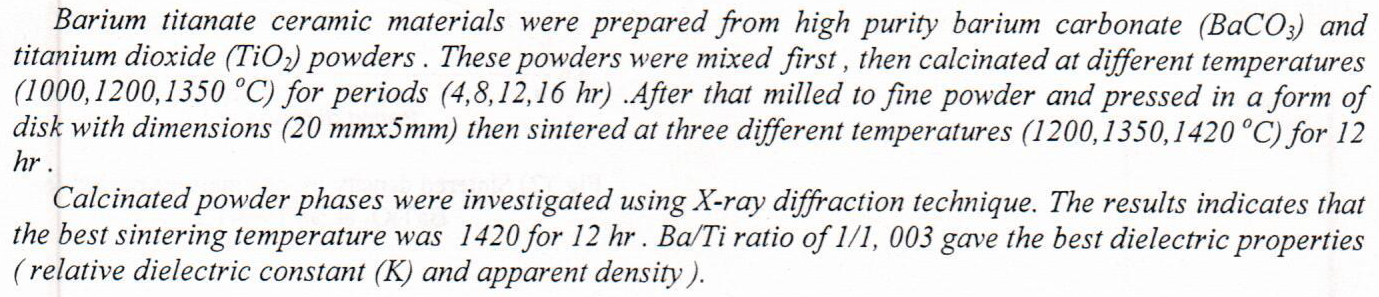

This study investigates the ionic conduction dependence on the size of alkaline cations in gel polymer electrolytes based on double iodide can enhance by incorporating a salt having a bulky cation.
... Show More (2)
(2)

Thin films of CdS:Cu were deposited onto glass substrate temperature 400 °c. The optieal properties have been studied for Cds doped with (1,3, 8) wt% of Cu before and after Gamma irradiation. It was found that the irradiation caused an ( Frenkel defects) where the atom is displaced from its original site leaving vacancy and forming on interstitial atom. It was found the irradiation caused an absorption edge shifting towards long wavelength as a result of the increasing of Cu concentration.

Concrete is widely used in construction materials since early 1800's. It has been known that concrete is weak in tension, so it requires some addition materials to have ductile behavior and enhance its tensile strength and strain capacity to improve their uses. In this study reactive powder concrete (RPC) was used with steel fiber by using different types of cement; (Ordinary Portland cement (OPC) and/or Portland- Limestone cement (PLC)) with three types of mixtures (OPC at the first mix, 50 % OPC and 50 % PLC at the second mix and PLC at the third mix). The behavior of RPC with steel fibers on compressive strength and tensile strength of concrete with different ages of curing (7, 14, 28 and 60) days and shrinkage have been studied. The clo
... Show More (9)
(9)
Expansive soil spreads in Iraq and some countries of the world. But there are many problems can be occurred to the structures that built on, so we must study the characteristics of these soils due to the problems that may be caused to these structures which built on these kinds of soil and then study the methods of treatment. The present study focuses on improving the geotechnical properties of expansive soils by treating it Metakaolin(M). Metakaolin (M) has never been used before as an improvement material for stabilizing the expansive soil . Metakaolin is a pozzolanic material. It’s obtained by calcination of kaolinite clay at temperatures from 700°C to 800°C. Kaolin chemical composition is
... Show MorePorous silicon (P-Si) has been produced in this work by photoelectrochemical (PEC) etching process. The irradiation has been achieved using diode laser of (2 W) power and 810 nm wavelength. The influence of various irradiation times on the properties of P-Si material such as P-Si layer thickness, surface aspect, pore diameter and the thickness of walls between pores as well as porosity and etching rate was investigated by depending on the scanning electron micrograph (SEM) technique and gravimetric measurements.
(1)
The rheological and fusion behavior of polyvinyl chloride (PVC) compounds plays a dominant role in
the processing operations and in the development of physical properties in the processed material. A
comprehensive study was made in this work to evaluate the effect of shear and thermal history on stability, mechanical and rheological properties of rigid PVC compounds. Different samples of Rigid Poly vinyl chloride including dry blend powder, granules, and bottles molded from both were examined. A study was also made on recycled RPVC where 25% of reclaimed material was continuously blended with fresh dry blend and processed for 15 cycles. Results showed that compaction of the PVC material took place in the brabender plastograph at co
(2)
Asphalt binder is a thermoplastic material that conducts as an elastic solid at lower service temperatures or throughout fast loading rate. At a high temperature or slow rate of loading, asphalt binder conducts as a different liquid. The classical duplication generates a required to assess the mechanical properties of asphalt concrete at the anticipated service temperature to reduce the stress cracking, which happens at lower temperatures, fatigue, and the plastic deformation at higher temperatures (rutting). In this study, an achievement was made to assess the effect of temperature on the mechanical characteristics of asphalt concrete mixes. A total of 132 asphalt concrete samples were attended utilizing two asphalt cement grades (40-50) a
... Show More
(6)
(5)
Iron-Epoxy composite samples were prepared by added
different weight percentages (0, 5, 10, 15, and 20 wt %) from Iron
particles in the range of (30-40μm) as a particle size. The contents
were mixed carefully, and placed a circular dies with a diameter of
2.5 cm. Different mechanical tests (Shore D Hardness, Tensile
strength, and Impact strength ) were carried out for all samples. The
samples were immersed in water for ten weeks, and after two weeks
the samples were take-out and drying to conducting all mechanical
tests were repeated for all samples. The hardness values increased
when the Iron particle concentration increased while the Impact
strength is not affected by the increasing of Iron particles
c
(2)