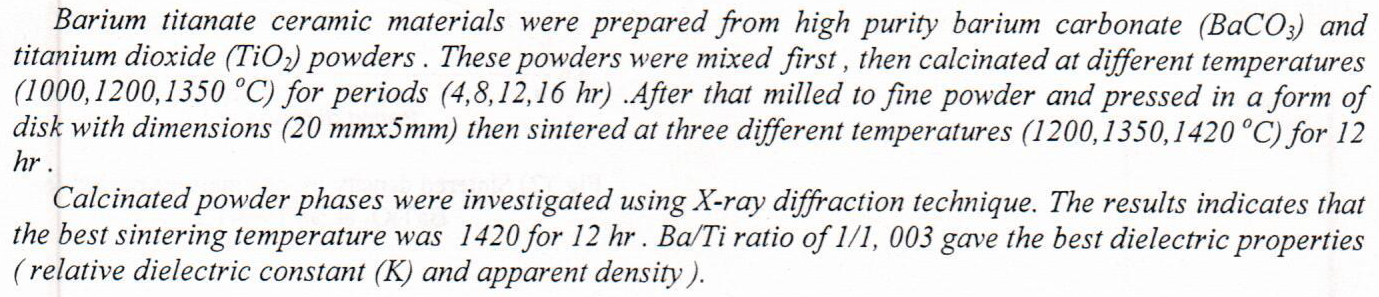
Preparation, Characterization, and Properties of Barium Titanate

The new azo dye was prepared from the reaction of the diazonium salt derived from 3-aminophenol with 2- hydroxyquinoline, then it was used to prepare a series of complexes with the chlorides of cobalt, chromium, copper, nickel, platinum, palladium and ammonium molybdate. The ligand was identified by a proton and carbon nuclear magnetic resonance spectroscopy, and the compounds were collected. The prepared materials were subjected to infrared, ultraviolet-visible, and mass spectrometry, as well as thermogravimetric analysis, differential calorimetry, and elemental analysis. Conductivity, magnetic susceptibility, metal content, and chlorine content of the complexes were also measured. The results showed that the ligand behaves in a trigonal b
... Show More (3)
(3)
 (2)
(2)


Perennial biofuel and cover crops systems are important for enhancing soil health and can provide numerous soil, agricultural, and environmental benefits. The study objective was to investigate the effects of cover crops and biofuel crops on soil hydraulic properties relative to traditional management for claypan soils. The study site included selected management practices: cover crop (CC) and no cover crop (NC) with corn/soybean rotation, switchgrass (SW), and miscanthus (MI). The CC mixture consisted of cereal rye, hairy vetch, and Austrian winter pea. The research site was located at Bradford Research Center in Missouri, USA, and was implemented on a Mexico silt loam. Intact soil cores (76‐mm diam. by 76‐mm long) were taken from the
... Show More
(5)
(6)

Thin films of CuPc of various thicknesses (150,300 and 450) nm have been deposited using pulsed laser deposition technique at room temperature. The study showed that the spectra of the optical absorption of the thin films of the CuPc are two bands of absorption one in the visible region at about 635 nm, referred to as Q-band, and the second in ultra-violet region where B-band is located at 330 nm. CuPc thin films were found to have direct band gap with values around (1.81 and 3.14 (eV respectively. The vibrational studies were carried out using Fourier transform infrared spectroscopy (FT-IR). Finally, From open and closed aperture Z-scan data non-linear absorption coefficient and non-linear refractive index have been calculated res
... Show More
(4)
Porcelain is one of the most important ceramic materials with a wide range of traditional and technical applications. Since most mixtures of porcelain have a high sintering temperature, bentonite has been added in this research to improve the characteristics of sintering and burning. The porcelain mixture consisted of the following Iraqi raw materials: 30% wt kaolin, 30 wt% non-plastic clay (grog), 10% wt sodium feldspar, 10 wt% potassium feldspar and 20 wt% flint. After the mechanical mixing process and transfer the powder mixture to the slurry by adding distilled water, then different weight percentage of the sodium bentonite(0, 2.5, 5, 7.5 and 10) wt% was added. The specimens were prepared by using the solid casting m
... Show More
(8)
in this paper the second order neutral differential equations are incestigated are were we give some new suffucient conditions for all nonoscillatory
(7)
(1)
This research deals with study of the effect of additives on rheological properties (yield point, plastic viscosity ,and apparent viscosity) of emulsions. Twenty seven emulsion samples were prepared; all emulsions in this investigation are invert emulsions when water droplets are dispersed in diesel oil. The resulting emulsions are called water-in-oil (W/O) emulsions. The rheological properties of these emulsions were investigated using a couett coaxial cylinder rotational viscometer (Fann-VG model 35 A), by measuring shear stress versus shear rate. It was found that the effect of additives on rheological properties of emulsions as follow: the increase in the concentration of asphaltic material tends to increase the rheological propertie
... Show MoreAlginate from Large brown seaweeds act as natural polymer has been investigated as polymer and has been added to concrete in different percentages ( 0% , 0.5% , 1% and 1.5% ) by the cement weight and the study show the effect of using alginate biopolymer admixtures on some of the fresh properties of the concrete (slump & the density fresh) also in the hardened state ( Compressive strength , Splitting tensile strength and Flexural strength ) at 28 days. The mix proportion was (1:2.26:2.26) (cement: sand: gravel) respectively and at constant w/c equal to 0.47. The results indicate that the use of alginate as a percent of the cement weight possess a positive effect on fresh properties of co
... Show More
(7)