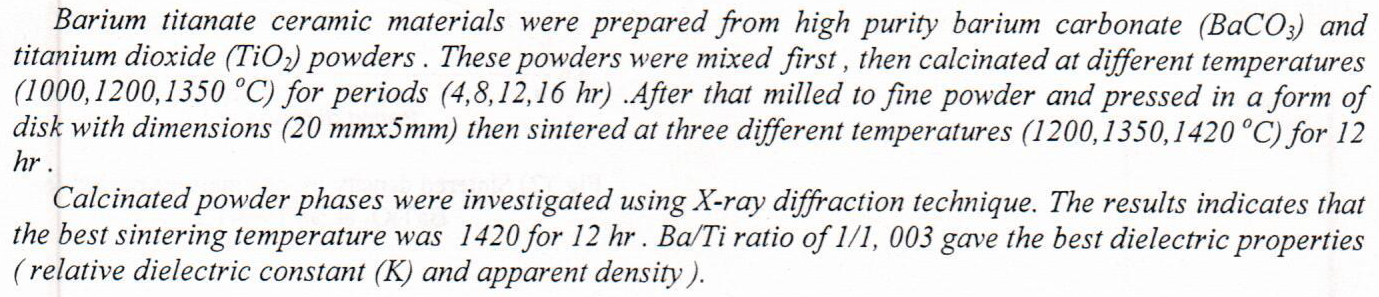
Preparation, Characterization, and Properties of Barium Titanate

Transition metal complexes of Co(II), Ni(II), Cu(II), and Zn(II) with 2-(4-antipyrine azo)-4-nitroaniline derived from 4-aminoantipyrine and 4-nitroaniline were synthesized. Characterization of these compounds has been done on the basis of elemental analysis, electronic data, FT-IR, UV-Vis and 1HNMR, as well as magnetic susceptibility and conductivity measurements. The nature of the complexes formed were studied following the mole ratio and continuous variation methods, Beer's law obeyed over a concentration range (1×10⁻⁴ - 3×10⁻⁴ M). High molar absorbtivity of the complex solutions were observed. From the analytical data, the stoichiometry of the complexes has been found to be 1:2 (metal:ligand). On the basis of physicochemical data octa
... Show MoreThe Schiff base (E)-2-(((2-(1H-benzo[d]imidazol-2-yl) phenyl) imino) methyl)-4-methylphenol (Lb) ligand with some metals(II) ion such as; Co, Cu, Cd, and Hg, were synthesis and characterized by the mass and 1 HNMR spectrometry for ligand Schiff base, the fourier-transform infrared spectroscop (FTIR), UV- visible and the flame atomic absorption (AA) spectrum, the CHN analysis, and the chlorine content, in addition to measuring the magnetic sensitivity of the complexes. All the complexes had octahedral geometry. The bioactivity activity for compounds against; Rhizopodium, Staphylococcus aureus, and Escherichia coli showed different efficacy towards these microorganisms
4,4'-(pyridine-2,6-diylbis(1,3,4-oxadiazole-5,2-diyl))bisphenol monomer (3)was synthesized from cyclization of N'2,N'6-bis(4-hydroxybenzylidene)pyridine-2,6-dicarbohydrazide (2)in the presence of bromine in glacialacetic acid. Newly five polymers (P1-P5) were synthesized from reaction bis-1,3,4-oxadiazole bisphenolmonomer with five different di acid chloride. The antibacterial activity of the synthesized polymers was screened against gram positive and gram negative bacteria. Polymers P4 and P5 exhibited significant antibacterial against all microorganisms, as well these polymers showed highest antifungal activity.
The Catharanthus roseus plant was extracted and converted to nanoparticles in this work. The Soxhlet method extracted alkaloid compounds from the plant Catharanthus roseus and converted them to the nanoscale. Chitosan polymer was used as a linking material and converted to Chitosan nanoparticles using Sodium TriPolyPhosphate (STPP). The extracted alkaloids were linked with Chitosan nanoparticles CSNPs by maleic anhydride to get the final product (CSNPs- Linker- alkaloids). The synthesized (CSNPs- Linker- alkaloids) was characterized using SEM spectroscopy UV–Vis., Zeta Potential, and HPLC High-Performance Liquid Chromatography. Scanning electron microscope (SEM) analysis shows that the Chitosan nanoparticles (CSNPs) have small dim
... Show More (5)
(5)


This study aims to fabricate and assess the β-tricalcium phosphate (β-TCP) bioactive ceramic coat layer on bioinert ceramic zirconia implants through the direct laser melting technique by applying a long-pulsed Nd:YAG laser of 1064 nm. Surface morphologies, adherence, and structural change in the coatings were evaluated by optical microscopy, field emission scanning electron microscope, hardness, and x-ray diffractometer. The elastic modulus (EM) of the coating was also determined using the nanoindentation test. The quality of the coating was improved when the laser power was 90 W with a decrease in the scan speed to 4 mm s−1. The chemical composition of the coat was maintained after laser processing; also, the Energy Dispersive
... Show More (10)
(8)
(10)
(8)
 (47)
(35)
(47)
(35)
The increasing prevalence of multidrug-resistant (MDR) pathogens necessitates the discovery of novel antibacterial agents. In this study, culturable soil bacteria from the Dead Sea region (Jordan) were isolated and the antibacterial activity of their extracellular metabolites were evaluated. Twenty-one isolates were screened using a perpendicular-streak primary assay; three stable producers (GH-15, GH-20, GH-21) were prioritized. Cell-free supernatants were extracted with n-hexane and ethyl acetate, tested using agar well diffusion, and profiled using thin-layer chromatography (TLC) coupled with bioautography (GH-15). Minimum inhibitory concentration (MIC) and minimum bactericidal concentration (MBC) were determined by broth microdi
... Show More
Aim: The present study aims to improve the poor water solubility of zaltoprofen which is a non-steroidal anti-inflammatory drug (NSAIDs) with a potent analgesic effect using solid dispersion then formulate it as a hollow type suppository to be more convenient for geriatric patients. Materials and Method: Zaltoprofen solid dispersions were prepared by solvent evaporation technique in different zaltoprofen: Soluplus® ratios. Results: Among the formulations tested, zaltoprofen solid dispersion preparation using 1:5 (zaltoprofen: Soluplus®) ratio showed the highest solubility and selected for further investigation. Solid dispersion characterization was evaluated by differential scanning calorimetry (DSC), X-ray diffraction study (XRD) and Fou
... Show MoreThe organic compound imidazole has the chemical formula C3N2H4. Numerous significant biological compounds contain imidazole. The amino acid histidine is the most prevalent. The substituted imidazole derivatives have great potential for treating a variety of systemic fungi infections. Thiourea is an organosulfur compound with the formula SC(NH2)2. It is a reagent in organic synthesis. In this paper, some new imidazole and thiourea derivatives are synthesized, characterized, and studied for their biological activity. These new compounds were synthesized from the starting material terephthalic acid, which was transformed to corresponding ester [I] by the refluxing of diacid with methanol in the presence of H2SO4 as a catalyst, compound [I] con
... Show More
(1)
Beryllium Zinc Oxide (BexZn1-xO) ternary nano thin films were deposited using the pulsed laser deposition (PLD) technique under a vacuum condition of 10-3 torr at room temperature on glass substrates with different films thicknesses, (300, 600 and 900 nm). UV-Vis spectra study found the optical band gap for Be0.2Zn0.8O to be (3.42, 3.51 and 3.65 eV) for the (300, 600 and 900nm) film thicknesses, respectively which is larger than the value of zinc oxide ZnO (3.36eV) and smaller than that of beryllium oxide BeO (10.6eV). While the X-ray diffraction (XRD) pattern analysis of ZnO, BeO and Be 0.2 Zn 0.8 O powder and nano-thin films indicated a hexa
... Show More
(1)