Preparation, Characterization, and Properties of Barium Titanate
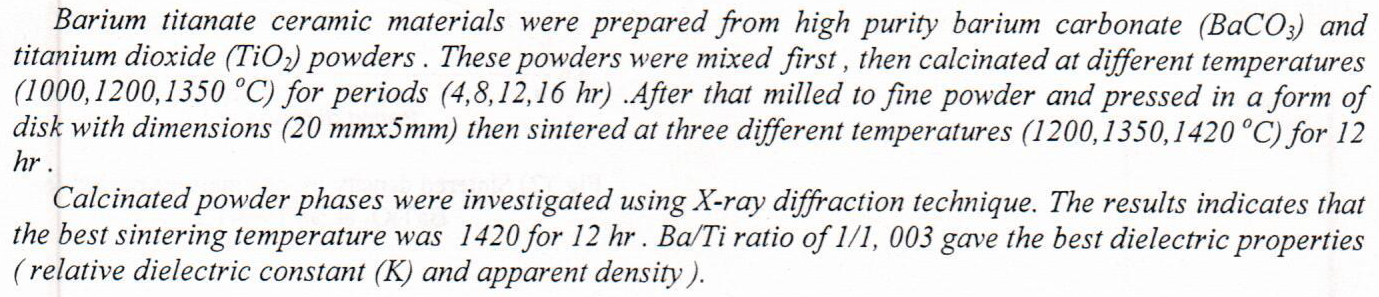

In the present research, the electrical properties which included the ac-conductivity (σac), loss tangent of dielectric (tan δ) and real dielectric constant (ε’) are studied for nano polycarbonate in different pressures and frequencies as a function of temperature these properties were studied at selective temperature gradients which are (RT-50-100-150-250)°C. The results of the study showed that the values of dielectric constant and dissipation factor increase with increasing pressure and temperature and decreases by increasing frequency. And the results of electrical conductivity showed that it increases with increasing temperature, pressure and frequency.

In this study, Laser Shock Peening (LSP) effect on the polymeric composite materials has been investigated experimentally. Polymeric composite materials are widely used because they are easy to fabricate and have many attractive features. Unsaturated polyester resin as a matrix was selected and Aluminum powder with micro particles as a reinforcement material was used with different volume fraction (2.5%, 5% and 7.5%). Hand lay-up process was used for preparation the composites. Fatigue test with constant amplitude with stress ratio (R =-1) was carried out before and after LSP process with two levels of energy (1Joule and 2Joule). The result showed an increase in the endurance strength of 25.448% at 7.5% volume fraction when peened is 1J
... Show More
Dental clinicians and professionals need an affordable, nontoxic, and effective disinfectant against infectious microorganisms when dealing with the contaminated dental impressions. This study evaluated the efficiency of hypochlorous acid (HOCl) as an antimicrobial disinfectant by spraying technique for the alginate impression materials, compared with sodium hypochlorite, and its effect on dimensional stability and reproduction of details. HOCl with a concentration of 200 ppm for 5 and 10 min was compared with the control group (no treatment) as a negative control and with sodium hypochlorite (% 0.5) as a positive control. Candida albicans, Staphylococcus aureus, and Pseudomonas aeruginosa were selected to assess the antimicrobi
... Show More (13)
(13)
 (8)
(8)

Oil well drilling fluid rheology, lubricity, swelling, and fluid loss control are all critical factors to take into account before beginning the hole's construction. Drilling fluids can be made smoother, more cost-effective, and more efficient by investigating and evaluating the effects of various nanoparticles including aluminum oxide (Al2O3) and iron oxide (Fe2O3) on their performance. A drilling fluid's performance can be assessed by comparing its baseline characteristics to those of nanoparticle (NPs) enhanced fluids. It was found that the drilling mud contained NPs in concentrations of 0,0.25, 0. 5, 0.75 and 1 g. According to the results, when drilling fluid was used without NPs, the coeff
... Show More
(4)
(15)
(13)
Stone Matrix Asphalt (SMA) is a gap-graded asphalt concrete hot blend combining high-quality coarse aggregate with a rich asphalt cement content. This blend generates a stable paving combination with a powerful stone-on-stone skeleton that offers excellent durability and routing strength. The objectives of this work are: Studying the durability performance of stone matrix asphalt (SMA) mixture in terms of moisture damage and temperature susceptibility and Discovering the effect of stabilized additive (Fly Ash ) on the performance of stone matrix asphalt (SMA) mixture. In this investigation, the durability of stone matrix asphalt concrete was assessed in terms of temperature susceptibility, resistance to moisture damage, and sensitivity t
... Show More
(2)
Dental clinicians and professionals need an affordable, nontoxic, and effective disinfectant against infectious microorganisms when dealing with the contaminated dental impressions. This study evaluated the efficiency of hypochlorous acid (HOCl) as an antimicrobial disinfectant by spraying technique for the alginate impression materials, compared with sodium hypochlorite, and its effect on dimensional stability and reproduction of details. HOCl with a concentration of 200 ppm for 5 and 10 min was compared with the control group (no treatment) as a negative control and with sodium hypochlorite (% 0.5) as a positive control. Candida albicans, Staphylococcus aureus, and Pseudomonas aeruginosa were selected to assess the antimicrobi
... Show More
(13)
(8)
(11)
(12)
The electrospun nanofibers membranes (ENMs) have gained great attention due to their superior performance. However, the low mechanical strength of ENMs, such as the rigidity and low strength, limits their applications in many aspects which need adequate strength, such as water filtration. This work investigates the impact of electrospinning parameters on the properties of ENMs fabricated from polyacrylonitrile (PAN) solved in N, N-Dimethylformamide (DMF). The studied electrospinning parameters were polymer concentration, solution flow rate, collector rotating speed, and the distance between the needle and collector. The fabricated ENMs were characterized using scanning electron microscopy (SEM) to understand the surface morphology and es
... Show More
(22)
(8)
Given the paucity and toxicity of available drugs for leishmaniasis, coupled with the advent of drug resistance, the discovery of new therapies for this neglected tropical disease is recognised as being of the utmost urgency. As such antimicrobial peptides (AMPs) have been proposed as promising compounds against the causative Leishmania species, insect vector-borne protozoan parasites. Here the AMP temporins A, B and 1Sa have been synthesised and screened for activity against Leishmania mexicana insect stage promastigotes and mammalian stage amastigotes, a significant cause of human cutaneous disease. In contrast to previous studies with other species the activity of these AMPs against L. mexicana amastigotes was low. This suggests that ama
... Show More
(29)
(28)