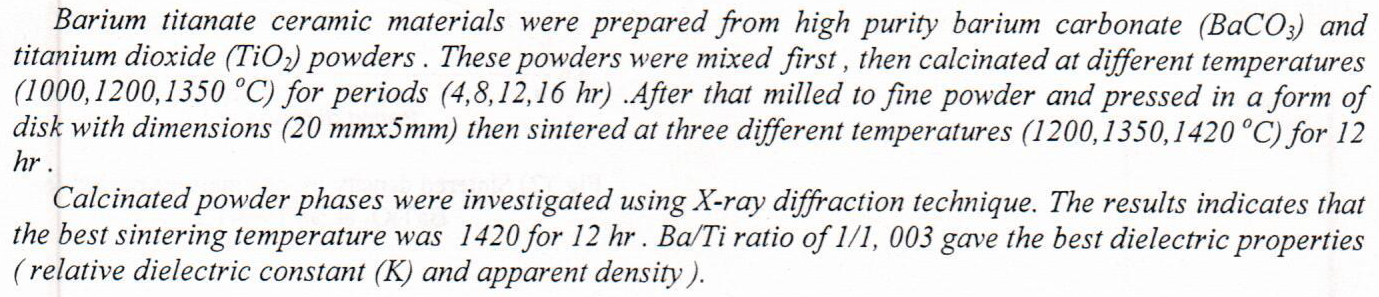
Preparation, Characterization, and Properties of Barium Titanate

This work deals with preparation of Sulfated Zirconia catalyst (SZ) for isomerization of n-hexane model and refinery light naphtha, as well as enhanced the role of promoters to get the target with the mild condition, stability, and to prevent formation of coke precursors on strong acidic sites of the catalyst. The prepared SZ catalysts were characterization by fourier transform infrared spectroscopy (FTIR), X-ray diffraction (XRD), Brunauer –Emmett-Teller (BET) surface area analysis, Thermogravimetric Analysis (TGA), Scanning Electron Microscope (SEM) and atomic force microscopy (AFM) Analyzer. The results illustrate that the maximum conversion and selectivity for n-hexane isomerization with Ni-WSZ and operating temperature of 150 °C
... Show More (2)
(2)

Calcium-Montmorillonite (bentonite) [Ca-MMT] has been prepared via cation exchange reaction using benzalkonium chloride [quaternary ammonium] as a surfactant to produce organoclay which is used to prepare polymer composites. Functionalization of this filler surface is very important factor for achieving good interaction between filler and polymer matrix. Basal spacing and functional groups identification of this organoclay were characterized using X-Ray Diffraction (XRD) and Fourier Transform Infrared (FTIR) spectroscopy respectively. The (XRD) results showed that the basal spacing of the treated clay (organoclay) with the benzalkonium chloride increased to 15.17213 0A, this represents an increment of about 77.9% in the
... Show MoreSome metal ions (Mn+2, Co+2, Ni+2, Cu+2, Zn+2, Cd+2 and Hg+2) complexes of quinaldic acid (QuinH) and α-picoline (α-Pic) have been synthesized and characterized on the basis of their , FTIR, (U.V-Vis) spectroscopy, conductivity measurements, magnetic susceptibility and atomic absorption. From the results obtained the following general formula has suggested for the prepared complexes [M(Quin)2( α-Pic)2].XH2O where M+2 = (Mn, Co, Ni, Cu, Zn, Cd and Hg), X = 2, X = zero for (Co+2 and Hg+2) complexes, (Quin-) = quinaldate ion, (α-Pic) = α-picoline. The results showed that the deprotonated ligand (QuinH) by using (KOH) coordinated to metal ions as bidentate ligand through the oxygen atom of the carboxylate group (-COO-) and the nitrogen ato
... Show MoreThe researchers wanted to make a novel azo imidazole as a follow-up to their previous work. We focused on the ligand 4-[(2-amino-4-phenylazo)- methyl]-cyclohexane carboxylic acid as a derivative of trans-4- (aminomethyl) cyclohexane carboxylic acid diazonium salt, synthesized a series of its chelate complexes with metal ions, and characterized these compounds using a variety techniques, including elemental analysis, FTIR, LC-Mass, NMR and UV-Vis spectral process as well TGA, conductivity and magnetic quantifications. Analytical data showed that the Cr(III), Mn(II) and Zn(II) complexes out to 1:1 metal-ligand ratio with octahedral geometry except Mn complex has tetrahedral geometry.
This paper presents a new azo dye 3-[2-(1H-indol-2-yl)ethyldiazenyl]quinolin-2-ol] from the reaction of the diazonium salt derived from tryptamine and 2-hydroxyquinoline. Azo dye was used to prepare a series of complexes with the chlorides of Ni(II), Pt(IV), Pd(II), Cd(II), and Zn(II). Compounds were analyzed and characterized using elemental analysis, magnetic measurement, UV-vis, IR, MS, NMR, and conductivity. The findings demonstrated that the ligand acts as ionic in complex form, O-bidentate, supporting the proposed formula. The complexes generally exhibited tetrahedral and octahedral geometries, except the palladium complex, which adopted a square planar geometry. TGA was used to investigate the thermal characteristics of compo
... Show More
With the aim of developing potential antimicrobials, a series of novel Ciprofloxacin methylene isatin derivatives incorporating different aromatic aldehydes were synthesized and characterized by FTIR, 1H NMR, Mass spectroscopy and bases of elemental analysis. In addition, the in vitro antibacterial and antifungal properties were tested against some human pathogenic microorganisms by employing the disc diffusion technique. A majority of compounds were showing activity against several of the microorganisms. The relationship between the functional group variation and the biological activity of the evaluated compounds is discussed. From comparisons of the compounds, 3c was determined to be the most active compound.
 (77)
(57)
(77)
(57)


A modern, rapid RP-HPLC-UV method was developed and validated in compliance with FDA and EMA guidelines for simultaneous quantification of 15 βlactam antibiotics) Ampicillin, Amoxicillin, cephalexin, cefotaxime, cefoxitin, cefamandole, cephalothin, piperacillin, penicillin, oxacillin, cloxacillin, nafcillin Carbenicillin, Mezlocillin and Dicloxacillin) in pharmaceutical formulations and pure forms. The method employs Column NEUCLEODUR C-18 (4.0 mm x 100 mm, 5µm particle size), at a temperature of thirty degrees Celsius, and the mobile phase was acetonitrile and KH2PO4 using gradient elution with a total separation time of 13 minutes, a flow rate of 1.3 ml/min, at = pH 4.5 for the buffer solution and the λ max was 220 nm. The met
... Show MoreEarth dams are constructed mainly from soil. A homogenous earth dam is composed of only one material. The seepage through such dams is quite high. Upstream impervious blanket is one of the methods used to control seepage through the dam foundations. Bennet's method is one of the commonly used methods to design an impervious upstream blanket. Design charts are developed relating the length of blanket, total reservoir head, total base width of the dam (excluding downstream drainage), the coefficient of permeability of the blanket material, blanket thickness, foundation thickness, and coefficient of permeability of the foundation soil, based on the equations governing the Bennet's method for a homogenous earth dam with a blanket of uniform
... Show More