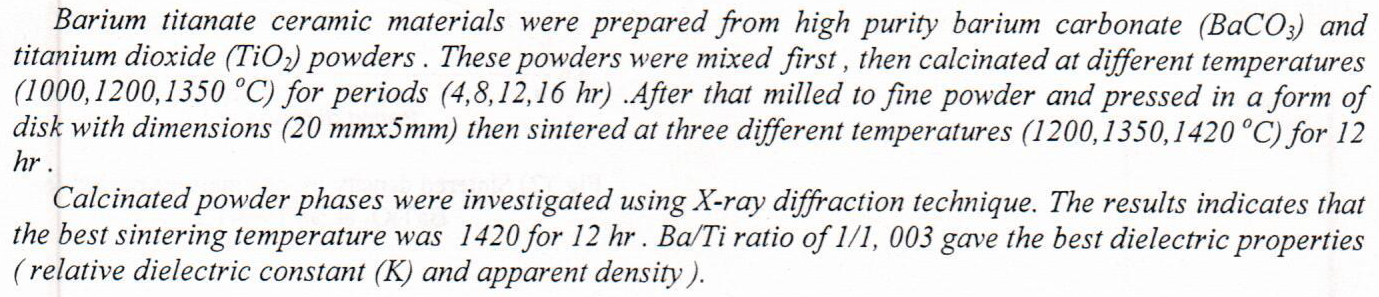
Preparation, Characterization, and Properties of Barium Titanate

This study shows how the structural and dielectric properties of (SnO2)1-x(Mn2O3)x, (where x=0.00, 0.03, 0.05,0.07, and 0.09) prepared using the solid state reaction technique, are affected by the doping of semiconducting metal oxide Mn2O3. Structural analysis of the composites was carried out using information from the composite samples obtained from X-ray diffraction (XRD). The diffraction peak shifting in XRD patterns indicated that Mn ions were successfully incorporated into the SnO2 crystal lattice. Mn ions were successfully doped in the Tin oxide matrix lattice with the subsequent increase of doping levels. The average crystal size evaluated using Scherrer's equation was found to vary from 33 to 37 nm, and the lattice constant
... Show More

Polypyrrole/silver (PPy/Ag) nanocomposites was synthesized via a chemical oxidative method. The AFM analysis is performed to study the surface roughness, morphology and size distribution of the PPy particles and PPy-ag nanocomposites. The results indicated that as the concentration of Ag in the nanocomposite increases, the roughness also increases. The size of nanoparticles was also evaluated and found in the range of 15 nm to 125 nm. The PPy/Ag nanocomposites exhibited an effectiveness against Gram-negative Escherichia coli showing an inhibition zone of 4mm and displayed poor efficacy against Gram-positive Staphylococcus aureus. Based on given adequate antibacterial characteristics of PPy/Ag nanocomposites, it can be identified as
... Show More (4)
(4)
Urea formaldehyde resin was prepared by using basic media by yield 95%. The Remaining of ureaplasts resin were prepared in acetic acid media by high yield. Alkyde resins were prepared by condensation polymerization by react Succinic, Maleic, Phthalic anhydrides with Ethylene glycol or Glycerol. Select samples of the prepared alkyde resins were mixed with Azo dyes in special ratio. The mixtures were used as coatings for wood, and compaised with pure dyes. The Coating that some alkyde resins showed better adhesion from using dyes alone. Preparation of wood coating by mixing ureaplast resins and alkyde resins with Azo dyes in special ratios. The coating showed better adhesion, brighter colors and better resistance to heat from Preceding coat
The influence of different thickness (500,750, and 1000) nm on the structure properties electrical conductivity and hall effect measurements have been investigated on the films of copper indium selenide CuInSe2 (CIS) the films were prepared by thermal evaporation technique on glass substrates at RT from compound alloy. The XRD pattern show that the film have poly crystalline structure a, the grain size increasing with as a function the thickness. Electrical conductivity (σ), the activation energies (Ea1,Ea2), hall mobility and the carrier concentration are investigated as function of thickness. All films contain two types of transport mechanisms of free carriers increase films thickness. The electrical conductivity increase with thickness
... Show MoreCdS and CdTe thin films were thermally deposited onto glass substrate. The CdCl2 layer was deposited onto CdS surface. These followed by annealing for different duration times to modify the surface and interface of the junction. The diffraction patterns showed that the intensity of the peaks increased with the CdCl2/annealed treatment, and the grain sizes are increased after CdCl2/annealed treatment
Copper tin sulfide (Cu2SnS3) thin films have been grown on glass
substrate with different thicknesses (500, 750 and 1000) nm by flash
thermal evaporation method after prepare its alloy from their
elements with high purity. The as-deposited films were annealed at
473 K for 1h. Compositional analysis was done using Energy
dispersive spectroscopy (EDS). The microstructure of CTS powder
examined by SEM and found that the large crystal grains are shown
clearly in images. XRD investigation revealed that the alloy was
polycrystalline nature and has cubic structure with preferred
orientation along (111) plane, while as deposited films of different
thickness have amorphous structure and converted to polycrystalline
Some of the characters of the Staphylolysin A and D enzymes purified from Pseudomonas aeruginosa P16 and P5 respectively were studied, the molecular weights of Staphylolysin A and D were 20.417 kilo dalton and 23.988 kilo Dalton respectively by SDS- polyacryl amide gel electrophoresis. The optimum pH for staphylolysin A activity was found to be 8 which gives higher activity reaches 150 unit/ml, and for enzyme stability was 7.5-8.5 in which the enzyme nearly retained its full activity, while it was 9.5 for staphylolysin D that gives higher activity of 16 unit/ml,and 8.5-9.5 for enzyme stability in which the enzyme nearly retained its full activity, Maximum activity of two enzymes was obtained at 40C in which the specific activity for st
... Show More
This research study the effect of Titanium dioxide on the tensile properties of
Polystyrene (PS) and Polycarbonate (PC) polymers. The stress – strain curve for pure PS
and pure PC, shows that Young modulus for PS is higher than Young modulus for PC,
because PS have higher ultimate strength than PC.
The addition of TiO2 to PS and PC will reduce the Young modulus and ultimate stress,
because the TiO2 particles will reduces or freeze the orientation of these molecular chain
and reduced the toughness of PC, while when the TiO2 were added to PS, the value of
toughness will be stabilized because TiO2 particles make these chains interlocked and the
mobility of the chains will be restrict.