Effects of Drying Conditions on the Properties of Dried Particles of Powdered steep Liquor
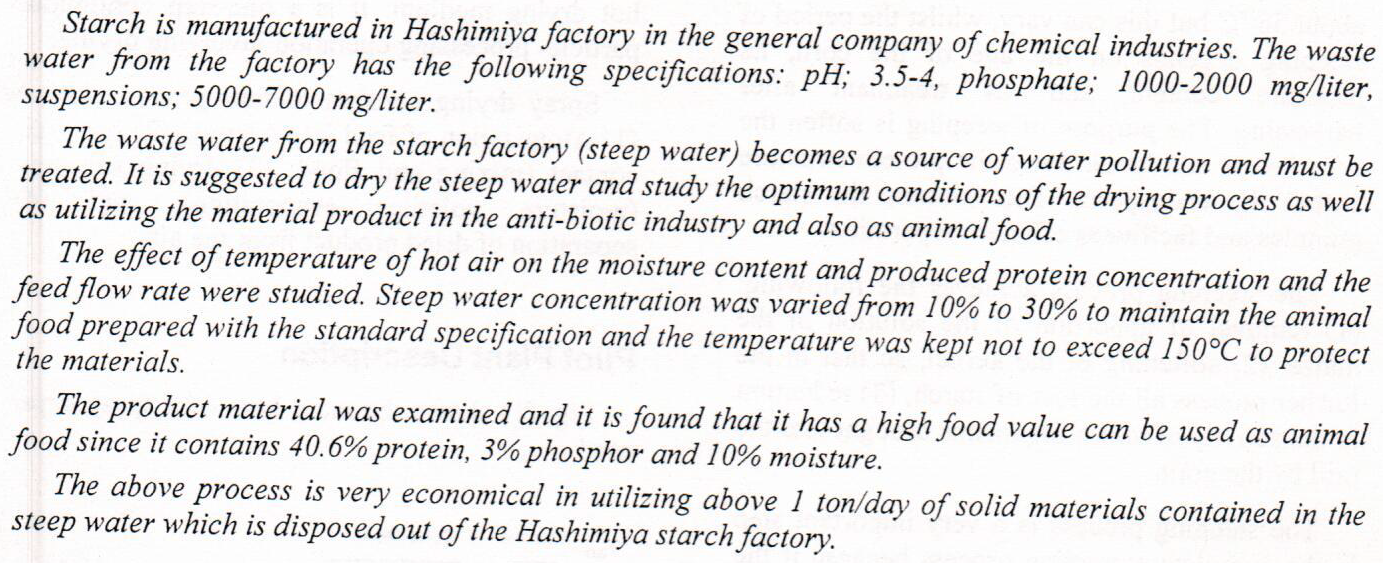

The best optimum temperature for the isolate was 30○C while the pH for the maximum mineral removal was 6. The best primary mineral removal was 100mg/L, while the maximum removal for all minerals was obtained after 8 hrs, and the maximum removal efficiency was obtained after 24 hrs. The results have proved that the best aeration for maximum removal was obtained at rotation speed of 150 rpm/ minute. Inoculums of 5ml/ 100ml which contained 106 cell/ ml showed maximum removal for the isolate.
Background: Poly propylene fibers with and without silane treatment have been used to reinforce heat cure denture base acrylic but, some mechanical properties like transverse strength, impact strength, tensile strength, hardness, wear resistance and wettability. Which are related to the clinical use of the prosthesis are not evaluated yet. The aim of the study is to identify the influence of incorporation of treated and untreated fibers on these properties Materials and methods: Eighty four heat cure acrylic specimens were constructed by conventional flasking technique. They were divided into six groups according to the tests and each group was subdivided into two subgroups control and experimental groups (seven samples for each subgroup
... Show MoreIn this work Study effect of annealing temperature on the Structure
of a-Se and electrical properties of a-Se/c-Si hetrojunction have been
studied.The hetrojunction fabricated by deposition of a-Se film on c-
Si using thermal evaporation.
Electrical properties of a-Se/ c-Si heterojunction include I-V
characteristics, in dark at different annealing temperature and C-V
characteristics are considered in the present work.
C-V characteristics suggested that the fabricated diode was
abrupt type, built in potential determined by extrapolation from
1/C2-V curve. The built - in potential (Vbi) for the Se/ Si System
was found to be increase from 1.21 to 1.62eV with increasing of
annealing temperature
Background: Denture lining materials are widely used in prosthodontic treatment and management of traumatized oral mucosa. A contaminated prosthesis can provide a source of cross-contamination between patients and dental personnel as well as a cause for denture stomatitis. Therefore, denture disinfection has been recommended as an essential procedure for maintenance of a healthy oral mucosa. This study investigated the effect of SOLO disinfectant solution on some properties of different denture lining materials. Materials and methods: Three different solutions were used in this study; SOLO disinfectant solution, sodium hypochlorite solution, and water on three types of acrylic denture lining materials; hot cure, cold cure, and soft acrylic
... Show MoreBackground: Deterioration of maxillofacial silicone properties due to microbial colonization is a common problem and leads to the replacement of the prosthesis. Incorporation of the antimicrobial agent into the silicone could be a solution. The purpose of this study was to evaluate the effect of silver-zinc zeolite addition on some mechanical properties of a maxillofacial silicone (VST-50). Materials and methods: Total 120 specimens were fabricated and divided into 3 groups: 40 specimens for tear strength test, 40 specimens for tensile and percentage of elongation tests and 40 specimens for Shore A hardness and surface roughness. Each group was divided into 4 subgroups according to the amount of zeolite added (0% “control”, 0.5%, 1% and
... Show MoreNo-fine concrete (NFC) is cellular concrete and it’s light weight concrete produced with the exclusion of sand from the concrete. This study includes the mechanical properties of lightweight reinforced by steel fiber, containing different proportions of steel fiber. This study was done using number of tests. These tests were density, compressive strength, flexural strength and absorption. These tests of the molds at different curing time. The results of tests that implication of fiber to No. fine concrete did not affect significantly on the compressive strength, While the flexural strength were gets better. Results explained that, the flexural strength of (1%) fiber No- fine concrete molds are four times that of the reference mold
... Show More (1)
(1)

One of the most important problems that faces the concrete industry in Iraq is the deterioration due to internal sulfate attack , since it reduces the compressive strength and increases the expansion of concrete. Consequently, the concrete structure may be damage .The effects of total and total effective sulfate contents on high strength concrete (HSC) have been studied in the present study. The research studied the effect of sulfate content in cement , sand and gravel , as well as comparing the total sulfate content with the total effective SO3 content. Materials used were divided into two groups of SO3 in cement ,three groups of SO3 in sand ,and two groups of SO3 in gravel. The results show that considering the total effective sulfate con
... Show MoreSelf-compacted concrete (SCC) is a highly flowable concrete, with no segregation which can be spread into place by filling the structures framework and permeate the reinforcement without any compaction or mechanical consolidation ACI 237R-14. One of the most important problems faced by concrete industry in Iraq and Gulf Arab land is deterioration due to internal sulfate attack (ISA) that causes damage of concrete and consequently reduces its compressive strength, increases expansion and may lead to its cracking and destruction. The experimental program was focused to study two ordinary Portland cements with different chemical composition with (5, 10 and 15) % percentage of high reactivity metakaoline (HRM)
... Show More
(21)
One of the most important problems that faces the concrete industry in Iraq is the deterioration due to internal sulfate attack , since it reduces the compressive strength and increases the expansion of concrete. Consequently, the concrete structure may be damage .The effects of total and total effective sulfate contents on high strength concrete (HSC) have been studied in the present study.
The research studied the effect of sulfate content in cement , sand and gravel , as well as comparing the total sulfate content with the total effective SO3 content. Materials used were divided into two groups of SO3 in cement ,three groups of SO3 in sand ,and two groups of SO
... Show More