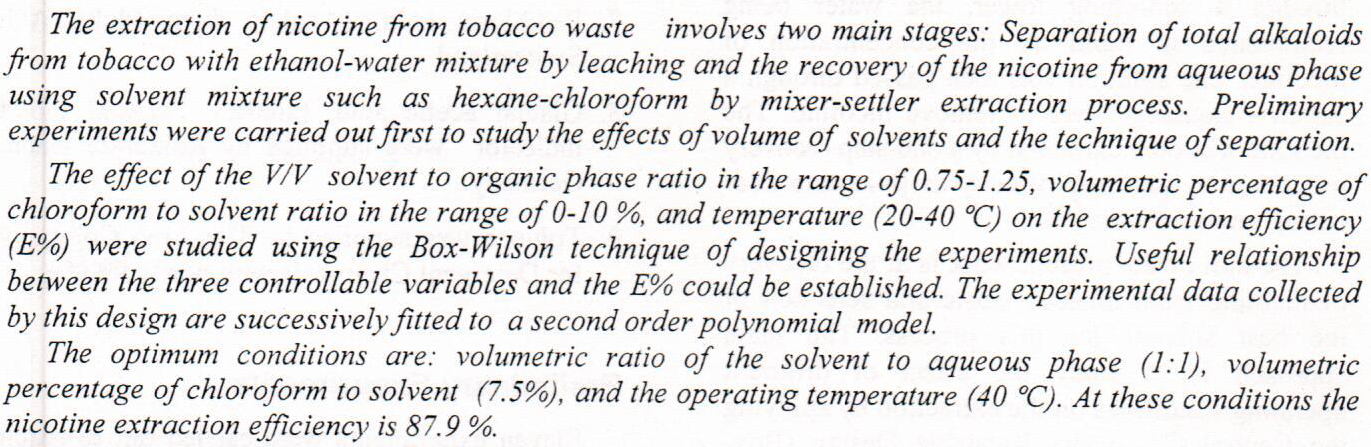
The Nicotine Extraction from Tobacco Wastes

Glutathione-S-transferases (GSTs) play a role in the detoxification of environmental chemicals and mutagens, such as those inhaled during tobacco smoking. There have been conflicting reports concerning GST polymorphisms as risk factors in the development of lung cancer. No studies focused on Arab populations exposed to Waterpipe (WP) tobacco smoke have been undertaken. Here Polymerase Chain Reaction-Restriction Fragment Length Polymorphism (PCR-RFLP) and gene sequenc- ing were applied to analyze allelic variations in GSTP1-rs1695 and -rs1138272 amongst 123 lung cancer patients and 129 controls. The data suggest that WP smoking raised the risk of lung cancer more than three-fold (OR 3.6; 95% CI 2.1–6.0; p < 0.0001). However, there was no s
... Show More (18)
(18)
 (15)
(15)



Osmotin and osmotin-like proteins belong to the PR-5 pathogenesis-related group of proteins and are induced in response to various types of biotic and abiotic stresses in several plant species. Carrot was transformed with a tobacco osmotin gene that encodes a protein lacking the vacuolar-sorting motif that is composed of a 20-amino-acid sequence at the C-terminal end, under the control of the cauliflower mosaic virus 35S promoter, using Agrobacterium-mediated transformation. Transgene integration and expression were confirmed by Southern and western blot analyses, and three selected transgenic lines were evaluated for their ability to tolerate drought stress. Under drought stress conditions, all transformants exhibited slower rates of wilti
... Show More
(22)
(21)
: Cigarette smoking is a lifestyle behavior that causes significant adverse health effects. Cigarette smoke contains chemicals, many of which are lead to the production of reactive oxygen species (ROS), which can lead to apoptosis and autophagy. To estimate the association of Cigarette smoking with the autophagy and immunity, technology of real time polymerase chain reaction (RTPCR) for gene expression of (LC3A, LC3B, LC3C, myd88) was used. Enzyme-linked immunosorbent assay (ELISA) technique was utilized to measurement the amount of TNF-α protein. The ratios of LC3A/LC3B and LC3B/LC3C were calculated to estimate the autophagy flux. The results indicate the expression of LC3B, LC3C and Myd88 genes in smokers is increased significantly (p
... Show MoreThe main object of the current work was to determine the antifungal efficiency of secondary metabolites product called synephrine that extracted from Citrus sinesis peels and the ability of synephrine to biosynthesis gold nanoparticles from HAucl4 which consider environmentally favourable method, then determine their activity against pathogenic human dermatophyte. The identification of synephrine done by Thin layer chromatography (TLC), High Performance Liquid Chromatography (HPLC) and The Fourier Transform Infrared (FTIR). The characterization of gold nanoparticles by using Ultra Violet-Visible Spectroscopy (UV-Vis), Field – Emission Scanning Electron Microscopy (FESEM) and Fourier Transform Infrared (FTIR), confirmed the biosynt
... Show More
(2)
(1)
Due to the importance of the extraction process in many engineering and medical industries, in addition to great interest in medicinal plants, in this research, microwave-assisted extraction has been applied to extract some active compounds from Rosmarinus officinalis leaves. The optimal extraction conditions were then determined by calculating the ratio and extraction efficiency. The process has also been described through kinetic study by applying five kinetic models, the Hyperbolic diffusion model, Power low model, the First order reaction model, Elovich's model, and Fick's second law diffusion model and determining their compatibility with the studies operation, and determining the kinetic constants for each model. The result
... Show More
(5)
Introduction: Melanin is a high-molecular weight pigment produced through the oxidative polymerization of phenolic or indolic compounds and plays a perfect role in UV-light shielding, as well as in photoprotection. Among biopolymers, melanin is unique in many aspects. This study is designed to screen Production, extraction and characterizes of an extracellular melanin pigment from clinically isolated P. aeruginosa. Objective: The aim of the current study is isolation and diagnosis of P.aeruginosa using vitek-2 compact system and screening the ability to produce melanin and characterization of extracted melanin by UV-vis, FTIR, XRD and SEM. Materials and methods: the samples swab inoculated on cetrimide agar as selective media and incubated
... Show More
(1)
Abstract : A research was conducted to study the process parameters affecting hexavalent chromium Cr (VI) (carcinogenic compound) the removal percentage from the electrical industries company waste water that contain 88 mg/l of Cr (VI) concentration by adsorption onto tea wastes. Synthetic water with 88 mg/l Cr (VI) concentration was used. Several operation parameters affecting Cr (VI) removal efficiency were investigated, such as pH, initial Cr (VI) concentration, stirring time and tea wastes dose. The experimental results reveal that maximum Cr (VI) removal reached up to 94.26% at pH of 2, stirring time of 180 minute, tea wastes do
... Show More
The current study was to examine the reliability and effectiveness of using most abundant, inexpensive waste in the form of scrap raw zero valent aluminum ZVAI and zero valent iron ZVI for the capture, retard, and removal of one of the most serious and hazardous heavy metals cadmium dissolved in water. Batch tests were conducted to examine contact time (0-250) min, sorbent dose (0.25-1 g ZVAI/100 mL and 2-8 g ZVI/100 mL), initial pH (3-6), pollutant concentration of 50mg/L initially, and speed of agitation (0-250) rpm . Maximum contaminant removal efficiency corresponding to (90 %) for cadmium at 250 min contact time, 1g ZVAI/ 6g ZVI sorbent mass ratio, pH 5.5, pollutant concentration of 50 mg/L initially, and 250 rpm agitation speed wer
... Show More
(12)