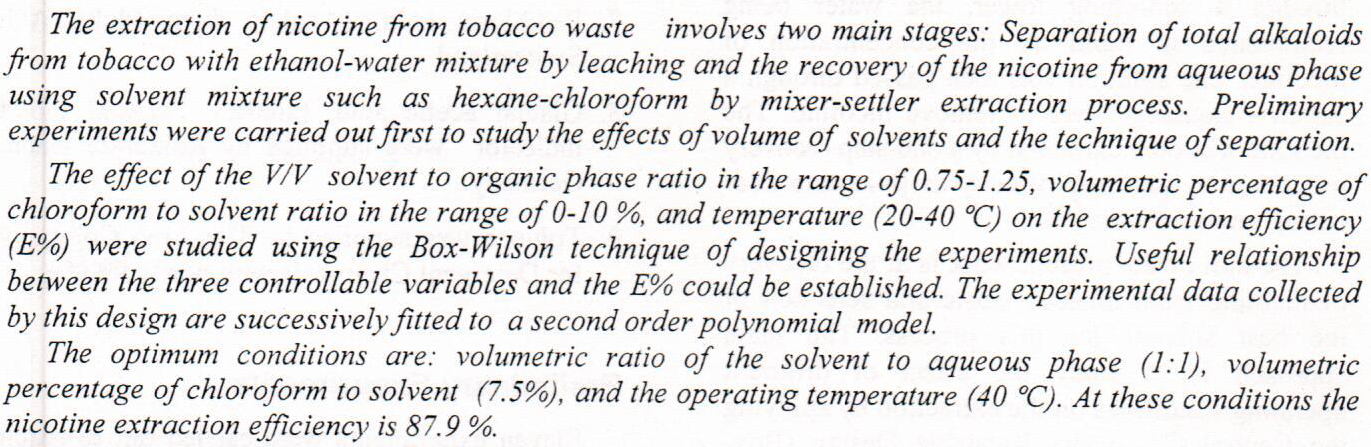
The Nicotine Extraction from Tobacco Wastes

P. aeruginosa is one of the complex targets for antimicrobial chemotherapy. Also, it is intrinsically resistant to several antibiotics. It produces β-lactamases enzymes that are responsible for the widespread β-lactam antimicrobial resistance. There are three major groups of β-lactamase enzymes, MBLs and ESBLs forming Pseudomonas is a major issue for the treatment of burns victims. Methods: A total of 28 clinical isolates related to P. aeruginosa have been obtained from the burns specimens from patients attending to AL-Imam hospital/Baghdad-Iraq, through the period from October 2015 to March 2016. Also, all isolates have been recognized as P. aeruginosa via utilizing bacteriological assay and confirmed by Vitek 2. In addition, the suscep
... Show MoreA rapid and sensitive method for analysis of amino acid hydrolysates of nigella sativa L seed has been developed using O-phthaldialehyde(OPA ) as a pre-column derivatizing agent. OPA reagents in the presence of mercaptoethanol react rapidly with primary amino acids ( less than 60 sec.) to form isindole derivatives which easily separated with good selectivity on ODS column. Resolution of amino acid derivatives is carried out with a methanol gradient in 0.01 maqueous sodium acetate. pH 7.1 . The quantitation of amino acid derivatives is reproducible within an average relative deviation of + 1.4% the linearity for most amino acids were more than 0.9993 with detection limit of 0.2 ppm. 15 amino acid were detected in the analysis of
... Show More (2)
(2)

 (11)
(4)
(11)
(4)


Biological activity substances was investigated in watery extract of lentil which found to contain phenols, tannin, saponins and resins while, flavons, terpens and steroids were not exist in the extract details explained that 5%, 10% of lentil extract largly inhibited the growth of Psedumonas aeruginosa then Escherichia coli and Bacillus subtilis. The growth of both Staphylococcus aureus and Salmonella typhimurium were slightly affected by all extract concentration. Extracellular protease were screened in all bacterial species under study. Complete inhibition was achieved for extracellular protease while different percentage of protease inhibition were seen for intracellular proteases.
ABSTRACT
Two compounds were isolated from the fruit part of Rhus coriaria that grow wildly or cultivated in the north of Iraq. The compounds were separated by preparative high-Performance Liquid Chromatography and their structures were established based on detailed spectroscopic techniques like FTIR and LC-MS/MS.
Keywords: Rhus coriaria, Preparative HPLC, LC-MSMS, FTIR
(12)
(2)
(15)
(8)
The efficient removal of dissolved organic compounds (DOC) from wastewater has become a major environmental concern because of its high toxicity even at low concentrations. Therefore, a technique was needed to reduce these pollutants. Ion exchange technology (IE) was used with AmberliteTM IR120 Na, AmberliteTM IR96RF, and AmberliteTM IR402, firstly by using anion and mixed bed system, where the following variables are investigated for the process of adsorption: The height of the bed in column (8,10 and 14 cm), different concentrations of (DOC) content at constant flow rate. The use of an ion exchanger unit (continuous system) with three columns (cation, anion, and mixed bed) was studied.
... Show More
(2)
This study aimed at isolating uropathogenic Escherichia coli from urinary tract infections (UTIs) of human and cattle to examine the molecular diversity and phylogenetic relationship of the isolates. A total of 100 urine samples were collected from UTIs of human and cattle. The isolates identification was done using routine diagnostic methods and confirmed by Vitek2. Antimicrobial susceptibility was tested against 10 antimicrobials. Random amplified polymorphic DNA (RAPD)-polymerase chain reaction (PCR) was applied to identify the genetic diversity among E. coli isolates from human and animal origin by using five different octamer primers. The gelJ software for the phylogenetic analysis created Dendrograms. Out of 50 human urine samples, E.
... Show More
(7)
This work investigates the effect of the gas nitriding process on the surface layer microstructure and mechanical properties for steel 37, tool steel X155CrVMo12-1 and stainless steel 316L. Nitriding was conducted at a temperature of 550 °C for 2 hours during the first stage and at 750 °C for 4 hours during the second stage. SEM and X-ray diffraction tests were performed to evaluate the microstructural features and the major phases formed after surface treatment. SEM and X-ray diffraction tests were performed to assess the microstructural features and the primary phases formed after surface treatment. The new secondary precipitates were identified as γ′-Fe4N, ε (Fe2–3N), and α-Fe, exhibiting an uneven chain-like pattern wit
... Show More
A qualitative chemical test was performed on functional groups extracted from fenugreek plant and its extracts (aqueous, alcoholic and volatile oil). Results revealed that fenugreek seeds contain the main functional groups, while extracts are varied accorodihg to their content of functional groups qualitatively and quantitively. Moreover, inhibition activity was tested for extracts of fenugreek seeds (aqueous, alcoholic and volatile oil). against gram negative (Salmonella typhimurium, Escherichia coli and Pseudomonas aeruginosa) and gram positive (Staphylococcus aureus) by the ager well diffusion method. Data have revealed that inhibition activity was different in accoradance with extract solvent and the tested microorgan. Oil extract (15)%
... Show More