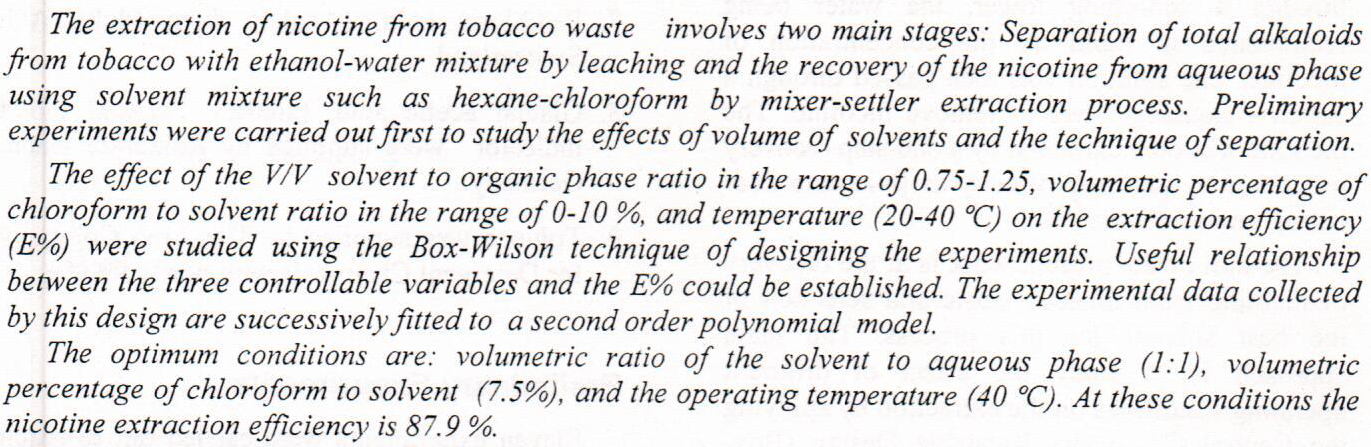
The Nicotine Extraction from Tobacco Wastes

The aim of this study is to utilize the electromembrane extraction (EME) system as a manner for effective removal of zinc from aqueous solutions. A novel and distinctive electrochemical cell design was adopted consisting of two glass chambers, a supported liquid membrane (SLM) housing a polypropylene flat membrane infused with 1-octanol and a carrier. Two electrodes were used, a graphite as anode and a stainless steel as cathode. A comprehensive examination of several influential factors including the choice of carrier, the applied voltage magnitude, the initial pH of the donor solution, and the initial concentration of zinc was performed, all in a concerted effort to ascertain their respective impacts on the efficiency of zinc elim
... Show More (5)
(5)
 (2)
(2)


 (8)
(6)
(8)
(6)
In this study Microwave and conventional methods have been used to extract and estimate pectin and its degree of esterification from dried grapefruit and orange peels. Acidified solution water with nitric acid in pH (1.5) was used. In conventional method, different temperature degrees for extraction pectin from grape fruit and orange(85 ,90 , 95 and 100?C) for 1 h were used The results showed grapefruit peels contained 12.82, 17.05, 18.47, 15.89% respectively, while the corresponding values were 5.96, 6.74, 7.41 and 8.00 %, respectively in orange peels. In microwave method, times were 90, 100, 110 and 120 seconds. Grapefruit peels contain 13.86, 16.57, 18.69, and 17.87%, respectively, while the corresponding values were of 6.53, 6.68, 7.2
... Show More
(2)
The art of calligraphy is regarded as one of the tremendous and distinct products in the history of Islamic arts through the unparalleled high ranks it reached to, until it gained Islam's indication and became a symbol for it, in terms of its function linked to the calligraphy of the holy Qur'anic texts, where this merit formed a strong impulse in seeking its development, the emergence of the calligraphic constructs, including the calligraphic straps, is one of this continual seeking products, and an advanced stage at the level of technical and expressive development, and also one of the natural results generated by the development of fonts and the increase of their employing methods through what they recorded at the level of formal char
... Show More
In the image processing’s field and computer vision it’s important to represent the image by its information. Image information comes from the image’s features that extracted from it using feature detection/extraction techniques and features description. Features in computer vision define informative data. For human eye its perfect to extract information from raw image, but computer cannot recognize image information. This is why various feature extraction techniques have been presented and progressed rapidly. This paper presents a general overview of the feature extraction categories for image.
The extraction of Basil oil from Iraqi Ocimum basillicum leaves using n-hexane and petroleum ether as organic solvents were studied and compared. The concentration of oil has been determined in a variety of extraction temperatures and agitation speed. The solvent to solid ratio effect has been studied in order to evaluate the concentration of Ocimum basillicum oil. The optimum experimental conditions for the oil extraction were established as follows: n-hexane as organic solvent, 60 °C extraction temperature, 300 rpm agitation speed and 40:1mL:g amount of solvent to solid ratio.
(9)
(8)
This study investigates the treatment of used lubricating oils from AL-Mussaib Gas Power Station Company-Iraq, which was treated with different extractive solvents (heptane and 2-propanol). The performance activity of these solvents in the extraction process was examined and evaluated experimentally. Operating parameters were solvent to oil ratios of (1:2, 1:4, 1:6, and 1:8), mixing time (20, 35, 50, and 65 min), temperatures (30, 40, 50, and 60 ºC), and mixing speed (500 rpm). These parameters were studied and analyzed. The quality is determined by the measuring and assessment of important characteristics specially viscosity, viscosity index, specific gravity, pour point, flash point, and ash content. The results confirm that the solve
... Show More
(6)
In many video and image processing applications, the frames are partitioned into blocks, which are extracted and processed sequentially. In this paper, we propose a fast algorithm for calculation of features of overlapping image blocks. We assume the features are projections of the block on separable 2D basis functions (usually orthogonal polynomials) where we benefit from the symmetry with respect to spatial variables. The main idea is based on a construction of auxiliary matrices that virtually extends the original image and makes it possible to avoid a time-consuming computation in loops. These matrices can be pre-calculated, stored and used repeatedly since they are independent of the image itself. We validated experimentally th
... Show More
(29)
(29)
The usage of remote sensing techniques in managing and monitoring the environmental areas is increasing due to the improvement of the sensors used in the observation satellites around the earth. Resolution merge process is used to combine high resolution one band image with another one that have low resolution multi bands image to produce one image that is high in both spatial and spectral resolution. In this work different merging methods were tested to evaluate their enhancement capabilities to extract different environmental areas; Principle component analysis (PCA), Brovey, modified (Intensity, Hue ,Saturation) method and High Pass Filter methods were tested and subjected to visual and statistical comparison for evaluation. Both visu
... Show More
(1)
This study investigates the treatment of used lubricating oils from AL-Mussaib Gas Power Station Company-Iraq, which was treated with different extractive solvents (heptane and 2-propanol). The performance activity of these solvents in the extraction process was examined and evaluated experimentally. Operating parameters were solvent to oil ratios of (1:2, 1:4, 1:6, and 1:8), mixing time (20, 35, 50, and 65 min), temperatures (30, 40, 50, and 60 ºC), and mixing speed (500 rpm). These parameters were studied and analyzed. The quality is determined by the measuring and assessment of important characteristics specially viscosity, viscosity index, specific gravity, pour point, flash point, and ash content. The results confirm that the
... Show More
(7)