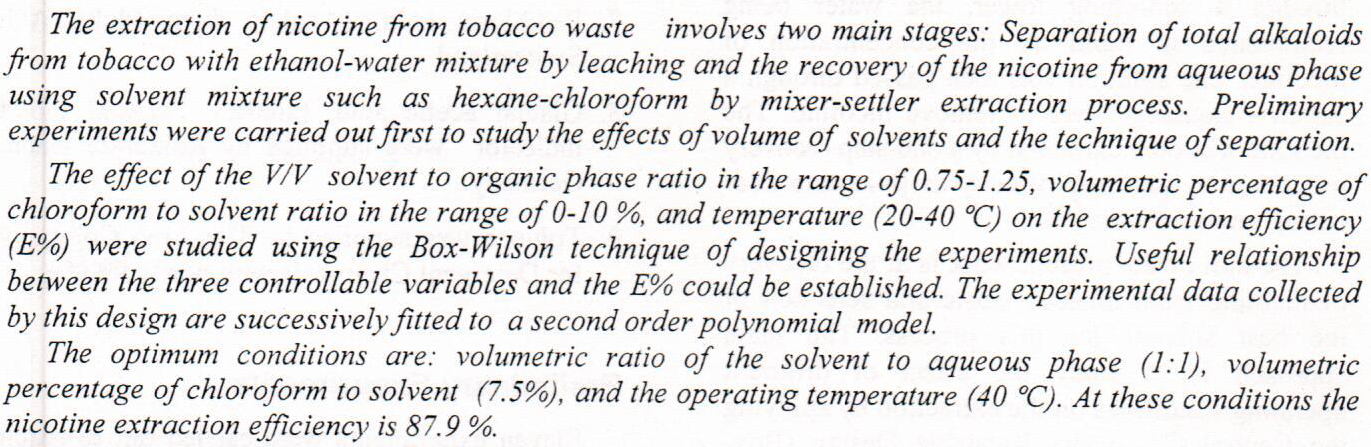
The Nicotine Extraction from Tobacco Wastes

Removal of solar brown and direct black dyes by coagulation with two aluminum based
coagulants was conducted. The main objective is to examine the efficiency of these
coagulants in the treatment of dye polluted water discharged from Al-Kadhymia Textile
Company (Baghdad-Iraq). The performance of these coagulants was investigated through
jar test by comparing dye percent removal at different wastewater pH, coagulant dose,
and initial dye concentration. Results show that alum works better than PAC under acidic
media (5-6) and PAC works better under basic media (7-8) in the removal of both solar
brown and direct black dyes. Higher doses of PAC were required to achieve the
maximum removal efficiency under optimum pH co

The removal of boron from aqueous solution was carried out by electrocoagulation (EC) using magnesium electrodes as anode and stainless steel electrodes as cathode. Several operating parameters on the removal efficiency of boron were investigated, such as initial pH, current density, initial boron ion concentration, NaCl concentration, spacing between electrodes, electrode material, and presence of carbonate concentration. The optimum removal efficiency of 91. 5 % was achieved at a current density of 3 mA/cm² and pH = 7 using (Mg/St. St. ) electrodes, within 45 min of operating time. The concentration of NaCl was o. 1 g/l with a 0.5cm spacing between the electrodes. First and second order rate equation were applied to study adsorp
... Show More (1)
(1)
This study focused on treating wastewater to remove phosphorus by adsorption onto naturaland local materials. Burned kaolin, porcelinite, bauxite and limestone were selected to be testedas adsorption materials.The adsorption isotherms were evaluated by batch experiments, studyingthe effects of pH, temperature and initial phosphorus concentration. The results showed that at pH6, temperature 20°C and 300 mg/l initial phosphorus concentration; the sorption capacity was0.61, 9, 10 and 13 mg/g at 10 h contact time, for burned kaolin, porcelanite, limestone and bauxiterespectively. As the pH increased from 2 to 10 the removal efficiency for the materials differs inbehaviour. The removal efficiency increased from 40 to 90 % for limestone, and dec
... Show More
(3)
The degradation and mineralization of 4-chlorophenol (4-CP) by advanced oxidation processes (AOPs) was investigated in this work, using both of UV/H2O2 and photo-Fenton UV/H2O2/Fe+3 systems.The reaction was influenced by the input concentration of H2O2, the amount of the iron catalyst, the type of iron salt, the pH and the concentration of 4-CP. A colored solution of benzoquinon can be observed through the first 5 minutes of irradiation time for UV/H2O2 system when low concentration (0.01mol/L) of H2O2 was used. The colored solution of benzoquinon could also be observed through the first 5 minutes for the UV/H2O2/Fe+3 system at high
concentration (100ppm) of 4-CP. The results have shown that adding Fe+3 to the UV/H2O2 system enhanced
(1)
In the present research, the chemical washing method has been selected using three chelating agents: citric acid, acetic acid and Ethylene Diamine Tetraacetic Acid (EDTA) to remove 137Cs from two different contaminated soil samples were classified as fine and coarse grained. The factors that affecting removal efficiency such as type of soil, mixing ratio and molarity have been investigated. The results revealed that no correlation relation was found between removal efficiency and the studied factors. The results also showed that conventional chemical washing method was not effective in removing 137Cs and that there are further studies still need to achieve this objective.
 (87)
(88)
(87)
(88)

 (21)
(19)
(21)
(19)
The presence of residual antibiotics in water results in the development of antibiotics resistant genes. The available wastewater treatment systems are not capable of removing such antibiotics from sewage. Thus, antibiotics need to be removed before the discharge of wastewater. Adsorption is among the promising techniques for the wastewater treatment to aid the removal of a wide range of organic and inorganic pollutants. The present work is a contribution to the search for an economical method for the removal of low concentrations of amoxicillin (AMX) from water by adsorption on water treatment residue, WTR, taken from a local drinking water facility. The chemical composition and the adsorptive characteristics of the material were first
... Show More
(22)
(19)
(39)
(36)
In this study miconazole nitrate was formulated as topically applied emulgel; different formulas were prepared using sodium carboxymethylcellulose (SCMC) and carboxypolymethylene (carbomer 941) as gelling agents. The influence of type of gelling agent and concentration of both oil phase and emulsifying agent on drug release was studied and compared with commercially available miconazole nitrate cream (Mecozalen®). The results of in vitro release showed that SCMC emulgel bases gave better release than carbomer 941 bases and the release of drug increase from both bases as a function of increasing the concentration of emulisifying agent. The oil phase had retardation effect when
... Show More
(7)