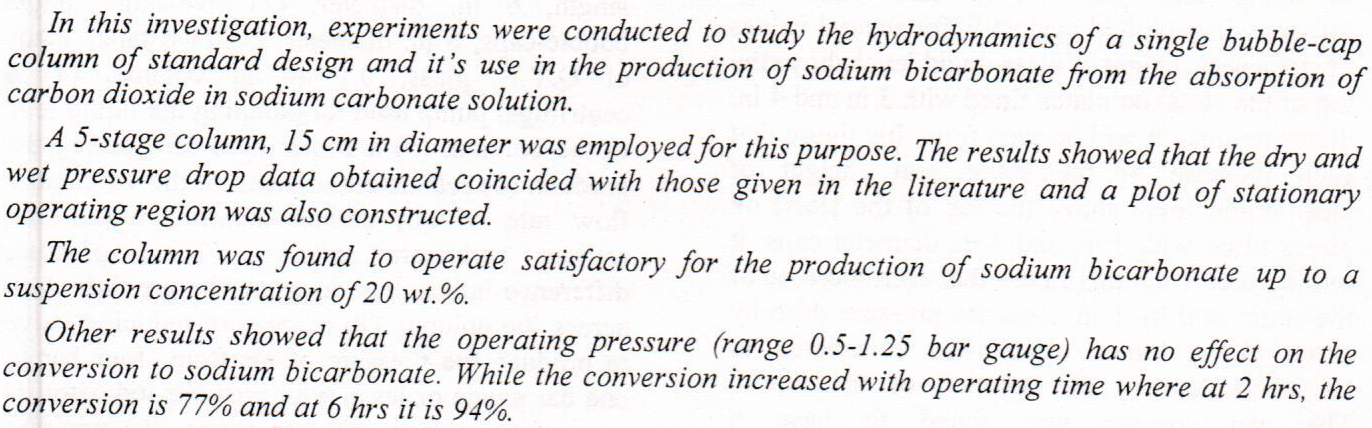
A Study of Absorption Column with Single Bubble Cap Tray in the Production of Sodium Bicarbonate

This paper develops a fuzzy multi-objective model for solving aggregate production planning problems that contain multiple products and multiple periods in uncertain environments. We seek to minimize total production cost and total labor cost. We adopted a new method that utilizes a Zimmermans approach to determine the tolerance and aspiration levels. The actual performance of an industrial company was used to prove the feasibility of the proposed model. The proposed model shows that the method is useful, generalizable, and can be applied to APP problems with other parameters.
 (12)
(12)
 (4)
(4)


The aim of this study is to shed light on the importance of biofuels as an alternative to conventional energy, in addition to the importance of preserving agricultural crops, which are the main source of this fuel, to maintain food security, especially in developing countries. The increase in global oil prices, in addition to the fear of global warming, are among the main factors that draw the world’s attention to searching for alternative sources of traditional energy, which are sustainable on the one hand, and on the other hand reduce carbon emissions. Therefore, the volume of global investment in renewable energy in general, and in liquid biofuels and biomass in particular, has increased. Global fears emerged that the excessive
... Show More
In this study, sulfur was removed from imitation oil using oxidative desulfurization process. Silicoaluminophosphate (SAPO-11) was prepared using the hydrothermal method with a concentration of carbon nanotubes (CNT) of 0% and 7.5% at 190 °C crystallization temperature. The final molar composition of the as-prepared SAPO-11 was Al2O3: 0.93P2O5: 0.414SiO2. 4% MO/SAPO-11 was prepared using impregnation methods. The produced SAPO-11 was described using X-ray diffraction (XRD) and Brunauer-Emmet-Teller (N2 adsorption–desorption isotherms). It was found that the addition of CNT increased the crystallinity of SAPO-11. The results showed that the surface area of SAPO-11 containing 7.5% CNT was 179.54 m2/g, and the pore volume was 0.31
... Show More
(6)
In this study, sulfur was removed from imitation oil using oxidative desulfurization process. Silicoaluminophosphate (SAPO-11) was prepared using the hydrothermal method with a concentration of carbon nanotubes (CNT) of 0% and 7.5% at 190 °C crystallization temperature. The final molar composition of the as-prepared SAPO-11 was Al2O3: 0.93P2O5: 0.414SiO2. 4% MO/SAPO-11 was prepared using impregnation methods. The produced SAPO-11 was described using X-ray diffraction (XRD) and Brunauer-Emmet-Teller (N2 adsorption–desorption isotherms). It was found that the addition of CNT increased the crystallinity of SAPO-11. The results showed that the surface area of SAPO-11 cont
... Show More
(6)
This research is devoted to study the effect of different in weight percentage of Sio2 particles and glass fibers (5, 10, 15, 20) wt. % on the wear rate epoxy resin. The results show that the value of hardness increase with the increase for the weight percentage of reinforcing particles and fibers, while the wear rate decrease with the increase the load level of the reinforcing particles and fibers . The largest value of the hardness, and the lowest value of the wear rate for epoxy reinforced with 20% of SiO2, the wear rate increase in general with increasing the applied load.
(2)
Background: Fixed orthodontic appliances impede the maintenance of oral hygiene and result in plaque accumulation leads to enamel demineralization caused by acids produced by bacteria. Studies on plaque control strategies in orthodontic populations are limited. This might be caused by difficulties in the quantitative evaluation of dental plaque because the teeth have various levels of bracket coverage, and different tooth sizes and malocclusions, making the traditional categorical indices complex. The present study aims to evaluate the effect of different hygiene protocols on plaque quantity on bands with different attachments. Materials and method: Twenty patients had four bands within the orthodontic appliance. Then randomly divided into
... Show MoreA group of acceptance sampling to testing the products was designed when the life time of an item follows a log-logistics distribution. The minimum number of groups (k) required for a given group size and acceptance number is determined when various values of Consumer’s Risk and test termination time are specified. All the results about these sampling plan and probability of acceptance were explained with tables.
Background: Fluoridated acrylic resin material can present more stable properties when compared with conventional one.The most widely used fluoride –containing substance added to dental resin materials is sodium fluoride (Naf). This study evaluated the effect of Naf in different concentration to the acrylic resin denture base material and its effect on tensile strength ,modules of elasticity with long –term water immersion (after 4 months immersion in de-ionized water) Materials and methods: Eighty specimens from dumbbells shaped metal pattern for tensile strength test were preparedaccording to ISO 527: 1993 plastic –Determination tensile properties ,in dimensions(60mm, 12mm, 3 ± 0.2mm) length, width and depth respec
... Show MoreThe research aims to determine the mix of production optimization in the case of several conflicting objectives to be achieved at the same time, therefore, discussions dealt with the concept of programming goals and entrances to be resolved and dealt with the general formula for the programming model the goals and finally determine the mix of production optimization using a programming model targets to the default case.