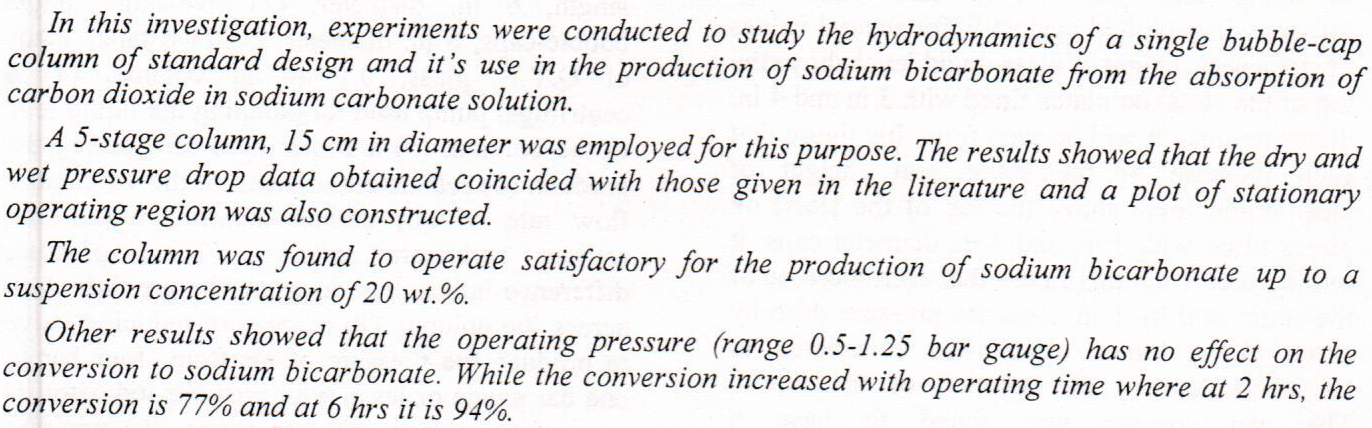
A Study of Absorption Column with Single Bubble Cap Tray in the Production of Sodium Bicarbonate

In this work, an explicit formula for a class of Bi-Bazilevic univalent functions involving differential operator is given, as well as the determination of upper bounds for the general Taylor-Maclaurin coefficient of a functions belong to this class, are established Faber polynomials are used as a coordinated system to study the geometry of the manifold of coefficients for these functions. Also determining bounds for the first two coefficients of such functions.
In certain cases, our initial estimates improve some of the coefficient bounds and link them to earlier thoughtful results that are published earlier.
 (4)
(4)
 (2)
(2)


 (1)
(2)
(1)
(2)
The growing demand for sustainable and high-performance asphalt binders has prompted the exploration of waste-derived modifiers. This study investigates the performance enhancement of Natural Asphalt (NA) using Sugarcane Molasses (SM) and Waste Engine Oil (WEO). The modified blends were prepared by partially replacing 50 % NA with varying proportions of SM and WEO ranging from 10 % to 40 % of the total weight of NA. Comprehensive testing was conducted, including penetration, softening point, ductility, viscosity, Bending Beam Rheometer (BBR), Multiple Stress Creep Recovery (MSCR), Energy Dispersive X-ray Spectroscopy (EDX), Fourier Transform Infrared (FTIR) spectroscopy, and Scanning Electron Microscopy (SEM). The results demonstrated that
... Show More
(5)
(3)
Magnetic nanoparticles (MNPs) of iron oxide (Fe3O4) represent the most promising materials in many applications. MNPs have been synthesized by co-precipitation of ferric and ferrous ions in alkaline solution. Two methods of synthesis were conducted with different parameters, such as temperature (25 and 80 ̊C), adding a base to the reactants and the opposite process, and using nitrogen as an inert gas. The product of the first method (MNPs-1) and the second method (MNPs-2) were characterized by x-ray diffractometer (XRD), Zeta Potential, atomic force microscope (AFM) and scanning electron microscope (SEM). AFM results showed convergent particle size of (MNPs-1) and (MNPs-2) with (86.01) and (74.14)
... Show More
(48)
(46)
(43)
(25)
(12)
A comparative study was done on the adsorption of methyl orange dye (MO) using non-activated and activated corn leaves with hydrochloric acid as an adsorbent material. Scanning electron microscopy (SEM) and Fourier Transform Infrared spectroscopy (FTIR) were utilized to specify the properties of adsorbent material. The effect of several variables (pH, initial dye concentration, temperature, amount of adsorbent and contact time) on the removal efficiency was studied and the results indicated that the adsorption efficiency increases with the increase in the concentration of dye, adsorbent dosage and contact time, while inversely proportional to the increase in pH and temperature for both the treated and untreated corn leaves. The equi
... Show More
(27)
Advancing the multi-scale performance of asphalt pavements requires innovative binder modifications that address limitations in rutting resistance, fatigue resistance, and durability across the binder, mixture, and structural levels. This study evaluates the performance of asphalt cement, mixtures, and pavement systems modified with a combination of polyethylene (PE) and carbon nanotubes (CNTs). The binder was modified using 4% PE and varying CNT contents (0.5%, 1%, 1.5%, and 2% by weight of the modified binder). Binder performance was assessed through conventional and rheological tests, including penetration, softening point, viscosity, performance grade (PG) evaluation, and master curve analysis. Mixture-level performance was eval
... Show More
(2)
(4)
Catalytic reduction is considered an effective approach for the reduction of toxic organic pollutants from the environment, but finding an active catalyst is still a big challenge. Herein, Ag decorated CeO2 catalyst was synthesized through polyol reduction method and applied for catalytic reduction (conversion) of 4-nitrophenol (4-NP) to 4-aminophenol (4-AP). The Ag decorated CeO2 catalyst displayed an outstanding reduction activity with 99% conversion of 4-NP in 5 min with a 0.61 min−1 reaction rate (k). A number of structural characterization techniques were executed to investigate the influence of Ag on CeO2 and its effect on the catalytic conversion of 4-NP. The outstanding catalytic performances of the Ag-CeO2 catalyst can be assigne
... Show More
(20)
(19)
(47)
(36)