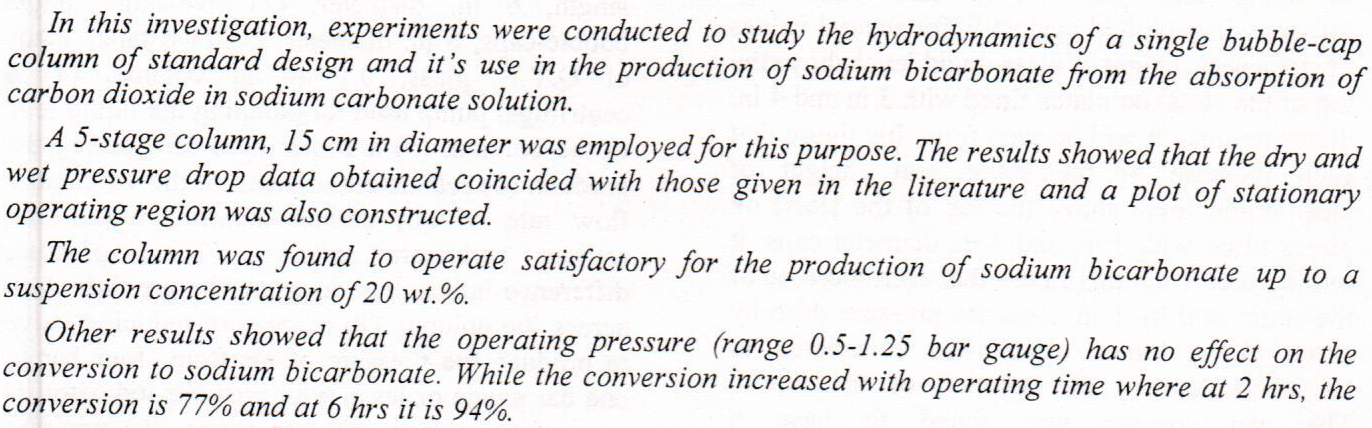
A Study of Absorption Column with Single Bubble Cap Tray in the Production of Sodium Bicarbonate

The varied thermal conductivity (insulation) of silica aerogel with heating for different pH has been investigated, it has been depended on ambient pressure drying method in the preparing silica aerogel samples, also six different pH of samples (1, 2, 3, 7, 8 and 9) were treated under five degree of heating with (50,100,150,200 and 250) ᴼC. This technique is important to test the carry-outs hydrophobic silica to temperature without high-quality material changes in the basic characteristics. The hot-wire technique is used in this work to examine the thermal conductivity, Fourier Transform Infrared Spectroscopy (FTIR) depended to characterize the bonds and their artificial by heating. Resu
... Show More (15)
(15)
 (9)
(9)



Sewage water is a mixture of water and solids added to water for various uses, so it needs to be treated to meet local or global standards for environmentally friendly waste production. The present study aimed to analyze the new Maaymyrh sewage treatment plant's quality parameters statistically at Hilla city. The plant is designed to serve 500,000 populations, and it is operating on a biological treatment method (Activated Sludge Process) with an average wastewater inflow of 107,000m3/day. Wastewater data were collected daily by the Mayoralty of Hilla from November 2019 to June 2020 from the influent and effluent in the (STP) new in Maaymyrh for five water quality standards, such as (BOD5), (COD), (TSS), (TP)
... Show More
(5)
The present work aimed to study the efficiency of nanofiltration (NF) and reverse osmosis (RO) process for treatment of heavy metals wastewater contains zinc. In this research, the salt of heavy metals were zinc chloride (ZnCl2) used as feed solution.Nanofiltration and reverse osmosis membranes are made from polyamide as spiral wound module. The parameters studied were: operating time (0 – 70 min), feed concentrations for zinc ions (10 – 300 mg/l), operating pressure (1 – 4 bar).The theoretical results showed, flux of water through membrane decline from 19 to 10.85 LMH with time. Flux decrease from 25.84 to 10.88 LMH with the increment of feed concentration. The raise of pressure, the flux increase for NF and RO membranes.The maximum
... Show MoreThis research was aimed to the purification and characterization of cytosine deaminase as a medically important enzyme from locally isolated Escherichia coli; then studying its cytotoxic anticancer effects against colon cancer cell line. Cytosine deaminase was subjected to three purification steps including precipitation with 90% ammonium sulfate saturation, ion exchange chromatography on DEAE-cellulose column, and gel filtration chromatography throughout Sephadex G-200 column. Specific activity of the purified enzyme was increased up to 9 U/mg with 12.85 folds of purification and 30.85% enzyme recovery. Characterization study of purified enzyme revealed that the molecular weight of cytosine deaminase produced by E. coli was about 48 KDa,
... Show More
(4)
(2)
For the first time Iron tungstate semiconductor oxides films (FeWO4) was successfully synthesized simply by advanced controlled chemical spray pyrolysis technique, via employed double nozzle instead of single nozzle using tungstic acid and iron nitrate solutions at three different compositions and spray separately at same time on heated silicone (n-type) substrate at 600 °C, followed by annealing treatment for one hour at 500 °C. The crystal structure, microstructure and morphology properties of prepared films were studied by X-ray diffraction analysis (XRD), electron Scanning Electron Microscopy (SEM) and Atomic Force Microscopy (AFM) respectively. According to characterization techniques, a material of well-crystallized monoclinic ph
... Show More
Abstract New derivatives of 1,2,4- triazole , 1,2,4-triazole -3-one and 1,2,4-triazole-3-thione were obtained through this research. Acid hydrazide derivative was present from reaction of poly acryloyl chloride with hydrazine hydrate in presence of DMF as a solvent then reacted with benzonitrile and its derivatives to give 1,2,4-triazole derivatives. After that reaction of poly acryloyl chloride with semicarbazide and semithiocarbazide to form semicarbazone and semithiocarbazone derivatives respectively. Finally, closing of semicarbazone and semithiocarbazone derivatives with 2% NaOH gave 1,2,4-triazole -3-one and 1,2,4-triazole-4-thione derivatives respectively. These new synthesized products have been characterized by infrared, 1 H-n
... Show MoreBackground: overweight and obesity are the fifth leadingrisk for global deaths. At least 2.8 million adults die eachyear as a result of being overweight or obese. Numerousstudies show that weight loss, even if only 5-10%,significantly improves dyslipidemia, hypertension, diabetesmellitus, risk for osteoarthritis and its symptoms and risk forselected cancers.Objectives: is to evaluate the effect of diet and exerciseprogram on anthropometric and biochemical status of adultobese patients.Methods: descriptive study. 124 adult obese patientsattending Al Kindy obesity research and therapy unit duringDecember 2012 were included. Measurement of Wt, heightHt and WC performed and BMI was calculated. Laboratorytest analysis, on the fasting state, w
... Show MoreZnO nanostructures were synthesized by hydrothermal method at different temperatures and growth times. The effect of increasing the temperature on structural and optical properties of ZnO were analyzed and discussed. The prepared ZnO nanostructures were characterized by X-ray diffraction (XRD), UV–Vis. absorption spectroscopy (UV–Vis.), Photoluminescence (PL), and scanning electron microscopy (SEM). In this work, hexagonal crystal structure prepared ZnO nanostructures was observed using X-ray diffraction (XRD) and the average crystallite size equal 14.7 and 23.8 nm for samples synthesized at growth time 7 and 8 hours respectively. A nanotubes-shaped surface morphology was found using scanning electron microscopy (SEM). The optic
... Show More
(4)
An experiment was conducted in a greenhouse - research station B - College of Agricultural Engineering Sciences, University of Baghdad, during the fall season of 2018 with the aim of propagating and initially studying the field performance of 18 and 20 potential potato lines derived from Rivera and Arizona cv. after in vitro exposure of nodal segments to different dosages of gamma rays (0, 10, 20, and 30 Gray) and EMS (0, 10, 20, and 30 mM). Each control cultivar and their derived lines were independently cultured in plastic bags according to the RCBD, with three replications. The results showed that the highest plant height and number of leaves were obtained from Arizona derived lines which gave 60.11 cm and 25.30 leaves.plant-1 in
... Show More
(9)
(2)
(3)
(3)