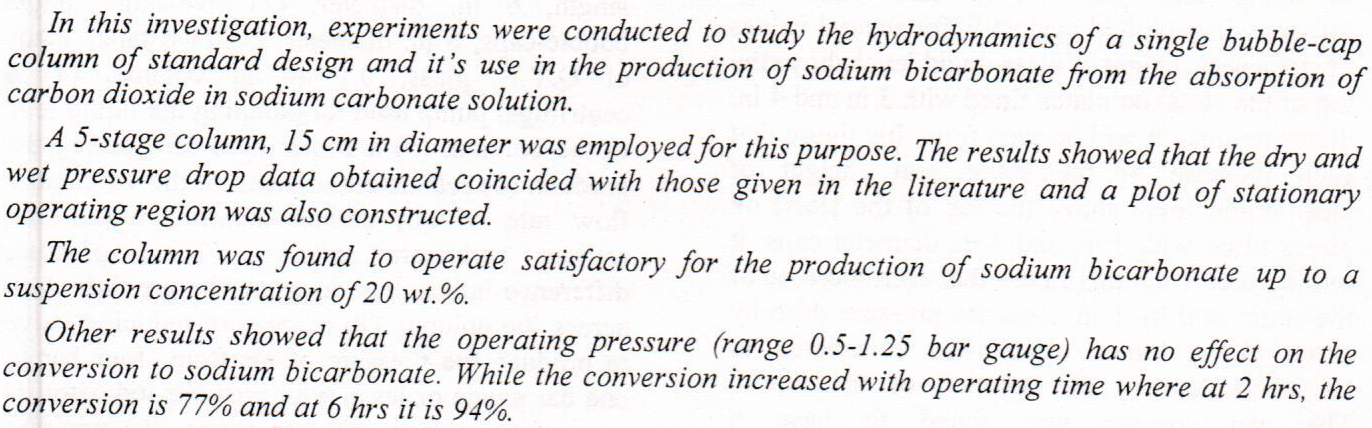
A Study of Absorption Column with Single Bubble Cap Tray in the Production of Sodium Bicarbonate

Aqueous Two Phase System (ATPS) or liquid-liquid extraction is used in biotechnology to recover valuable compounds from raw sources. In Aqueous Two-Phase Systems, many factors influence the Partition coefficient, K, (which is the ratio of protein concentration in the top phase to that in the bottom phase) and the Recovery percentage (Rec%). In this research, two systems of ATPS were used: first, polyethylene glycol (PEG) 4000/Sodium citrate (SC), and the second, PEG8000/ Sodium phosphate (SPH), for the extraction of Bovine Serum Albumin (BSA). The behavior of Rec% and K of pure (BSA) in ATPS has been investigated throughout the study by the effects of five parameters: temperature, concentration of polyethylene glycol (P
... Show More (5)
(5)
 (4)
(4)


Equilibrium and rate of mixing of free flowing solid materials are found using gas fluidized bed. The solid materials were sand (size 0.7 mm), sugar (size0.7 mm) and 15% cast iron used as a tracer. The fluidizing gas was air with velocity ranged from 0.45-0.65 m/s while the mixing time was up to 10 minutes. The mixing index for each experiment was calculated by averaging the results of 10 samples taken from different radial and axial positions in fluidized QVF column 150 mm ID and 900 mm height.
The experimental results were used in solving a mathematical model of mixing rate and mixing index at an equilibrium proposed by Rose. The results show that mixing index increases with inc
... Show MoreA rapid high performance liquid chromatography method for the determination of sphinganine (Sa) and sphingosine (So) in urine samples by employing a silica-based monolithic column is described. The samples were first extracted using ethyl acetate and derivatized using ortho-phthaldialdehyde in the presence of 2-mercaptoethanol. C20 sphinganine was used as internal standard. Under the optimized conditions, separation was achieved using a mixture of methanol:water (93:7, v/v), column temperature at 30°C, flow rate of 1 mL min−1, and an injection volume of 10 μL. Good linearity was obtained for Sa and So over the concentration range 20–500 ng mL−1(correlation coefficients ≥0.9978). The detection limits were 0.45 ng mL−1 for Sa and
... Show More
(1)
(1)
 (5)
(4)
(5)
(4)
This study utilized low-cost agricultural waste (molasses production waste powder) to extract copper ions from aqueous solutions. The present investigation explored a range of factors that influence the adsorption process, including temperature, pH, ionic strength, contact time, quantity of adsorbent, and particle size. Spectrophotometric analysis was used to determine the solution's absorbance both before and after the adsorption procedure. The Langmuir and Freundlich adsorption models were used to match the equilibrium data. The Freundlich model was determined to be the best isotherm model using the linear regression coefficient R2=0.9868. Thermodynamic parameters, including enthalpy, entropy, and Gibbs free energy, were calculate
... Show More
True random number generators are essential components for communications to be conconfidentially secured. In this paper a new method is proposed to generate random sequences of numbers based on the difference of the arrival times of photons detected in a coincidence window between two single-photon counting modules
(23)
(18)
the first part of the research involves investigate the aspect of the radiation superposed on the one bright soliton pulse propagated on ideal single mode
This study has been conducted to examin the effect of sodium propionate at different level of 0.03,0.06,0.10% on the number of bacteria and mold and to extend the storage life of laboratory processed biscuit. The results indicated that the use of 0.10% sodium propionate prolonged the storage peroid until the third month, while the use of 0.20% sodium propionate showed no growth of bacteria up to six month of storage, three types of bacteria has been isolated from processed biscuit, namely, Staphylococcus aureus, Bacillus cereus, Esherichia coli. using 0.10% sodium propionate showed no growth of mold up to three month of storage ,while using of 0.15 % and 0.20% sodium propionate prevent the growth
... Show More