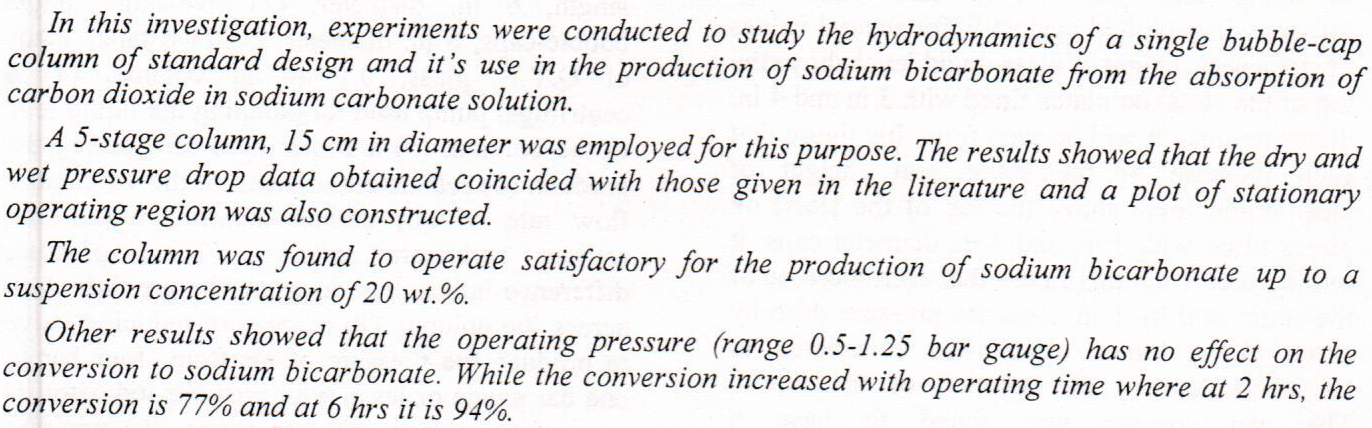
A Study of Absorption Column with Single Bubble Cap Tray in the Production of Sodium Bicarbonate

 (10)
(10)
 (9)
(9)

 (150)
(146)
(150)
(146)

Drastic threat to the natural system is caused by the uncontrolled release of synthetic pollutants, including azo dyes. This study centered on the decolorization and biodegradation of water soluble azo dye reactive blue (RB) in a batch mode sequential anaerobic-aerobic processes. A local sewage treatment plant was the source where activated sludge was collected to be used as non-adapted mixed culture with both free and the alginate immobilized cells for RB biodegradation. Under anaerobic conditions, the free and immobilized mixed cells were proved to completely decolorize 10 mg/ L of RB within 20 and 30 h, respectively. Alginate- immobilized mixed cells, resulted in 88%, 87%, and 87% maximum COD removals with samples con
... Show More
(15)
For the most reliable and reproducible results for calibration or general testing purposes of two immiscible liquids, such as water in engine oil, good emulsification is vital. This study explores the impact of emulsion quality on the Fourier transform infrared (FT-IR) spectroscopy calibration standards for measuring water contamination in used or in-service engine oil, in an attempt to strengthen the specific guidelines of ASTM International standards for sample preparation. By using different emulsification techniques and readily available laboratory equipment, this work is an attempt to establish the ideal sample preparation technique for reliability, repeatability, and reproducibility for FT-IR analysis while still considering t
... Show More
(13)
(11)
(2)
(8)
(6)
In this paper, fire resistance and residual capacity tests were carried out on encased pultruded glass fiber-reinforced polymer (GFRP) I-beams with high-strength concrete beams. The specimens were loaded concurrently under 25% of the ultimate load and fire exposure (an increase in temperature of 700 °C) for 70 min. Subsequently, the fire-damaged specimens were allowed to cool and then were loaded statically until failure to explore the residual behaviors. The effects of using shear connectors and web stiffeners on the residual behavior were investigated. Finite Element (FE) analysis was developed to simulate the encased pultruded GFRP I-beams under the effect of fire loading. The thermal analyses were performed using the general-pu
... Show More
(34)
(36)
(27)
Polypyrrole/silver (PPy/Ag) nanocomposites was synthesized via a chemical oxidative method. The AFM analysis is performed to study the surface roughness, morphology and size distribution of the PPy particles and PPy-ag nanocomposites. The results indicated that as the concentration of Ag in the nanocomposite increases, the roughness also increases. The size of nanoparticles was also evaluated and found in the range of 15 nm to 125 nm. The PPy/Ag nanocomposites exhibited an effectiveness against Gram-negative Escherichia coli showing an inhibition zone of 4mm and displayed poor efficacy against Gram-positive Staphylococcus aureus. Based on given adequate antibacterial characteristics of PPy/Ag nanocomposites, it can be identified as a pro
... Show More
(4)
(1)