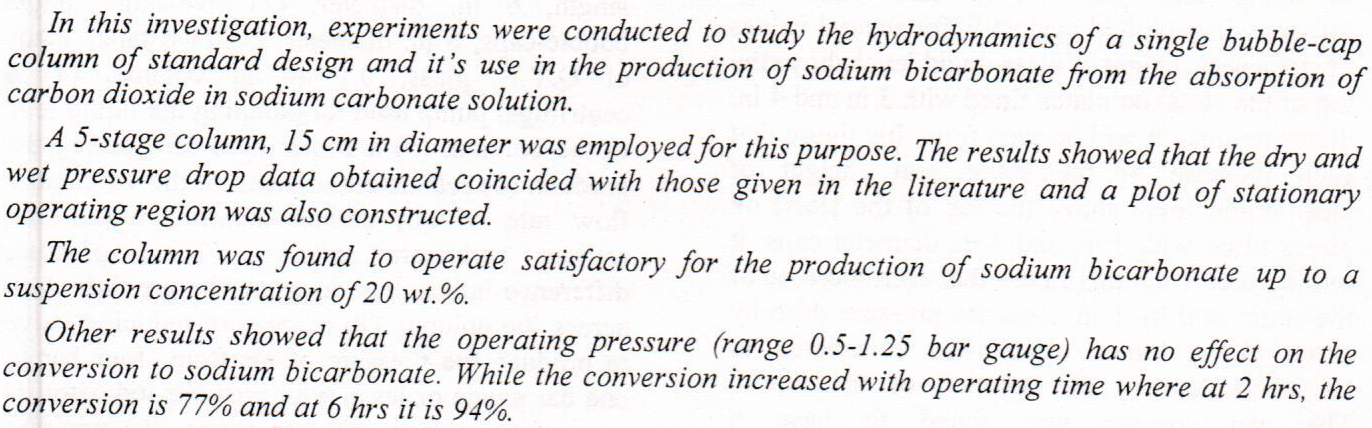
A Study of Absorption Column with Single Bubble Cap Tray in the Production of Sodium Bicarbonate

The Sonic Scanner is a multifunctional instrument designed to log wells, assess elastic characteristics, and support reservoir characterisation. Furthermore, it facilitates comprehension of rock mechanics, gas detection, and well positioning, while also furnishing data for geomechanical computations and sand management. The present work involved the application of the Sonic Scanner for both basic and advanced processing of oil-well-penetrating carbonate media. The study aimed to characterize the compressional, shear, Stoneley slowness, rock mechanical properties, and Shear anisotropy analysis of the formation. Except for intervals where significant washouts are encountered, the data quality of the Monopole, Dipole, and Stoneley modes is gen
... Show MoreA simple physical technique was used in this study to create stable and cost-effective copper oxide (CuO) nanoparticles from pure copper metal using the pulsed laser ablation technique. The synthesis of crystalline CuO nanoparticles was confirmed by various analytical techniques such as particle concentration measurement using atomic absorption spectrometry (AAS), field emission scanning electron microscopy (FE-SEM), the energy dispersive X-ray (EDX), and X-ray diffraction (XRD) to determine the crystal size and identify of the crystal structure of the prepared particles. The main characteristic diffraction peaks of the three samples were consistent. The corresponding 2θ is also consistent, and the cytotoxicity of the nanoparticles was
... Show More (2)
(2)

 (3)
(3)

In this study, manganese dioxide (MnO₂) nanoparticles (NPs) were synthesized via the hydrothermal method and utilized for the adsorption of Janus green dye (JG) from aqueous solutions. The effects of MnO₂ NPs on kinetics and diffusion were also analyzed. The synthesized NPs were characterized by scanning electron microscopy (SEM), X-ray diffraction (XRD), energy-dispersive X-ray analysis (EDX), and Fourier-transform infrared spectroscopy (FT-IR), with XRD confirming the nanoparticle size of 6.23 nm. The adsorption kinetics were investigated using three models: pseudo-first-order (PFO), pseudo-second-order (PSO), and the intraparticle diffusion model. The PSO model provided the best fit (R² = 0.999), indicating that the adsorpti
... Show More
(1)
 (21)
(19)
(21)
(19)
The variation in wing morphological features was investigated using geometric morphometric technique of the Sand Fly from two Iraqi provinces Babylon and Diyala . We distributed eleven landmarks on the wings of Sand Fly species. By using the centroid size and shape together, all species were clearly distinguished. It is clear from these results that the wing analysis is an essential method for future geometric morphometry studies to distinguish the species of Sand Flies in Iraq.
(1)
Phytochemical Screening and Antibacterial Effect of Stevia Rebaudiana (Bertoni) Alcoholic Leaves Extract on Streptococcus Oralis (Dental Plaque’s Primary Colonizer), Manar Ibrahim
Reverse Osmosis (RO) has already proved its worth as an efficient treatment method in chemical and environmental engineering applications. Various successful RO attempts for the rejection of organic and highly toxic pollutants from wastewater can be found in the literature over the last decade. Dimethylphenol is classified as a high-toxic organic compound found ubiquitously in wastewater. It poses a real threat to humans and the environment even at low concentration. In this paper, a model based framework was developed for the simulation and optimisation of RO process for the removal of dimethylphenol from wastewater. We incorporated our earlier developed and validated process model into the Species Conserving Genetic Algorithm (SCG
... Show More
(15)
(13)
In this study, the antimicrobial properties of newly synthesized Schiff bases (4a-4e) and thiazolidinone compounds (5a-5e) generated from 3,5-dinitrobenzoic acid were assessed. These compounds were obtained by reacting 3,5-dinitrobenzoic acid (1) with ethanol in a few drops of concentrated H2SO4 to produce the ester (2). The acid hydrazide (3), which was produced by treating the ester with hydrazine hydrate, reacted with the proper aldehydes, including 4-bromobenzaldehyde, 4-chlorobenzaldehyde, 4-hydroxybenzaldehyde, 4-methoxybenzaldehyde, and 4-hydroxy-3-methoxybenzaldehyde, respectively, to form Schiff bases (4a-4e). The thiazolidinone compounds (5a-5e) were produced by the cyclocondensation reaction of compounds (4a-4e) with thio
... Show More
In this study, the antimicrobial properties of newly synthesized Schiff bases (4a-4e) and thiazolidinone compounds (5a-5e) generated from 3,5-dinitrobenzoic acid were assessed. These compounds were obtained by reacting 3,5-dinitrobenzoic acid (1) with ethanol in a few drops of concentrated H2SO4 to produce the ester (2). The acid hydrazide (3), which was produced by treating the ester with hydrazine hydrate, reacted with the proper aldehydes, including 4-bromobenzaldehyde, 4-chlorobenzaldehyde, 4-hydroxybenzaldehyde, 4-methoxybenzaldehyde, and 4-hydroxy-3-methoxybenzaldehyde, respectively, to form Schiff bases (4a-4e). The thiazolidinone compounds (5a-5e) were produced by the cyclocondensation reaction of compounds (4a-4e) with thio
... Show More