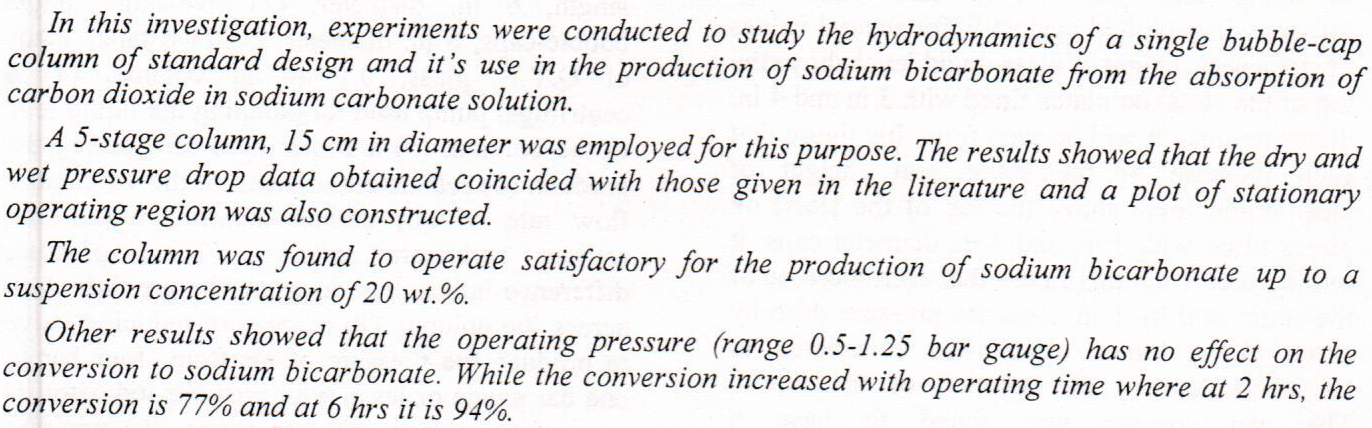
A Study of Absorption Column with Single Bubble Cap Tray in the Production of Sodium Bicarbonate

Abstract: Background: Staphylococcus aureus is Gram-positive bacteria that lives as a normal flora in living organisms but can be pathogenic to humans. Although a relatively unspectacular, nonmotile coccoid bacterium, S. aureus is a dangerous human pathogen in both community-acquired and nosocomial infections. Due to the increasing emergence of new strains of this antibiotic-resistant bacteria, it has become essential to approach different methods to control this pathogen. One of these methods is the antimicrobial photodynamic inactivation process using a low-level laser, in this paper, the Photodynamic effects of Rose Bengal and LLLL on the virulence factors of S.aureus were evaluated.
Purpose Heavy metals are toxic pollutants released into the environment as a result of different industrial activities. Biosorption of heavy metals from aqueous solutions is a new technology for the treatment of industrial wastewater. The aim of the present research is to highlight the basic biosorption theory to heavy metal removal. Materials and methods Heterogeneous cultures mostly dried anaerobic bacteria, yeast (fungi), and protozoa were used as low-cost material to remove metallic cations Pb(II), Cr(III), and Cd(II) from synthetic wastewater. Competitive biosorption of these metals was studied. Results The main biosorption mechanisms were complexation and physical adsorption onto natural active functional groups. It is observed that
... Show More (52)
(52)

This study uses an environmentally friendly and low-cost synthesis method to manufacture zinc oxide nanoparticles (ZnO NPs) by using zinc sulfate. Eucalyptus leaf extract is an effective chelating and capping agent for synthesizing ZnO NPs. The structure, morphology, thermal behavior, chemical composition, and optical properties of ZnO nanoparticles were studied utilizing FT-IR, FE-SEM, EDAX, AFM, and Zeta potential analysis. The FE-SEM pictures confirmed that the ZnO NPs with a size range of (22-37) nm were crystalline and spherical. Two methods were used to prepare ZnO NPs. The first method involved calcining the resulting ZnO NPs, while the second method did not. The prepared ZnO NPs were used as adsorbents for removing acid black 210
... Show More (6)
(4)
(6)
(4)
 (54)
(48)
(54)
(48)

Laboratory studies were conducted at the biological control unit, college of Agriculture, University of Baghdad to evaluate some biological aspects of the predator Chilocorus bipustulatus (Coleoptera: Coccinellidae), which is considered one of the most important predators on many insect pests, especially the scale insect, Parlatoria blanchardi, (Homoptera: Diaspididae) on date palms. The results showed that biological parameters of the predator were varied according to different degree of temperature. Egg incubation period was significantly different and reached to 7.5 and 5.44 day at 25 and 30°C respectively, Fertility was the same 100% at both temperature degrees. Larval growth periods were 17.41 and 16.12 day as well as the mortality
... Show More
(3)
(3)
Objective: to assess the awareness and knowledge of our medical students regarding dose levels of imaging procedures and radiation safety issues, and to conclude how the curriculum of clinical radiology in the college medical program impacts such knowledge.
Subjects and methods: this is a cross-sectional study conducted among 150 medical students in Alkindy College of Medicine between January 2021 to July 2021, regardless of their age or gender. The study included six grades according to the year 2020-2021. A questionnaire consisting of 12 multiple-choice questions was conducted via an online survey using Google Forms. The questions were divided into two parts
... Show More
(1)
Aromatic Schiff-bases are known to have antibacterial activity, but most of these compounds are sparingly soluble in water. The present work describes the synthesis of new Schiff-bases derived from branched aminosugars. Treatment of 3-Amino-3-Cyano-3-Deoxy-1,2:5,6-Di-O-Isopropylene-α-D-Allofuranose (1) with the aldehydes (2) under reflux in methanol afforded the Schiff-bases (3) in good yields. The new Schiff-bases were in accord with their NMR, IR spectral data and elemental analysis.
The current study aimed the syntheses and characterizations of Gold nanoparticles (Au NPs) using a laser ablation Q-switched Nd: YAG laser with a wave-length of 355 nm at a variety of laser pulse energies (E) and deposited on porous silicon (PS). Optical emission spectrometer was used to diagnosed medium air to study gold plasma characteristics and prepared Au nanoparticles. The laser pulse energy influence has been studied on the plasma characteristics in air. The data showed the emergence of the ionic (Au II) spectral emission lines in the gold plasma emission spectrum. XRD has been utilized to examine structural characteristics. Moreover, AFM results 37.2 nm as the mean value of the diameter that is coordinated in a shape similar to the
... Show More