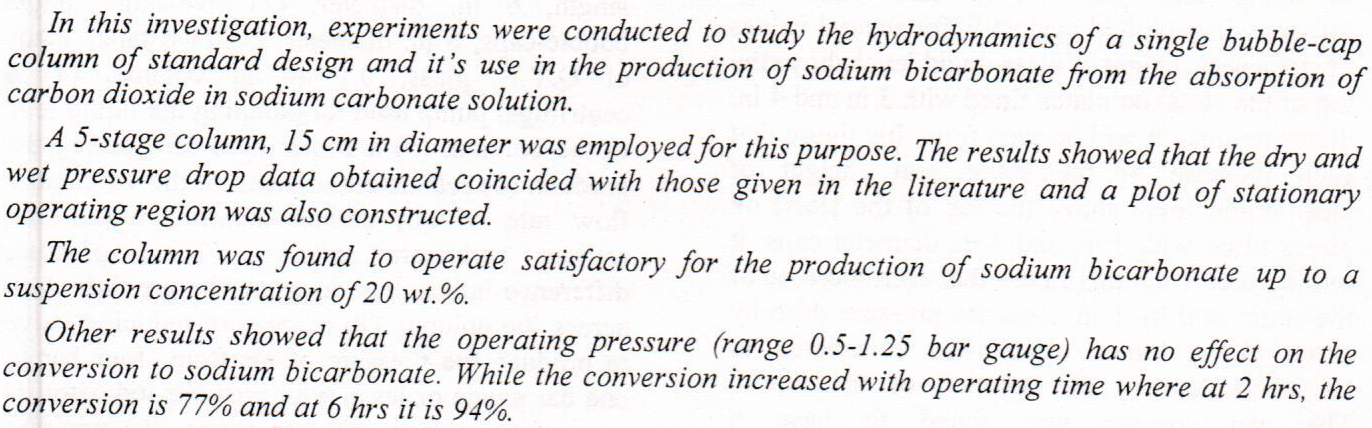
A Study of Absorption Column with Single Bubble Cap Tray in the Production of Sodium Bicarbonate

Non-steroidal anti-inflammatory drugs (NSAIDs) contain free –COOH which thought to be responsible for the GI irritation associated with all traditional NSAIDs. The esterification of this group is one of an approach to ultimate aim for reduce the gastric irritation; so in this study we synthesized and preliminarily evaluated new ester compounds as new analogues with expected selectivity toward COX-2 enzyme. Synthetic procedures have been successfully developed for the generation of the target compounds (III a and b). The synthetic approach involved multi-steps procedures which include: Synthesis of 4-hydroxy benzene sulphonamide ( I b ), synthesis of Naproxen and Ibuprofen acyl chloride and then reacting them with 4-hydroxy benzene sulphon
... Show More (10)
(10)

This study was carried out to determine the heavy metal accumulation of Juncus rigidus Desfontaines, 1798 from three different regions of the Basrah Province in Southern of Iraq. Specifically, the concentrations of lead, nickel, and cadmium were determined in the roots, culms and leaves of the plant. The results indicated that the highest accumulation of the heavy metal was recorded in lead (Pb) 12.50± 3.58 mg kg-1and then in nickel (< 0.30). The lowest value was recorded for cadmium (< 0.05). As well, lead concentrations in J. rigidus varied in different locations and parts of the plant from undetectable in control to 12.66, 19.33, and 9.80 mg kg-1 in leaves, culm, and roots respective
... Show More
(5)
 (3)
(3)
 (153)
(141)
(153)
(141)

Nasryia oil field is located about 38 Km to the north-west of Nasryia city. The field was discovered in 1975 after doing seismic by Iraqi national oil company. Mishrif formation is a carbonate rock (Limestone and Dolomite) and its thickness reach to 170m. The main reservoir is the lower Mishrif (MB) layer which has medium permeability (3.5-100) md and good porosity (10-25) %. Form well logging interpretation, it has been confirmed the rock type of Mishrif formation as carbonate rock. A ten meter shale layer is separating the MA from MB layer. Environmental corrections had been applied on well logs to use the corrected one in the analysis. The combination of Neutron-Density porosity has been chosen for interpretation as it is c
... Show More
(1)
(9)
(7)
Used cooking oil was undergoing trans-esterification reaction to produce biodiesel fuel. Method of production consisted of pretreatment steps, trans-esterification, separation, washing and drying. Trans-esterification of treated oils was studied at different operation conditions, the methanol to oil mole ratio were 6:1, 8:1, 10:1, and 12:1, at different temperature 30, 40, 50, and 60 º C, reaction time 40, 60, 80, and 120 minutes, amount of catalyst 0.5, 1, 1.5, and 2 wt.% based on oil and mixing speed 400 rpm. The maximum yield of biodiesel was 91.68 wt.% for treated oils obtained by trans-esterification reaction with 10:1 methanol to oil mole ratio, 60 º C reaction temperature, 80 minute reactio
... Show MoreNowadays, there is increased interest in the biosynthesis of microbial melanin related to their numerous biological functions and applications in many fields, especially in medical fields, including immune-modulating, antimicrobial antibiotic, antiviral antivenin, anticancer, antitumor activity, and anti-biofilm activity. Pyomelanin is a hydrophobic macromolecule that is typically dark brown or black in color, formed by the oxidative polymerization of phenolic or indolic compounds. Pyomelanin is reported to be safe for consumption, thus providing a crucial strategy for biocontrol of biofilm. Furthermore, natural pyomelanin is known as a potent antioxidant, photoprotective, and free radical scavenging. Objective: This study focuses on the
... Show More
(4)
Development and population expansion have the lion's share of driving up the fuel cost. Biodiesel has considerable attention as a renewable, ecologically friendly and alternative fuel source. In this study, CaO nanocatalyst is produced from mango leaves as a catalysis for the transesterification of waste cooking oil (WCO) to biodiesel. The mango tree is a perennial plant, and its fruit holds significant economic worth due to its abundance of vitamins and minerals. This plant has a wide geographical range and its leaves can be utilized without any negative impact on its growth and yield. An analysis was conducted to determine the calcium content in the fallen leaves, revealing a significant quantity of calcium that holds potential fo
... Show More
(18)
(14)