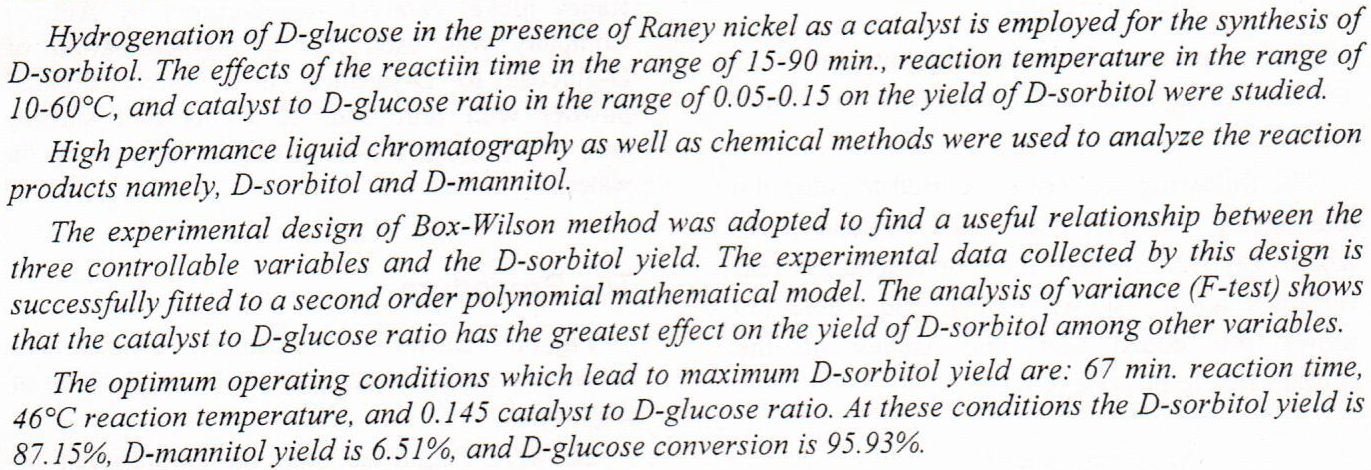
D-Sorbitol Production by Catalytic Hydrogenation of D-Glucose

Background: Deep vein thrombosis is a multi causal disease and its one of most common venous disorder, but only one quarter of the patients who have signs and symptoms of a clot in the vein actually have thrombosis and need treatment .The disease can be difficult to diagnose. Venous ultrasound in combination with clinical finding is accurate for venous thromboembolism, its costly because a large number of patients with suspicious signs and symptoms. Venography still the gold standard for venous thromboembolism but it is invasive. The D-dimer increasingly is being seen as valuable tool rolling out venous thromboembolism and sparing low risk patients for further workup.Objectives: this study has designed the role of D-dimer to confirm diag
... Show MoreThe effect of the initial pressure upon the laminar flame speed, for a methane-air mixtures, has been detected paractically, for a wide range of equivalence ratio. In this work, a measurement system is designed in order to measure the laminar flame speed using a constant volume method with a thermocouples technique. The laminar burning velocity is measured, by using the density ratio method. The comparison of the present work results and the previous ones show good agreement between them. This indicates that the measurements and the calculations employed in the present work are successful and precise
 (1)
(1)

 (6)
(4)
(6)
(4)

The paper aims to propose Teaching Learning based Optimization (TLBO) algorithm to solve 3-D packing problem in containers. The objective which can be presented in a mathematical model is optimizing the space usage in a container. Besides the interaction effect between students and teacher, this algorithm also observes the learning process between students in the classroom which does not need any control parameters. Thus, TLBO provides the teachers phase and students phase as its main updating process to find the best solution. More precisely, to validate the algorithm effectiveness, it was implemented in three sample cases. There was small data which had 5 size-types of items with 12 units, medium data which had 10 size-types of items w
... Show More

This research include design and implementation of an Iraqi cities database using spatial data structure for storing data in two or more dimension called k-d tree .The proposed system should allow records to be inserted, deleted and searched by name or coordinate. All the programming of the proposed system written using Delphi ver. 7 and performed on personal computer (Intel core i3).
COVID-19 is a unique viral infectious illness that causes a variety of symptoms and health hazards, particularly to the respiratory system and has been declared a worldwide pandemic. The disease is characterized by a cytokine release in severe conditions. Interleukin-6 (IL-6), a proinflammatory cytokine, mediates an important immunomodulatory process. Also, vitamin D was identified to have a role in the innate immunity of individuals. Our study was designed to find the role of IL-6 and vitamin D in COVID-19 patients, as well as, to see whether there is a link between vitamin D deficiency and cytokine syndrome development. The study included 90 COVID-19 patients and 30 control people from Baghdad, Iraq. The age of the participants was non-s
... Show More
Increasing hydrocarbon recovery from tight reservoirs is an essential goal of oil industry in the recent years. Building real dynamic simulation models and selecting and designing suitable development strategies for such reservoirs need basically to construct accurate structural static model construction. The uncertainties in building 3-D reservoir models are a real challenge for such micro to nano pore scale structure. Based on data from 24 wells distributed throughout the Sadi tight formation. An application of building a 3-D static model for a tight limestone oil reservoir in Iraq is presented in this study. The most common uncertainties confronted while building the model were illustrated. Such as accurate estimations of cut-off permeab
... Show MoreIncreasing hydrocarbon recovery from tight reservoirs is an essential goal of oil industry in the recent years. Building real dynamic simulation models and selecting and designing suitable development strategies for such reservoirs need basically to construct accurate structural static model construction. The uncertainties in building 3-D reservoir models are a real challenge for such micro to nano pore scale structure. Based on data from 24 wells distributed throughout the Sadi tight formation. An application of building a 3-D static model for a tight limestone oil reservoir in Iraq is presented in this study. The most common uncertainties confronted while building the model were illustrated. Such as accurate estimations of cut-off
... Show More
(2)
2-hydrazinylbenzo[d]thiazole compound [1] is produced from reaction of 2-mercapto-benzothiazole with hydrazine hydride in ethanol. Compound [1] reacted with maleic anhydride in DMF to produce (Z)-4-(2-(benzo[d] thiazol-2yl) hydrazinyl)-4-oxobut-2-enoic acid [compound (2)]. While the treatment of compound [2] with the ammonium persulfate (NH4)2S2O8 (as the initiator) in order to produce compound [3], then compound [3] reacted with thionyl chloride in benzene to produce compound [4], finally compound [4] reaction with various drugs: cephalexin, amoxicillin, sulfamethizole, elecoxib obtained polymers [5–8]. The structure of synthesized compounds identified by spectral data: fourier transform infrared (FTIR) and proton nuclear magneti
... Show More
(7)
(4)